


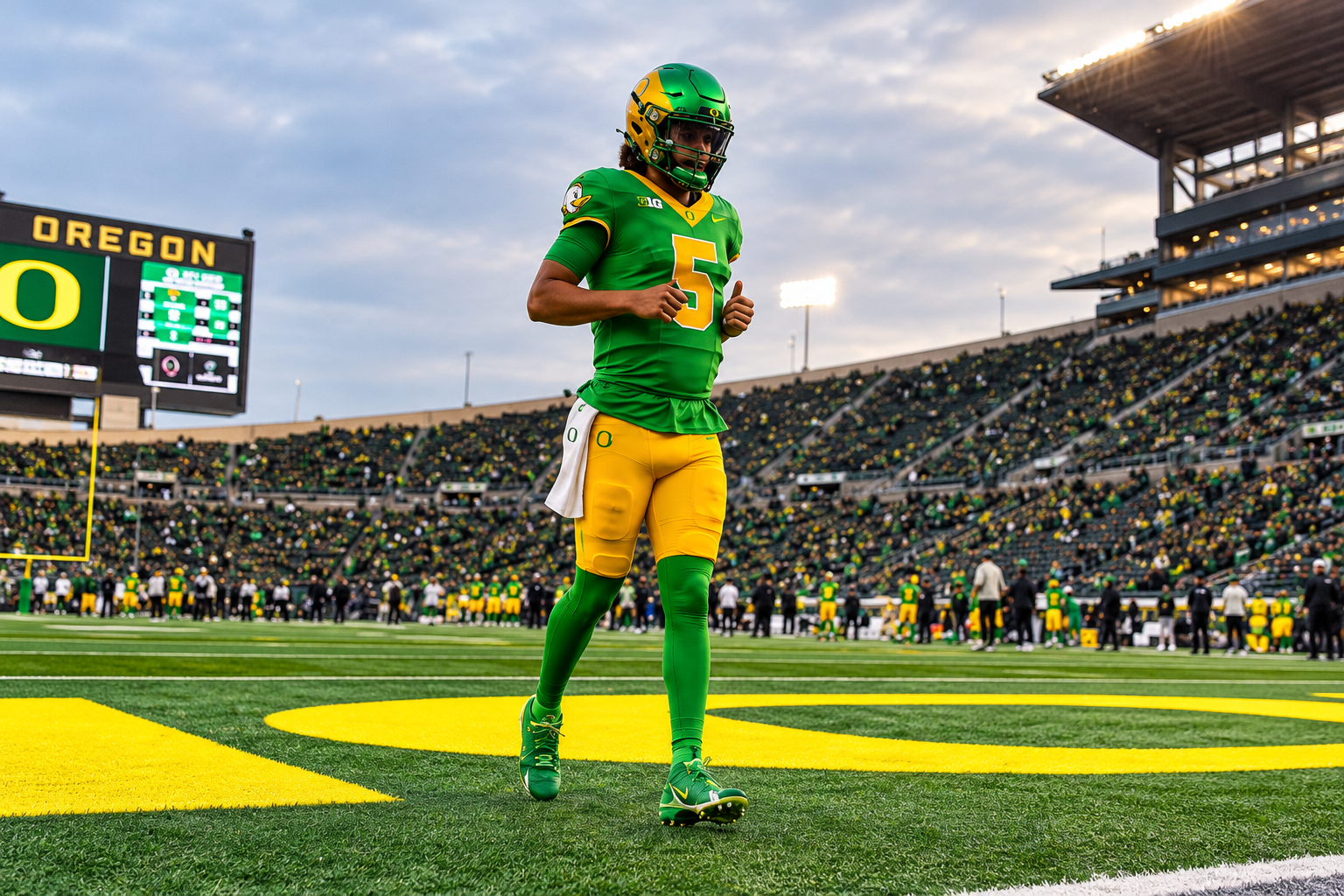
The Oregon Ducks entered the 2026 college football season ranked second in the nation, carrying national championship expectations and the return of one of the country’s most talented quarterbacks. Seven games later, those ambitions have been derailed by a serious injury, an offense struggling to produce points and a coaching change that has left Oregon fighting to regain its footing in the Big Ten Conference.
Head coach Dan Lanning confirmed Monday evening, October 26, that quarterback Dante Moore is unlikely to return this season following a concussion sustained during Oregon’s September 26 victory over Southern California. The development leaves the Ducks at 4-3, outside the Associated Press Top 25 and facing a demanding November schedule without the player expected to lead their offense.
Moore, 21, has not played since suffering the injury during the first half of Oregon’s 41-27 victory over USC in Los Angeles. While scrambling toward the red zone, Moore attempted to slide at the conclusion of a running play when USC linebacker Desman Stephens II struck him in the head. Medical personnel attended to Moore before he was transported by ambulance to a Los Angeles hospital.
Initial imaging revealed no structural injury, but Moore was diagnosed with a concussion and entered medical recovery protocols. Although he subsequently resumed limited football activities, including throwing passes during controlled practices, he has not received clearance to return to competitive games.
Lanning indicated that the decision reflects medical considerations rather than Oregon’s disappointing record. The coaching staff remains optimistic about Moore’s recovery, but the unpredictable physical contact associated with competition presents risks that cannot be controlled during supervised practices.
Moore’s absence represents a substantial loss for a program that entered the season with championship aspirations.
After completing 296 of 412 passes for 3,565 yards and 30 touchdowns during Oregon’s 13-2 campaign in 2025, Moore elected to return to Eugene rather than enter the NFL Draft. His performance had established him as a potential early first-round selection and helped carry Oregon to the national semifinals before its season ended against eventual champion Indiana.
The Associated Press named Moore a first-team preseason All-American entering 2026, and he was considered among the leading Heisman Trophy candidates.
Through portions of four games this season, Moore completed 69 of 99 passes for 926 yards, nine touchdowns and no interceptions, maintaining a 69.7 percent completion rate.
Replacing that production has proven difficult.
Nebraska transfer Dylan Raiola initially provided an encouraging response after replacing Moore against USC, throwing for 289 yards and two touchdowns. Oregon’s offensive performance deteriorated in subsequent games, however, exposing problems that have continued despite adjustments at quarterback.
The Ducks fell 17-15 to UCLA on October 10 in a contest marked by seven turnovers. Raiola completed just six of 19 passes for 43 yards and threw two interceptions.
Oregon returned home October 17 and defeated Nebraska 17-14, with Eugene native Brock Thomas receiving the starting assignment before Raiola entered and delivered the winning touchdown pass to Jamari Johnson with 28 seconds remaining.
The victory offered temporary relief, but Oregon’s offensive difficulties continued October 24 when Illinois defeated the Ducks 21-10. Raiola completed 27 of 41 passes for 246 yards, although Oregon struggled to convert offensive possessions into points.
In three games since Moore’s injury, the Ducks have averaged just 14 points and posted a 1-2 record.
The continued offensive struggles prompted Lanning to dismiss offensive coordinator Drew Mehringer on Sunday, October 25. Mehringer had served on Oregon’s staff since 2022 and assumed expanded responsibilities following Will Stein’s departure to become head coach at Kentucky.
Assistant coach Jay Johnson has been assigned responsibility for coordinating Oregon’s offense for the remainder of the season.
Johnson inherits an offense struggling with inconsistent quarterback production, turnovers and an inability to sustain scoring drives. His immediate responsibilities include developing an offensive approach suited to the available personnel while preparing for several nationally ranked opponents.
Raiola remains a central part of those plans, although Oregon has not committed publicly to using one quarterback exclusively. Thomas has also received playing opportunities, while Lanning has identified Akili Smith Jr. as another potential contributor.
The coaching transition comes at a particularly difficult point in Oregon’s schedule, leaving little time to establish continuity before the Ducks face some of the Big Ten’s strongest programs.
Beyond the immediate football consequences, Moore’s injury has raised questions about his collegiate and professional future.
His decision to return for the 2026 season postponed a potential NFL career in pursuit of another championship opportunity. Under current NCAA eligibility provisions, Moore could potentially return to college football in 2027 or pursue the NFL Draft following this season.
Neither option has been announced, and Lanning has declined to speculate about the quarterback’s next decision.
Moore’s recovery remains the primary consideration. Concussions can produce symptoms that persist beyond the initial injury, and participation in limited practices does not necessarily indicate readiness for full-contact competition. Medical clearance depends on the athlete’s recovery and ability to safely resume increasingly demanding physical activity.
Despite his absence from games, Moore is expected to remain involved with Oregon’s football program during his recovery.
His accomplishments also extend beyond the field. On October 21, Oregon announced that Moore was among 18 finalists for the 2026 William V. Campbell Trophy, which recognizes college football players for academic achievement, athletic performance and leadership.
For the Ducks, the immediate concern is salvaging a season that began with national championship expectations.
Oregon needs two additional victories to reach the traditional six-win threshold for postseason bowl eligibility, although additional eligibility considerations can apply.
The next opportunity comes Saturday, October 31, when Oregon hosts nationally ranked Northwestern at Autzen Stadium. Kickoff is scheduled for 12:30 p.m. Pacific, with television coverage on Peacock.
The Ducks then travel to Columbus for a November 7 meeting with Ohio State before returning to Eugene to face Michigan on November 14.
Those contests will test Oregon’s offensive adjustments under Johnson and determine whether the Ducks can recover enough momentum to secure postseason participation.
The program also faces longer-term decisions concerning quarterback development and offensive leadership, particularly if Moore elects to pursue a professional career rather than return for another collegiate season.
For a team that opened the year ranked second nationally, the circumstances represent a dramatic reversal. Oregon has lost its starting quarterback, replaced its offensive coordinator and fallen out of the national rankings before entering the final stretch of conference play.
Moore’s return to Eugene was supposed to provide another opportunity to compete for a national championship. Instead, his season has been interrupted by an injury that has forced Oregon to reconsider its immediate priorities and future plans.
With five games remaining, Lanning and his staff must find enough offensive production to compete against a difficult Big Ten schedule while Moore continues his recovery and considers the next chapter of his football career.