


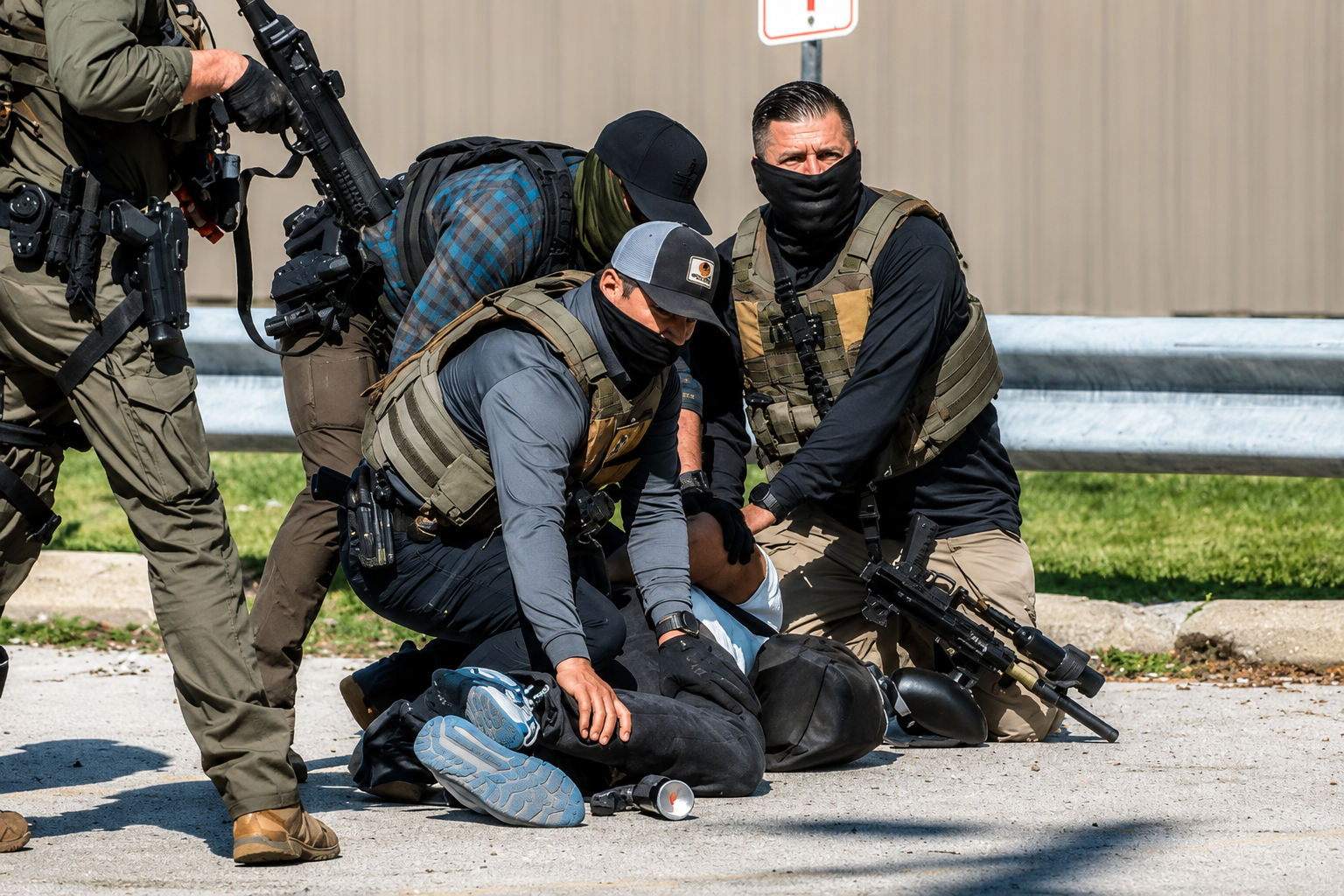
Federal immigration officers took people into custody during a series of drug raids in Jackson and Josephine counties last week, bringing ICE activity in Southern Oregon into view as a federal judge examines the agency’s conduct in earlier arrests around Medford and Ashland.
The number detained during the raids remains unconfirmed by federal authorities. Rogue Valley Migra Watch, a community group that monitors immigration enforcement, reported at least 21 ICE detentions over two days: 13 in Jackson County on September 23 and at least eight in Josephine County on September 24. ICE and the FBI have not publicly identified those taken into custody or provided a complete account of where they were taken, whether they face immigration proceedings or whether any face criminal charges.
The September 23 searches grew out of a two-year investigation into a suspected drug-trafficking organization, according to the Jackson County Sheriff’s Office. Officers served warrants at homes, businesses and agricultural properties in and around Medford, Central Point, Eagle Point, Rogue River and Jacksonville. Federal and local officers were also reported at a cannabis property near Cave Junction the following day.
Jackson County sheriff’s spokesman Aaron Lewis described the searches as a drug investigation rather than an ICE operation. He said deputies had not been told in advance that immigration detentions were planned and that the sheriff’s office did not assist ICE with immigration enforcement. Medford police likewise described their participation as support for the criminal investigation, separate from federal immigration enforcement.
Those statements establish how the local agencies describe their roles, but they do not account for every step that led to the ICE detentions. Federal authorities have not publicly confirmed the community group’s count or explained the circumstances of each detention. The status of the drug investigation and the circumstances of the immigration actions remain separate questions.
Earlier ICE arrests in the Rogue Valley are receiving their own examination in federal court. At a September hearing, witnesses described encounters in Medford and near Ashland as lawyers argued that immigration officers had failed to comply with a February court order governing warrantless arrests in Oregon.
U.S. District Judge Mustafa Kasubhai issued the preliminary order requiring ICE officers to make an individual assessment of whether a person was likely to evade arrest before taking that person into custody without a warrant. Lawyers representing people arrested by ICE contend that officers have continued to make arrests without following that requirement. Federal government attorneys dispute the allegation. The judge has heard testimony and requested additional written arguments but has not ruled on the latest claims.
One Medford man testified that officers surrounded his vehicle when he arrived at work in June, broke a window and handcuffed him. Officers released him after checking his identity and determining that he was not the person they were seeking, according to his testimony. He told the court that he had an active asylum application at the time.
Another witness described being followed from a Medford store to Emigrant Lake in July before he and a companion were taken into custody. Their accounts are evidence presented to the court, not judicial findings that the arrests violated the February order. Government attorneys have challenged the allegations and presented an ICE officer’s testimony about the encounters.
That officer, who works from ICE’s Medford office, acknowledged under oath that a written arrest account inaccurately suggested officers had identified one man as a target before approaching him. He testified that he had used substantially the same narrative for two arrests, although he had not known one of the men beforehand. A Justice Department attorney argued that the officer had candidly explained the discrepancy and had not acted with malicious intent. Kasubhai questioned the reliability of the arrest documentation and left the matter open for further argument.
The Oregon Department of Justice entered two other federal disputes on September 23. Attorney General Dan Rayfield joined a group of attorneys general arguing that a person held in prolonged ICE detention should receive an individual hearing on whether continued confinement is necessary. In a separate case, he supported a Colorado court order requiring officers to assess flight risk before making a warrantless immigration arrest.
Neither filing determines what happened during last week’s Southern Oregon raids. The Oregon court hearing also concerns arrests that occurred before those raids. Each proceeding has its own evidence and legal questions, even as all three developments bear on how immigration arrests and detentions are carried out.
For Southern Oregon residents, the clearest recent event is the series of searches across Jackson and Josephine counties and the reported ICE detentions that followed. The public record has yet to establish an official detention count or the individual circumstances of those taken into custody. In federal court, the judge must still decide whether earlier arrests in the region complied with his order.