


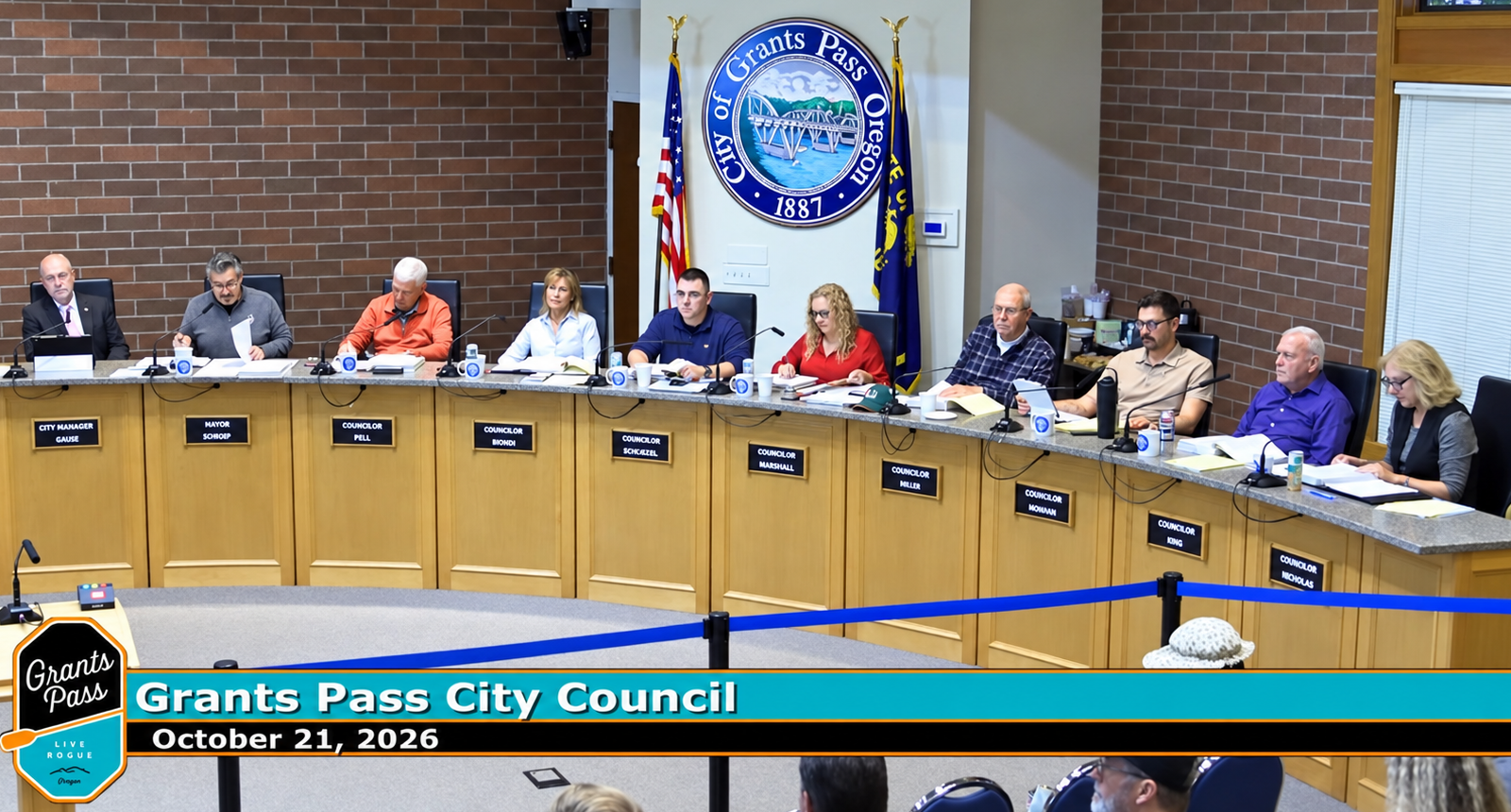
Last summer, the Grants Pass City Council began studying in earnest the potential to create a municipal court. In another extensive workshop on the topic on Monday of this week, the concept took a giant leap forward towards becoming a reality.
Grants Pass has been one of the only larger cities in Oregon in the last few decades that didn’t have its own municipal court. And it’s generally not feasible to partner with Josephine County for a local justice of the peace court to handle local issues because these types of courts are not allowed to be located in the county seat under state law. And so, for decades, everything from minor violations and traffic tickets to serious crimes has been processed through the state’s circuit court of Josephine County.
The City Charter already has provisions for a municipal court, including powers and duties of a municipal judge. The City Council’s primary motivation to consider launching a municipal court would be to address some of the lower-level nuisance-type crimes and misdemeanors that the county jail and county district attorney don’t have the resources to fully prosecute. Certain Council members have also expressed concerns about repeated trespassing and other nuisance crimes committed by some homeless individuals in Grants Pass.
A municipal court in Grants Pass could potentially give the city more local control over both the prosecution of misdemeanors and local traffic and other violations. And it could help bypass some of the state roadblocks that keep the county jail and district attorney from fully prosecuting all levels of crimes.
In the workshop on Monday this week, Grants Pass City Attorney Stephanie Nuttall unveiled the massive research project she has undertaken in recent months looking at the options the city has to open its own municipal court. The city court could process only violations and traffic citations but also has the option to prosecute misdemeanors in a manner very similar to how the state and district attorney prosecute criminal cases. As an exception, most municipal courts do not prosecute DUI arrests due to their complexity.
Processing traffic and other violations would almost be a break-even proposal from a financial perspective, but the prosecution of misdemeanors would be a costly venture. Relaunching a municipal court in Grants Pass would likely start with only prosecuting violations, and once this is up and running, misdemeanor prosecution would be added. Violation processing and court operations (which would be held in the Council Chambers) could be up and running as soon as the end of 2027.
While the majority of the City Council advised moving forward with the next steps required to start municipal court operations, several Council members expressed hesitation due to the cost of prosecuting misdemeanors. Just like the prosecution of more serious crimes through the state court system, prosecuting misdemeanors through the city court would require the city to contract with a prosecuting attorney and defense attorneys for those in need.
Unless some type of administrative fee structure is added to cases that go through municipal court, a city court that prosecuted both violations and misdemeanors is estimated to cost an additional $805,000 to the City’s General Fund in year one, going down to an estimated $630,000 in additional annual General Fund support by year three of court operations. It remains unclear at this time whether the City could implement administrative fees, filing fees, or conviction fees that could be sufficient for the municipal court to be financially self-sustaining without extra support from the General Fund. This would be addressed next year along with other municipal code changes that would be required before launching court operations.
During the Monday workshop, Police Chief Warren Hensman reminded the Council that the city police arrest individuals who commit all levels of crimes, including misdemeanors. And while Monday’s workshop was an extensive review of municipal court information, additional questions remain about the incremental benefit of a local city court.
However, it was stated during the workshop that the City could enter into an agreement with the county jail to have more local control over jail time resulting from city-prosecuted crimes. But it was not immediately clear from the workshop how much that might reduce the “catch and release” that anecdotally happens often when police arrest individuals for lower-level crimes.
It was stated that the financial estimates about the potential cost of a municipal court were likely the worst-case scenario. Revenue estimates appear to be built on the actual number of case convictions that went through the local circuit court in the last three years. Theoretically, a municipal court would allow many more cases to be prosecuted as compared to the resources available to the district attorney. Data was not made available in the workshop on how many misdemeanor cases in the last three years were not prosecuted due to lack of resources in the district attorney’s office.
In future discussions, it would be helpful to understand the number of misdemeanor cases brought by city police that have not been fully prosecuted by the county district attorney in recent years due to lack of resources. Knowing how many more cases could be properly prosecuted through the city court could help the City Council decide whether to make a significant investment in public funds to create a municipal court.
That being said, if the goal is to be able to prosecute more of the nuisance-type crimes affecting Grants Pass, the City Council made the right call this week by moving this concept forward. The key questions that remain to be addressed appear to be how much revenue might be gained by adding some level of administrative fees to cases processed through the city court and how many misdemeanor cases per year are currently not being prosecuted due to lack of resources in the county district attorney’s office.