


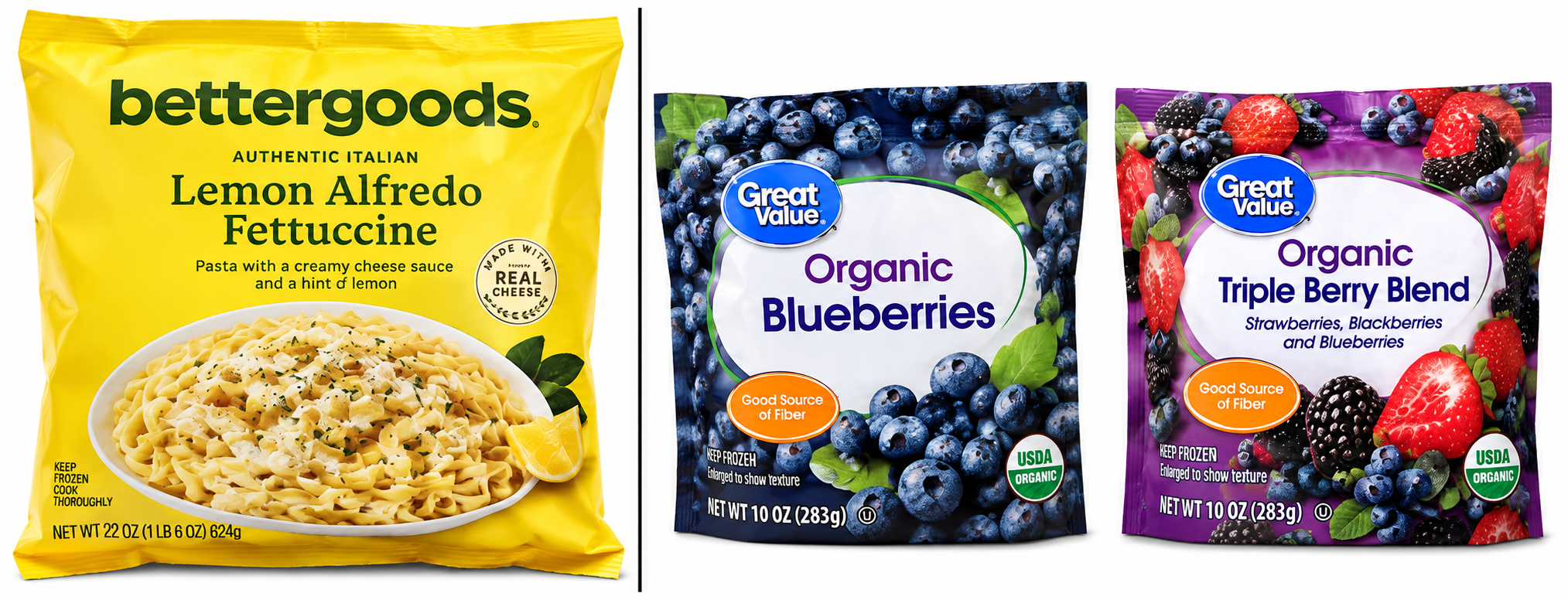
Two major food safety recalls involving frozen products sold at Walmart have expanded within days of each other, placing additional attention on potentially contaminated groceries that may already be stored in household freezers across the United States. Federal regulators have identified separate bacterial contamination concerns involving Walmart’s Bettergoods frozen pasta and Great Value frozen fruit, with one recall carrying the Food and Drug Administration’s highest risk classification and the other connected to a multistate E. coli outbreak responsible for 17 illnesses and six hospitalizations.
The recalls, expanded October 1 and October 2, involve different manufacturers, unrelated contamination investigations and two potentially dangerous foodborne pathogens. Both concern products distributed through Walmart’s extensive grocery operations, although the geographic distribution and scope of the recalls differ considerably. The frozen pasta was sold nationwide, while the affected frozen fruit reached selected Walmart locations in 30 states and Puerto Rico.
The first recall involves Bettergoods Authentic Italian Lemon Alfredo Fettuccine, a frozen pasta product manufactured by Gias Foods Inc. of New York. Initially recalled September 15 because of possible contamination with Listeria monocytogenes, the product became the subject of a substantially broader warning October 1 when the company expanded the recall from two production lots to every lot of the affected pasta.
The recalled fettuccine is packaged in a distinctive yellow, 22-ounce plastic bag bearing Universal Product Code 194346442706. The original recall identified production lots L6079C and L6080C, with expiration dates of September 19 and September 20, 2027. However, the October expansion eliminated those lot restrictions, meaning every package of the specified Bettergoods product is included regardless of its individual production code.
The FDA subsequently assigned the pasta recall its Class I designation, the agency’s most serious classification. Class I recalls involve products for which exposure presents a reasonable probability of serious adverse health consequences or death. The designation reflects the potential severity of the contamination hazard rather than confirmation that consumers have suffered those outcomes.
The contamination concern emerged through routine sampling conducted by the Washington State Department of Agriculture and the Florida Department of Agriculture and Consumer Services. Testing identified possible Listeria contamination in finished products, prompting Gias Foods to halt distribution while federal and company investigators examined the source of the problem.
No illnesses had been reported in connection with the recalled Bettergoods pasta when the expanded recall notice was issued. Nevertheless, the potential consequences of Listeria infection are particularly serious for pregnant women, newborns, older adults and individuals with weakened immune systems.
Listeriosis can produce fever, muscle aches, nausea, diarrhea and other gastrointestinal symptoms. In more serious cases, the bacteria can invade the bloodstream or nervous system, producing complications that require hospitalization. Infection during pregnancy can also result in miscarriage, stillbirth, premature delivery or severe illness in newborns, sometimes even when the pregnant patient experiences relatively mild symptoms.
The bacteria present an additional food safety concern because Listeria can survive and multiply at refrigerator temperatures. Freezing can inhibit bacterial growth but does not reliably destroy the organism, allowing contaminated products to remain hazardous after extended storage. Proper cooking can kill Listeria, but federal recall instructions direct consumers not to use the affected pasta.
A separate recall involving Walmart’s Great Value frozen fruit expanded October 2 after federal investigators identified additional potentially contaminated products associated with an E. coli outbreak. The affected merchandise includes Great Value Organic Blueberries and Great Value Organic Triple Berry Blend, both distributed in 10-ounce frozen packages.
The fruit originated from Frutas y Hortalizas del Sur S.A., a supplier based in San Carlos, Chile. Federal investigators connected the supplier’s frozen organic blueberries to an outbreak involving E. coli O145:H28, a Shiga toxin-producing strain capable of causing severe gastrointestinal illness and potentially life-threatening complications.
The Centers for Disease Control and Prevention documented 17 confirmed infections in Florida and Georgia, including six patients who required hospitalization. No deaths were reported. Illnesses began between May 11 and August 2, 2026, with investigators examining patient interviews, laboratory results and product distribution records to determine the source of exposure.
Among 13 patients interviewed during the investigation, 11 reported consuming frozen blueberries before becoming ill. Laboratory testing also identified the outbreak strain in a frozen blueberry sample associated with the supplier. Those findings, combined with subsequent tracing of production and distribution records, supported the investigation’s connection to contaminated frozen fruit.
The FDA and CDC declared the outbreak investigation complete September 21. However, additional supplier information subsequently identified more potentially affected products, resulting in the October recall expansion. Federal officials have not attributed the 17 illnesses specifically to the recalled Walmart products, and no additional illnesses were reported in the FDA’s October 5 update.
The affected Great Value Organic Triple Berry Blend contains strawberries, blackberries and blueberries. The October expansion identifies 10-ounce packages bearing UPC 7874211226 and lot codes 6 031 01 and 6 041 01, with corresponding best-by dates of January 31 and February 10, 2028.
Great Value Organic Blueberries, also packaged in 10-ounce bags, carries UPC 7874211213. Recalled packages include lot codes 6 019 01, 6 040 01 and 6 163 01, with best-by dates of January 19, February 9 and June 12, 2028.
An earlier recall also covered Great Value Organic Triple Berry Blend bearing lot code 6040 01-6 and a February 9, 2028, best-by date. The continuing expansion means consumers must examine more than one production code when determining whether their frozen fruit is affected.
The recalled Great Value fruit was shipped to selected Walmart stores in Alabama, Arkansas, Connecticut, Florida, Georgia, Iowa, Illinois, Indiana, Kansas, Kentucky, Louisiana, Michigan, Minnesota, Missouri, Mississippi, North Carolina, North Dakota, Nebraska, New Jersey, New York, Ohio, Oklahoma, Pennsylvania, South Carolina, South Dakota, Tennessee, Texas, Virginia, Wisconsin and West Virginia, along with Puerto Rico.
Oregon was not included in the identified distribution states for the Great Value fruit recall, although the separate Bettergoods pasta recall applies nationwide. Consumers who purchased groceries while traveling or who have frozen products obtained from other households should also examine the identifying information rather than relying exclusively on their current state of residence.
The E. coli contamination presents different medical risks from those associated with Listeria. Shiga toxin-producing E. coli can cause severe abdominal cramps, vomiting and diarrhea that may become bloody. Symptoms generally develop several days after exposure, and some patients experience complications requiring emergency medical treatment.
One of the most serious complications is hemolytic uremic syndrome, a condition that can damage the kidneys and interfere with normal blood function. Young children, older adults and people with weakened immune systems are especially vulnerable, although otherwise healthy individuals can also develop severe infections.
The six hospitalizations associated with the frozen blueberry outbreak demonstrate the potential seriousness of the bacterial strain. Federal health authorities also recognize that confirmed outbreak totals frequently represent only a portion of actual infections because many people recover without seeking medical treatment or receiving laboratory testing.
Investigators examined the Chilean supplier’s food safety procedures and production controls as part of the federal response. The FDA subsequently placed products from the company under Import Alert 99-35, permitting frozen blueberry shipments from the supplier to be detained at American ports without physical examination. The measure provides an additional regulatory safeguard against potentially contaminated merchandise entering domestic distribution.
The overlapping Walmart recalls have particular implications for consumers who purchase frozen groceries in larger quantities. Both affected product categories are commonly stored for extended periods, and their printed expiration dates reach into 2027 and 2028. Consequently, products purchased before the recalls were expanded could remain in household freezers long after the original contamination investigations began.
Frozen berries are frequently consumed in smoothies, yogurt, breakfast preparations and desserts without additional cooking. Unlike foods that undergo thorough heating before consumption, these preparations may expose consumers directly to bacteria present on contaminated fruit. Freezer temperatures preserve the products but do not guarantee that harmful microorganisms have been eliminated.
The FDA advises consumers not to eat any of the recalled products. Affected Great Value fruit should be discarded or returned to Walmart for a refund, while consumers possessing the recalled Bettergoods pasta may return it to the place of purchase for a full refund. Individuals who develop symptoms consistent with foodborne illness after consuming the products should seek medical attention, particularly when severe abdominal pain, bloody diarrhea, persistent fever, dehydration or neurological symptoms occur.
Consumers should also inspect freezer shelves, storage containers and surrounding surfaces that may have come into contact with leaking or damaged packaging. Proper cleaning and sanitation can reduce the possibility of contamination spreading to other foods or food preparation surfaces.
Although both recalls involve frozen foods sold by Walmart, the investigations remain separate. The Bettergoods pasta recall concerns possible Listeria contamination identified through government product sampling, with no associated illnesses reported in the recall notice. The Great Value fruit recall concerns potential E. coli contamination identified through an outbreak investigation that documented 17 infections and six hospitalizations.
The two developments place different categories of frozen groceries under federal consumer safety warnings during the same week, with the most recent recall expansions substantially increasing the number of products requiring examination. The pasta recall now encompasses every lot of the specified Bettergoods fettuccine, while the fruit recall identifies several additional Great Value production lots distributed across much of the country.
For Walmart customers, the immediate concern extends beyond products currently available for purchase. With expiration dates stretching nearly two years into the future, affected frozen pasta and fruit may remain in residential freezers despite their removal from retail distribution. Federal health authorities continue to direct consumers to identify and remove recalled packages, even as the investigation into the E. coli outbreak has concluded and the separate Listeria contamination investigation proceeds.