


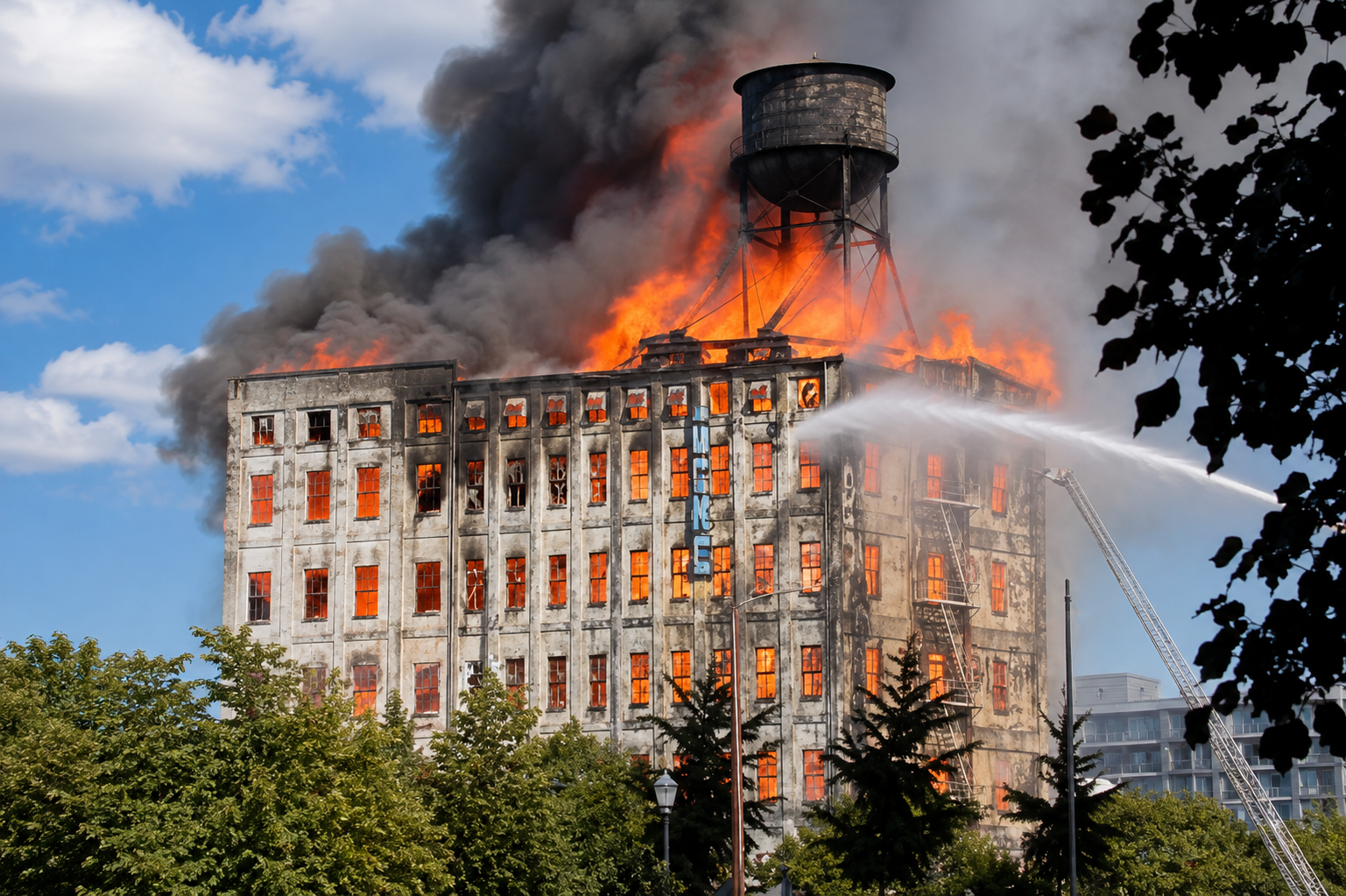
The destructive fire that gutted Portland’s historic Centennial Mills complex has developed into a multifaceted public safety emergency as investigators examine evidence that human remains may be buried beneath the rubble, engineers confront the possibility of structural collapse, asbestos contamination complicates demolition and city officials dispute plans to resume freight rail operations immediately beside the damaged property.
The four-alarm fire erupted Aug. 2 at the former Centennial Mills warehouse along Northwest Naito Parkway in Portland’s Pearl District. Nearly 100 Portland Fire & Rescue personnel responded as flames and heavy smoke consumed the approximately 116-year-old industrial structure.
Because the eight-story warehouse was already considered structurally unsafe, firefighters conducted defensive operations from outside rather than entering the building. The fire eventually caused all eight interior floors to collapse, leaving unstable exterior walls surrounding a massive accumulation of burned debris. The roof was also severely damaged near the large water tank mounted above the building.
Although no fatalities were initially confirmed, the investigation took a more serious turn following searches of the ruins.
A human-remains-detection canine team searched the property Aug. 3 without producing a positive alert. Portland Fire & Rescue and specialized canine teams returned Aug. 6 and conducted two additional searches. Both produced positive alerts in the debris.
Investigators subsequently determined there is a high likelihood that human remains could be buried within the burned material. As of the latest official information, however, remains had not been publicly confirmed, recovered or identified.
Reaching the areas identified during the canine searches presents substantial risks because of the instability of the surviving structure. Investigators cannot safely conduct a conventional search through portions of the debris until dangerous sections of the building are removed.
That has connected the potential recovery effort directly with plans to demolish Centennial Mills.
Portland Permitting & Development issued a dangerous-structure notification and demolition order Aug. 6 covering the warehouse and its rooftop water tank. Controlled demolition is required to begin no later than Aug. 14. A Portland Fire & Rescue lead investigator is expected to work alongside the demolition team so evidence can be evaluated and protected as unstable portions of the structure are removed.
Demolition will also provide investigators safer access to locations identified by the canine teams, allowing a more extensive forensic examination of the debris.
Environmental hazards have added another complication. Centennial Mills was constructed during an era when asbestos-containing building materials were widely used. Although previous abatement work removed substantial amounts of asbestos, the material had not been completely eliminated from the property before the fire.
Testing of debris following the blaze confirmed the presence of asbestos. Federal, state and local environmental and health agencies have participated in monitoring conditions surrounding the site. Preliminary findings have indicated a low potential for airborne asbestos exposure outside the immediate fire area, although precautions remain in effect around ash and debris.
The emergency has also disrupted one of Portland’s important rail corridors.
Railroad tracks immediately adjacent to Centennial Mills fall within the safety perimeter established because of the possibility that the remaining structure could collapse. Rail operations were interrupted following the fire, and passenger service between Portland and Seattle has been affected, with buses replacing some Amtrak train service.
Union Pacific subsequently notified Portland that freight operations were expected to resume Aug. 9 on tracks beside the burned warehouse. City officials objected, citing engineering concerns that movement or vibration near the building could contribute to a structural collapse.
The railroad agreed to delay trains carrying hazardous materials along the affected route until Aug. 21, but Portland officials have maintained concerns about other freight traffic operating beside the structure before demolition eliminates the immediate collapse hazard.
The city requested additional precautions if freight service proceeds, including vibration-monitoring equipment near Centennial Mills and a hazardous-materials response team positioned near the railroad. Portland had not received notice that passenger trains would immediately resume operations on the tracks directly adjacent to the property.
The surrounding area remains restricted. Northwest Naito Parkway has been closed near the site, and The Fields Park has also been temporarily closed because of the collapse danger. Authorities have warned people against entering the restricted perimeter after individuals were observed crossing barriers surrounding the property.
Beyond the immediate emergency, the fire represents another dramatic chapter in the history of one of Portland’s surviving industrial landmarks. The Centennial Mills complex dates to the early 20th century and was connected to Portland’s emergence as an important center for grain milling and international agricultural trade. Milling operations continued under different ownership until the late 1990s, and the waterfront property later became the subject of extensive redevelopment planning.
The cause of the Aug. 2 fire remains under investigation.
What began as a major structural fire has consequently become a broader investigation involving several overlapping challenges. Authorities must determine how the fire started, establish whether human remains are actually buried inside the ruins, safely dismantle an unstable century-old structure, manage asbestos-contaminated debris and address transportation operations beside an active investigation and demolition site.
Until demolition provides investigators with safe access to the interior debris, some of the most consequential questions surrounding the Centennial Mills fire remain unresolved.