


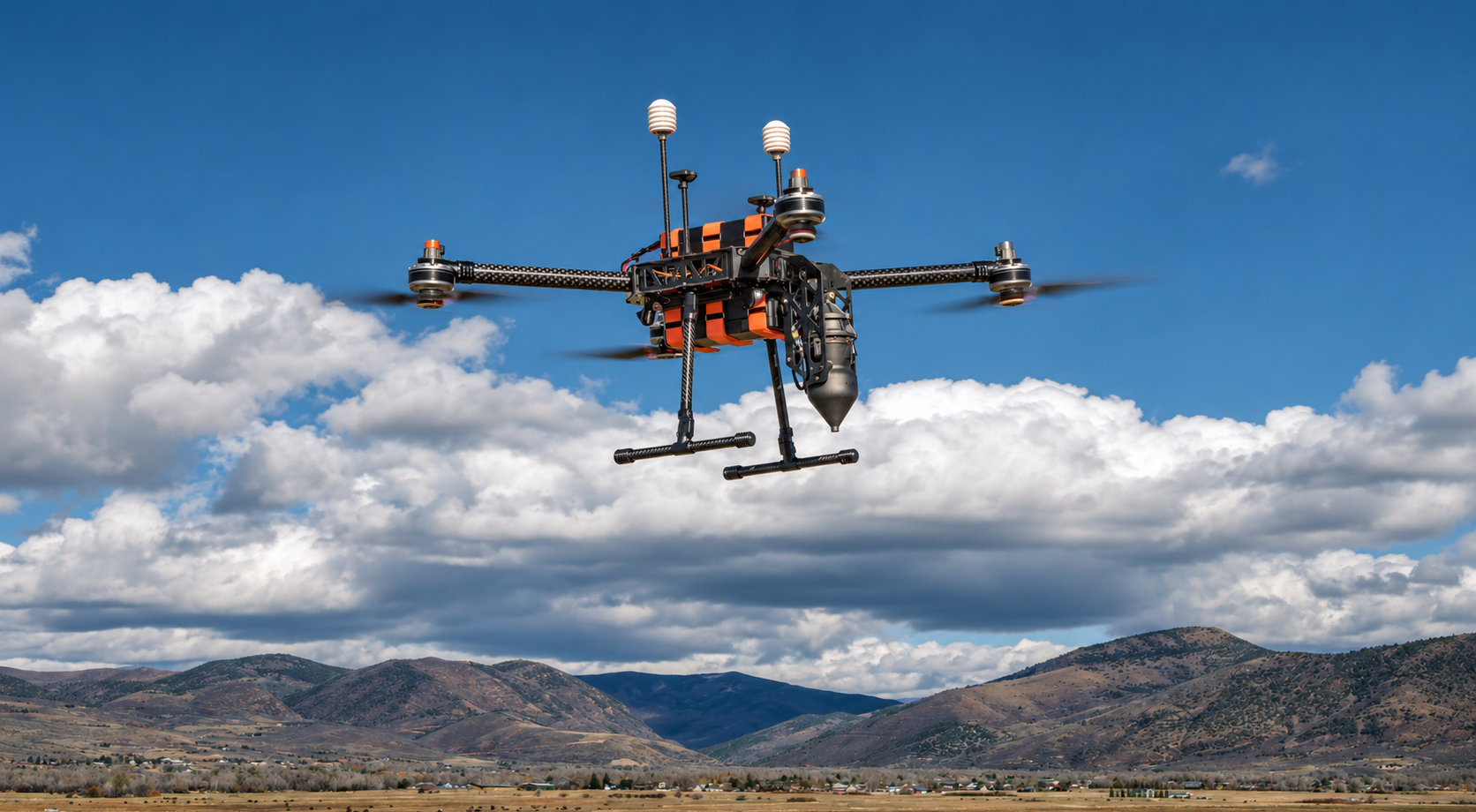
A proposal to seed winter clouds over Southern Oregon would send drones and a piloted aircraft above mountain terrain in an effort to increase snowfall and water supplies, drawing objections from residents concerned about the materials released and how their effects would be monitored.
Rainmaker Technology Corporation is seeking Oregon Department of Agriculture authorization for a research operation covering approximately 1,640 square miles, with potential effects extending into parts of four counties. Residents raised concerns during a November 10 public hearing at the Medford Library as the state considered the company’s license application.
The proposed operating area includes the Rogue–Umpqua Divide, Applegate Valley and western slopes of the southern Cascades in Jackson, Josephine and Douglas counties. Rainmaker’s notice identifies an additional area extending approximately 50 miles downwind to the east and southeast, bringing portions of Klamath County within the territory potentially affected.
The company proposes operating from November 2026 through May 2027, when suitable winter clouds are present. A final state licensing decision had not been verified as of November 12.
Rainmaker describes the project as a research and development campaign intended to increase winter precipitation and mountain snowpack. Its stated objectives include supporting irrigation, water supplies, groundwater recharge and hydropower. The company would conduct the operation on its own behalf.
For Southern Oregon, the proposal places mountain watersheds and the water they provide at the center of the state’s review. The application identifies potential benefits for agricultural and other water uses, but the available project information does not establish how much additional water would reach local streams, reservoirs or groundwater supplies.
Flights would use Rainmaker’s Elijah quadcopter drones and a Beechcraft King Air C90A aircraft to release ice-forming particles into winter clouds containing supercooled liquid water. The process is intended to encourage ice crystals to form and grow, increasing precipitation under suitable conditions.
The proposed materials include silver iodide and an organic ice-nucleating agent. The public notice does not identify the organic agent’s specific composition. Aircraft would carry flares or dispensing equipment, while radar, weather balloons, onboard sensors and precipitation gauges would support flight targeting and evaluation.
Residents participating in the hearing questioned potential effects on watersheds, soils and livestock. They also sought independent scientific review, environmental assessment and public oversight. Rainmaker representatives emphasized the long history of cloud seeding, the company’s use of drones and the small quantities of material involved.
The Department of Agriculture must determine whether the company is qualified to conduct the proposed operation, whether it could benefit water or energy resources or agricultural or forest crops, and whether it would avoid injury to public health or safety.
Oregon law also requires applicants to demonstrate financial responsibility for potential accident liability. Licensed operators must maintain records of the materials and equipment used, operating locations and times, and estimated precipitation gains or losses supported by data. Those reports and the department’s records are available for public examination.
A license authorizes the activities described in its terms. Operations using equipment or materials outside those terms can lead to suspension or revocation.
Scientific assessments have found potential precipitation gains from cloud seeding while identifying persistent difficulties in measuring results. A December 2024 U.S. Government Accountability Office review found estimates of additional precipitation ranging from zero to 20 percent across the studies examined. The review found that research limitations make effectiveness difficult to evaluate and that operations depend on suitable clouds being present.
The same assessment found that the limited recent research it reviewed did not indicate environmental or health concerns from silver iodide at existing application levels. It also identified uncertainty about the effects of more widespread use.
Rainmaker-affiliated researchers published a study November 5 examining drone-seeding operations during the company’s 2025–2026 season. They analyzed 71 radar-observed seeding signatures across 15 intensive observation periods and reported evidence of precipitation enhancements following drone releases. The study measured radar-estimated precipitation associated with those signatures; it did not establish a projected water yield for the proposed Southern Oregon operation.
Federal requirements call for weather-modification operators to report planned activities to the National Oceanic and Atmospheric Administration, generally at least 10 days before operations begin. NOAA collects those reports but does not license cloud-seeding projects.
A February 2026 federal audit found shortcomings in the national reporting system, including missing required information and inconsistent submissions. The findings addressed reporting nationwide and did not identify deficiencies specific to the Southern Oregon application.
The project’s total cost, funding sources, planned chemical quantities and independent environmental monitoring arrangements were not established in the records available for review. Specific flight authorizations also remained unverified.
Written comments for the state proceeding closed November 10. The Department of Agriculture’s licensing review will determine whether Rainmaker can proceed with the proposed operation over Southern Oregon’s mountain watersheds.