


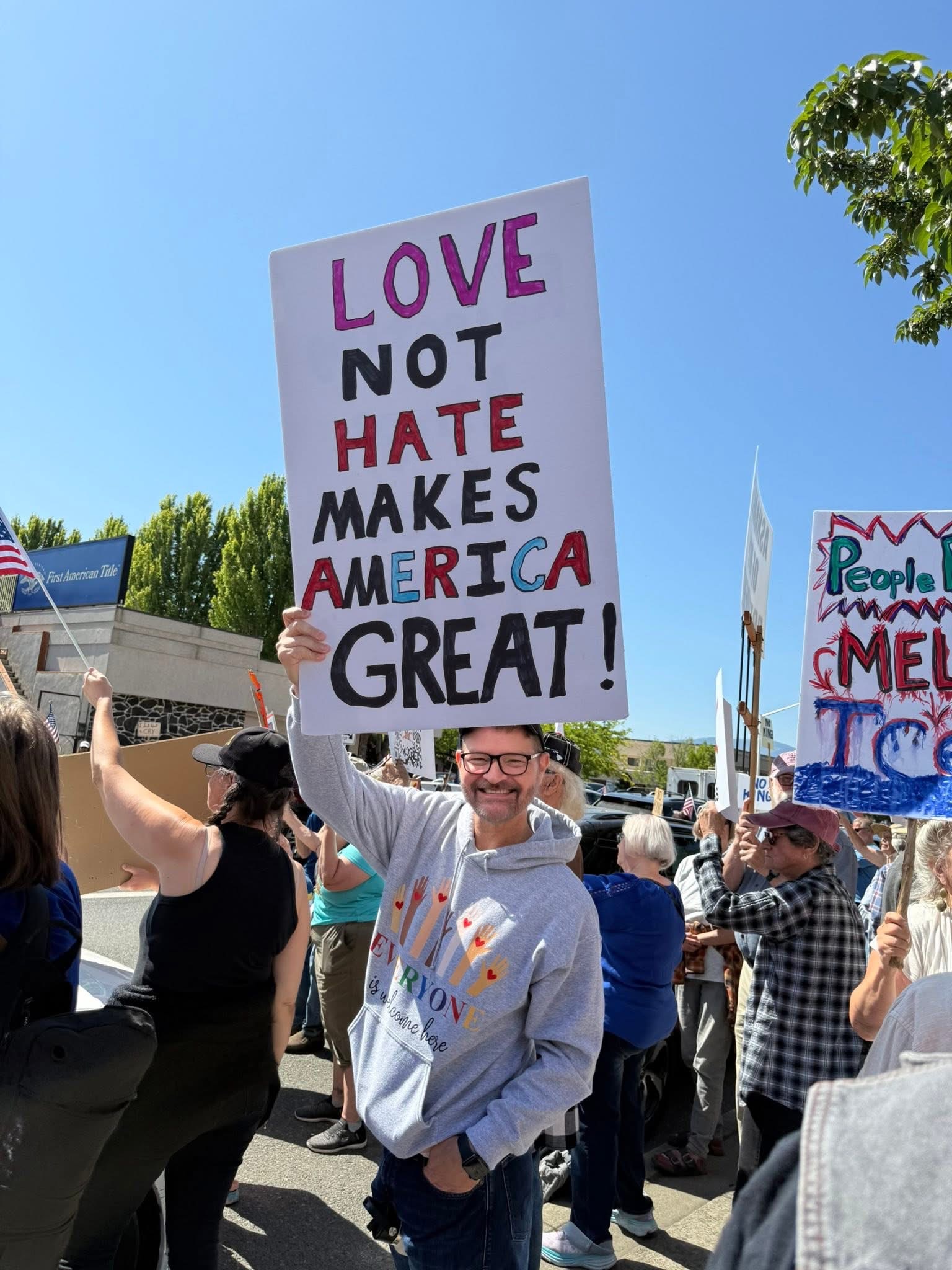
Yesterday under the blue skies of a Southern Oregon afternoon, more than a few hundred residents gathered outside the Josephine County Courthouse on Saturday to take part in what organizers called the “No Kings” rally — a grassroots demonstration grounded in the First Amendment and the principle that no leader, regardless of political party, should rise above the rule of law.
Despite the polarized national climate, the event unfolded with civility and purpose. Families, veterans, college students, retirees, and working-class citizens stood shoulder to shoulder, many holding homemade signs that simply read “No Kings.” There was no shouting, no conflict, and no arrests — just a collective reaffirmation of democratic ideals through peaceful assembly.
The courthouse steps became a podium for civic engagement, where locals took turns speaking to the crowd. Without party banners or corporate sponsorships, the rally reflected a local yearning for transparency, accountability, and unity. It was, at its core, a reminder that in America, ordinary people still have the right — and the responsibility — to speak up.
The broader “No Kings” movement gained traction nationwide in response to a recent show of military fanfare coinciding with the 250th anniversary of the U.S. Army and President Trump’s birthday. Critics of the display viewed it as an inappropriate blurring of patriotism and political pageantry. Though no specific national group claimed sponsorship of the Josephine County event, it became one of dozens of rallies held across Oregon on the same day, including large demonstrations in Medford, Eugene, and Portland.
Here in Grants Pass, however, the tone remained distinctly local. Rather than chants or confrontational slogans, the rally’s defining characteristic was conversation. Protesters chatted calmly with one another and welcomed passersby to join in or ask questions. Many waved to cars driving past, receiving an encouraging chorus of honks and thumbs-up signals from motorists. There were no counter-protests. There was no need for law enforcement intervention.
The diversity of attendees underscored the event’s message. A retired Army sergeant stood near a young high school student handing out flyers about the Constitution. A local teacher held a sign beside a small child drawing peace symbols on the sidewalk. These weren’t political operatives or out-of-town agitators — they were neighbors.
Throughout the afternoon, citizens shared why they came: to protect civil liberties, to voice concern about rising authoritarianism, to encourage community dialogue. Though the specific motivations varied, they were united in the belief that democracy is not automatic — it is preserved through participation.
The Grants Pass rally stood in sharp contrast to other demonstrations across the state. In Jacksonville, reports surfaced of a separate protest briefly descending into chaos after an individual attempted to spray an unidentified liquid into the crowd, triggering a swift police response. Meanwhile, the Josephine County gathering remained calm and composed throughout — a textbook example of peaceful protest marked by mutual respect, civic responsibility, and an unwavering commitment to free speech.
Though the crowd began to disperse by late afternoon, many attendees expressed interest in continuing the conversation. Organizers hinted at future events, including public forums and civic workshops designed to engage residents beyond single-day demonstrations. Some floated the idea of holding a “Democracy Fair” this summer — a nonpartisan event featuring voter registration booths, historical exhibits, and town hall discussions.
As the sun began to set over the courthouse lawn, the quiet resolve of the rally lingered. There were no speeches from local politicians, no endorsements from national movements, no media circus. Just local voices, exercising one of the oldest rights granted in the U.S. Constitution.
In a time when politics often divides, the “No Kings” rally in Josephine County offered a rare and powerful reminder: when democracy is treated as a shared responsibility rather than a partisan battleground, a peaceful crowd with handmade signs can speak louder than any politician with a podium.