


Yesterday, on June 14, the United States Army marked a momentous milestone: its 250th birthday. Across the country—and in select posts around the world—the Army was honored in ceremonies that spanned military tradition, national pride, and a reflection on the evolving role of America’s oldest and largest military branch.
The centerpiece of the celebration unfolded in Washington, D.C., where thousands of uniformed soldiers, veterans, and civilians converged on the National Mall to witness a full-scale military parade unlike anything seen in years. The event was timed to coincide with Flag Day, which shares its date with the Army’s official founding in 1775, when the Second Continental Congress established a unified force to confront British troops in the Revolutionary War.
The anniversary’s theme, “This We’ll Defend,” echoed across speeches, signage, and ceremonies throughout the day—a nod to the enduring motto that has defined the Army’s mission for two and a half centuries. From defending the fledgling republic in its infancy to leading complex operations across the globe today, the Army has stood at the front line of the American story.
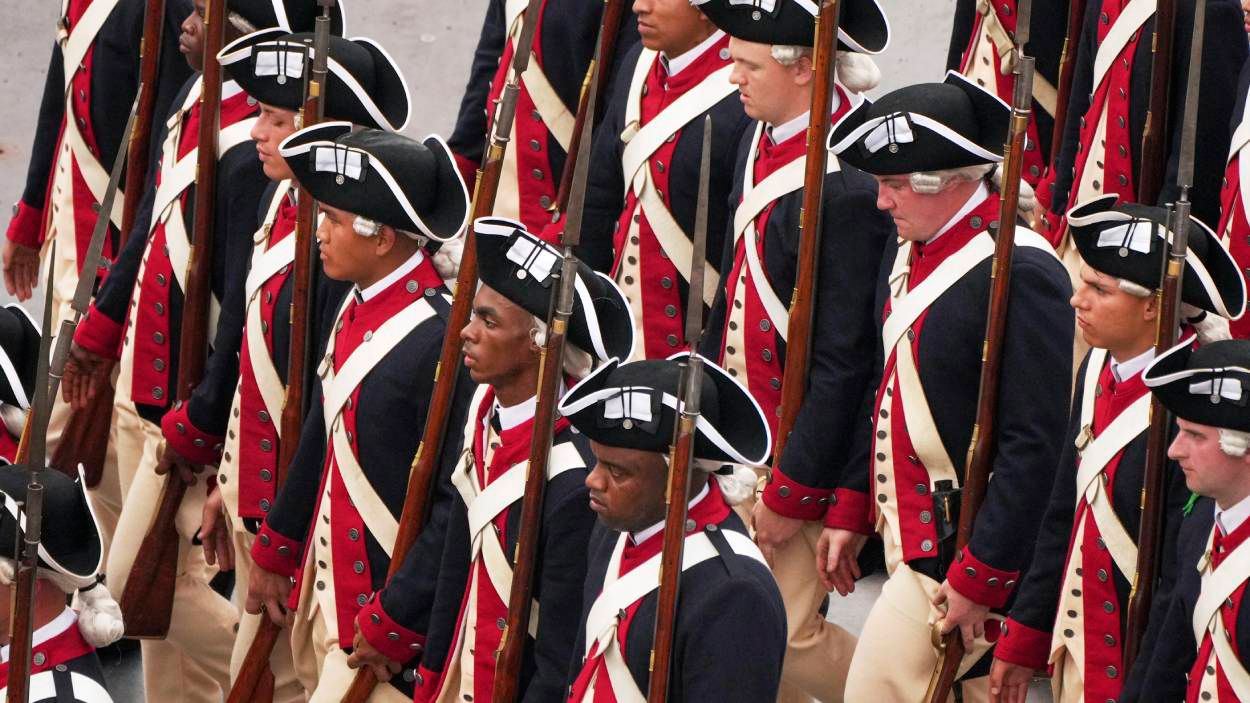
The grand parade included over 6,000 service members and featured a showcase of military vehicles, from horse-drawn Revolutionary War-era cannons to the Army’s latest unmanned ground systems. Reenactors marched shoulder to shoulder with active-duty soldiers, visually stitching together 250 years of history. Army bands performed patriotic music, while aircraft flew overhead in carefully choreographed formations. A highlight came in the form of a coordinated parachute jump by the Army’s Golden Knights, landing with precision on the National Mall and delivering an oversized American flag to thunderous applause.
Beyond the spectacle, the Army used the occasion as an opportunity to honor its people. In a symbolic tribute to service and sacrifice, 250 soldiers from diverse backgrounds took part in a mass re-enlistment ceremony, reaffirming their commitment to continue serving. For many, the moment reflected not only personal pride but a deep connection to the Army’s historic mission.
Throughout the day, interactive exhibits lined the Mall, drawing families and history enthusiasts eager to get a closer look at military gear from every era of American warfare. From Civil War rifles to virtual reality combat simulations, the displays offered a comprehensive look at how the Army has evolved to meet the demands of an ever-changing world.
However, the celebration wasn’t confined to the nation’s capital. Across all 50 states, Army installations and local communities held their own events—from reenactments and fireworks to ceremonies honoring local veterans. Overseas bases also participated, with soldiers stationed in Germany, South Korea, and even aboard Navy ships marking the day with special gatherings and messages sent home to loved ones.
Notably, the day also carried political undertones. The scale of the D.C. parade, which included tanks, helicopters, and a concert near the Washington Monument, drew mixed reactions. While many saw it as a fitting tribute to the military’s past and present, others questioned the cost—estimated to be in the tens of millions of dollars—and whether it blurred the line between celebration and political pageantry. The event coincided with President Donald Trump’s 79th birthday, and while he played a ceremonial role, critics argued that the overlap risked politicizing the moment.
Despite differing perspectives on the parade’s tone and expense, the heart of the occasion remained clear: to honor the American soldier. From the Battle of Saratoga to the streets of Baghdad, and from Valley Forge to Fort Liberty, the Army has not only protected the nation’s borders but helped define its character. With more than a million active-duty, reserve, and National Guard soldiers currently serving, the Army’s relevance in both foreign and domestic affairs remains deeply rooted in the country’s fabric.