


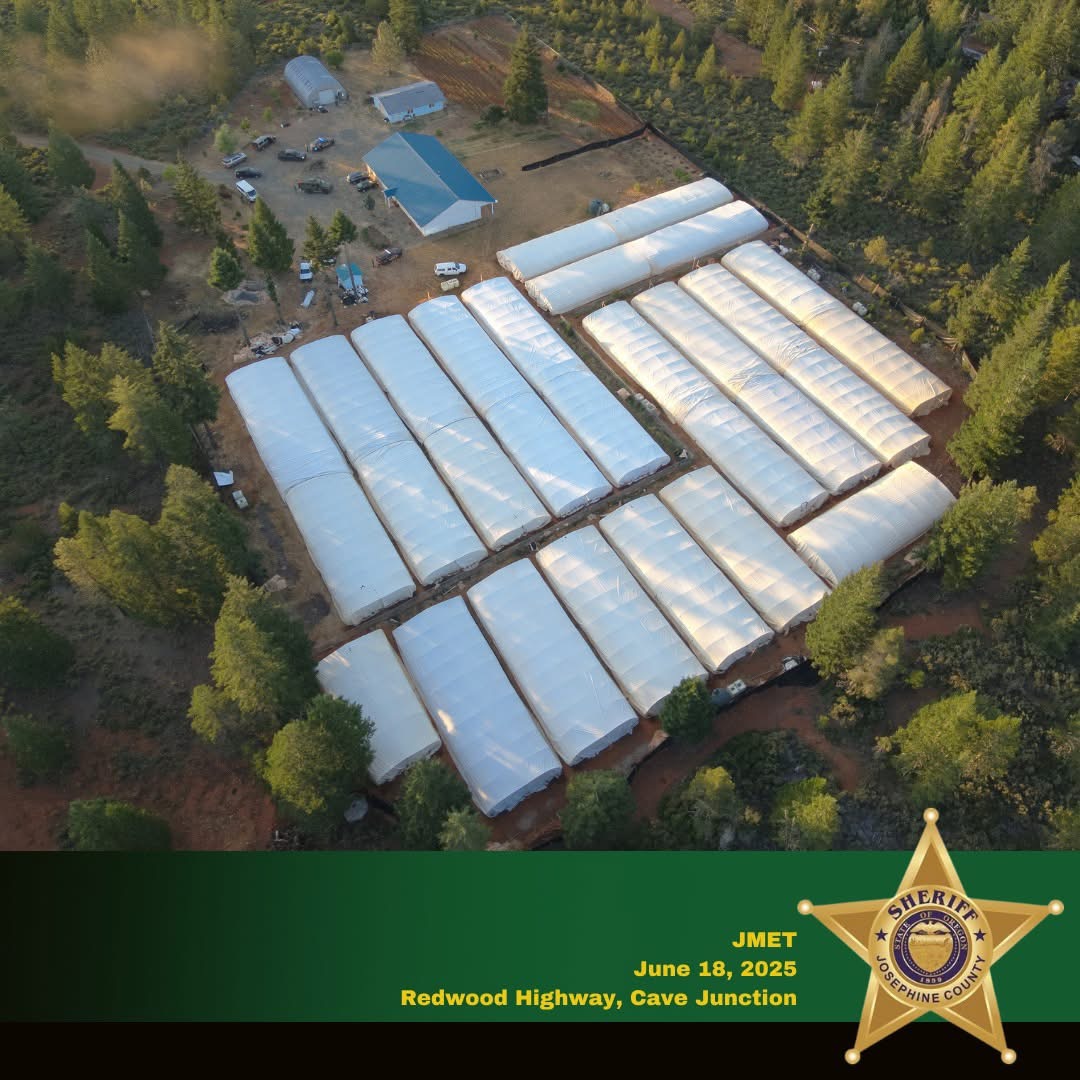
Josephine County’s multi-agency marijuana task force has dismantled a second sprawling illegal cannabis operation in as many weeks, underscoring how far the region’s black-market producers continue to stray from Oregon’s tightly regulated legal framework. On June 18 the Josephine Marijuana Enforcement Team (JMET), backed by an alphabet soup of federal partners, executed a search warrant on rural acreage along the 31 000 block of Redwood Highway outside Cave Junction. By the time investigators finished working through hoop houses, drying rooms, and makeshift storage sheds, more than 7 000 mature marijuana plants and roughly 300 pounds of processed flower had been seized and destroyed.
Agents from the FBI, Homeland Security Investigations, the U.S. Marshals Service, the Bureau of Land Management, the Internal Revenue Service, and the state-level Illegal Marijuana Enforcement Team swarmed the property before daylight to secure the site. Power shut-offs, water lines, and solid-waste hazards were among the first issues crews tackled. Inspectors quickly flagged multiple electrical, plumbing, and refuse violations—each one a potential fire, contamination, or community-health threat. Those code infractions, combined with the hefty drug haul, open the door for civil forfeiture; the county can now argue the land itself served as an instrumentality of an ongoing crime.
The scale of the Cave Junction grow rivals a raid two weeks earlier near Hugo that netted a similar number of plants and several hundred pounds of processed product. Collectively, the two sites would have pumped well over a ton of unlicensed cannabis into distribution networks that stretch far beyond Southern Oregon. For investigators, the back-to-back discoveries confirm suspicions that large, syndicate-backed grows are again proliferating despite a statewide licensing freeze and tougher water-use rules.
Oregon law allows licensed cultivators to raise commercial-grade cannabis, but only under strict oversight. Growers must track plants from seed to sale, submit to random inspections, and buy power and water through legitimate channels. The Cave Junction site skirted every one of those requirements. Illicit wells and un-metered water lines diverted thousands of gallons per day from an already stressed watershed, while jury-rigged electrical panels bypassed utility meters and created arc-flash hazards hidden beneath plastic tarps. Investigators noted that the operation’s carbon-filtration system was both undersized and inoperative, a shortcut that kept costs down but left surrounding homes blanketed in pungent odor.
At the heart of the bust is JMET’s evolving enforcement model. The county task force now integrates intelligence from federal agencies that specialize in money-laundering, immigration, and environmental crimes. Those partnerships allow local deputies to move quickly once a grow is identified, sealing search warrants within days rather than weeks. In the Cave Junction case, aerial photography flagged an unusual number of hoop houses in April; by early June, undercover surveillance confirmed round-the-clock cultivation activity, diesel-powered generators, and delivery trucks arriving after midnight.
Despite extensive planning, the primary suspects avoided arrest. Detectives believe they fled in the hours before the raid, tipping off workers to abandon the site as well. Arrest warrants for unlawful manufacture and possession of marijuana—along with unlawful appropriation of water—are being prepared. Because federal agencies assisted, charges could expand to include conspiracy and racketeering counts if investigators tie the operation to a broader distribution network.
For residents along Redwood Highway, the takedown offers relief but also underscores the persistence of unregulated cultivation in Josephine County’s backcountry. Unpermitted wells lower water tables, diesel spills seep into tributaries of the Illinois River, and drug-linked traffic brings unfamiliar vehicles to once-quiet gravel roads. Each large bust temporarily disrupts that ecosystem, yet law-enforcement leaders concede another site often springs up to replace it within months.
The historic magnitude of the last two raids has prompted calls for tougher land-use oversight and faster state licensing audits. County officials are also weighing new ordinances that would empower code-enforcement officers to tag and condemn structures that appear purpose-built for illegal growing, short-circuiting criminal enterprises before harvest season. Meanwhile, JMET says it will keep leaning on intelligence sharing and inter-agency muscle to stay ahead of growers who view Southern Oregon’s climate—and its patchwork of rural parcels—as the ideal backdrop for covert industrial-scale cultivation.
With summer temperatures climbing and outdoor plants entering their most water-intensive growth phase, investigators expect the pace of enforcement to accelerate. Whether the Cave Junction bust, combined with its equally hefty predecessor, alters the risk calculus for rogue cultivators remains to be seen. For now, law-enforcement leaders hope the sheer size of the seizures—and the looming threat of property forfeiture—send a clear message: the era of hiding massive illegal grows in plain sight may finally be drawing to a close in Josephine County.