


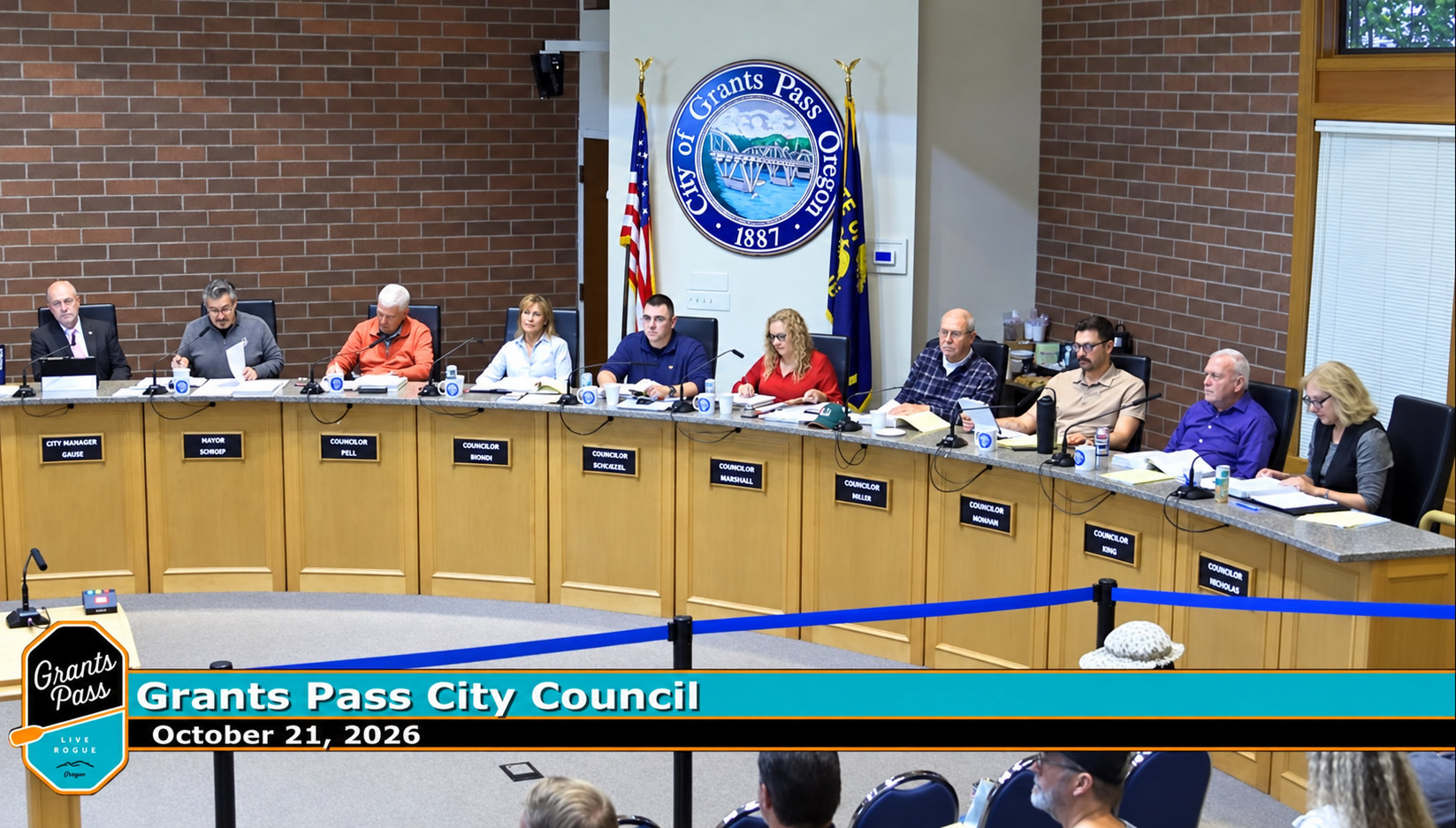
Grants Pass City Council adopted formal rules for opening prayers on a divided vote Wednesday, October 21, while approving housing development measures, an amended agreement for the Allenwood housing project and an additional retirement savings option for city employees.
The invocation policy passed 6–2, with Council President Rob Pell and Councilor Indra Nicholas voting against it. The decision establishes an application and scheduling system for religious congregations seeking to provide speakers before council meetings, along with rules governing participation, speaker conduct and city staff responsibilities.
Under the policy, eligible congregations must be located within the Grants Pass urban growth boundary or be attended by a city resident. A congregation outside the boundary may participate with the support of a resident who attends it. Applications are limited to authorized representatives of established religious congregations, who may deliver the invocation themselves or designate another speaker.
The City Recorder will compile an annual list of participating congregations and schedule their representatives. Public invitations will appear in a newspaper, on the city website and through city social media accounts. Congregations will apply through the city website, with staff responsible for verifying religious organization status and representative authority.
The policy requires initial invitations within 30 days of its effective date, followed by annual invitations around November 1. Speakers will be scheduled on a first-come, first-served basis and may request particular meeting dates. Each participating congregation will receive one assignment before the scheduling rotation repeats.
Invocations are limited to three minutes, and speakers will receive no compensation. Councilors, city employees and audience members are not required to participate, and the policy requires equal treatment of those who participate and those who decline.
City elected officials and employees may not review invocation content in advance. The policy asks speakers to refrain from attempting to convert attendees or disparaging other faiths or beliefs. It also prohibits elected officials and employees from delivering an invocation while acting in their official capacities.
The application process does not establish a separate opportunity for residents to apply without an affiliation with a qualifying congregation, although an authorized congregational representative may designate another person to speak. If a scheduled speaker does not appear, or no speaker can be arranged at least 48 hours before a meeting, the mayor may offer a moment of personal reflection or prayer.
Housing occupied another substantial portion of Wednesday’s business. Council approved development-code amendments addressing middle housing land divisions, covering procedures for applications, zoning, lot creation, access and utilities. The changes incorporate state requirements into the city’s development review process.
Council also approved findings, revised conditions of approval and development plans for Eden Glen at 1907 Fruitdale Drive. The proposed 20-lot townhouse development involved an appeal of the Urban Area Planning Commission’s denial of street-variance applications.
For the Allenwood project, council authorized the city manager to enter into an amended agreement with Allenwood Homes LLC for mixed-income residential development at 175 and 225 Allenwood Drive. The agreement provides for the developer to purchase a 5.7-acre city-owned parcel for $450,000 after satisfying the required conditions.
The planned rental phase includes 110 homes and a community center. The broader development anticipates at least 125 homes, including a later homeownership component.
The amended agreement follows a June 17 council decision that ended in a 4–4 split, with Mayor Clint Scherf casting the deciding vote in favor. During the subsequent financing process, the developer sought revisions because its lenders would not provide funding under the original agreement.
City project documents identify more than $37 million in approved funding through Oregon Housing and Community Services’ Local Innovation and Fast Track program. The city also secured a $1.9 million Business Oregon infrastructure grant to support street construction.
The city’s responsibilities include extending Arroyo Drive, constructing an additional public street and installing associated utilities. Allenwood Homes is responsible for securing funds to complete the remainder of the project. Proceeds from the land sale will return to the city’s park development system development charge account for future parkland acquisition.
The property was originally acquired in 2005 for park inventory. Subsequent planning identified a portion for housing while retaining land for public use.
Council separately approved a 401(a) retirement savings plan for employees, adding an option alongside the Oregon Public Employees Retirement System and the city’s existing voluntary 457(b) savings plan.
The new plan allows authorized employee contributions through payroll deductions. The city’s benefit vendors will administer the accounts under Human Resources oversight. Staff identified no additional city cost to establish the program, with account fees charged to participating employees.
Wednesday’s actions also included a resolution reinstating Parks Advisory Committee appointments and ratifying resolutions and motions from the October 5 special meeting’s consent agenda.
Earlier in the week, council’s October 19 workshop addressed revisions to the comprehensive fee schedule and changes to the city manager evaluation process.
Council agreed to increase a nonresident fee from $7 to $10 and proceed with fee revisions and annual inflation adjustments for January 1. The fee review also included Owl Plaza rates, background-check charges and shelter charges.
The city manager evaluation discussion covered a revised evaluation form, quarterly reviews, advance completion of forms by all councilors and a discussion facilitated by the mayor. Council also considered development of a 360-degree review for 2027.
Adoption of the evaluation process is scheduled for November 4, followed by the city manager’s evaluation on November 18.