


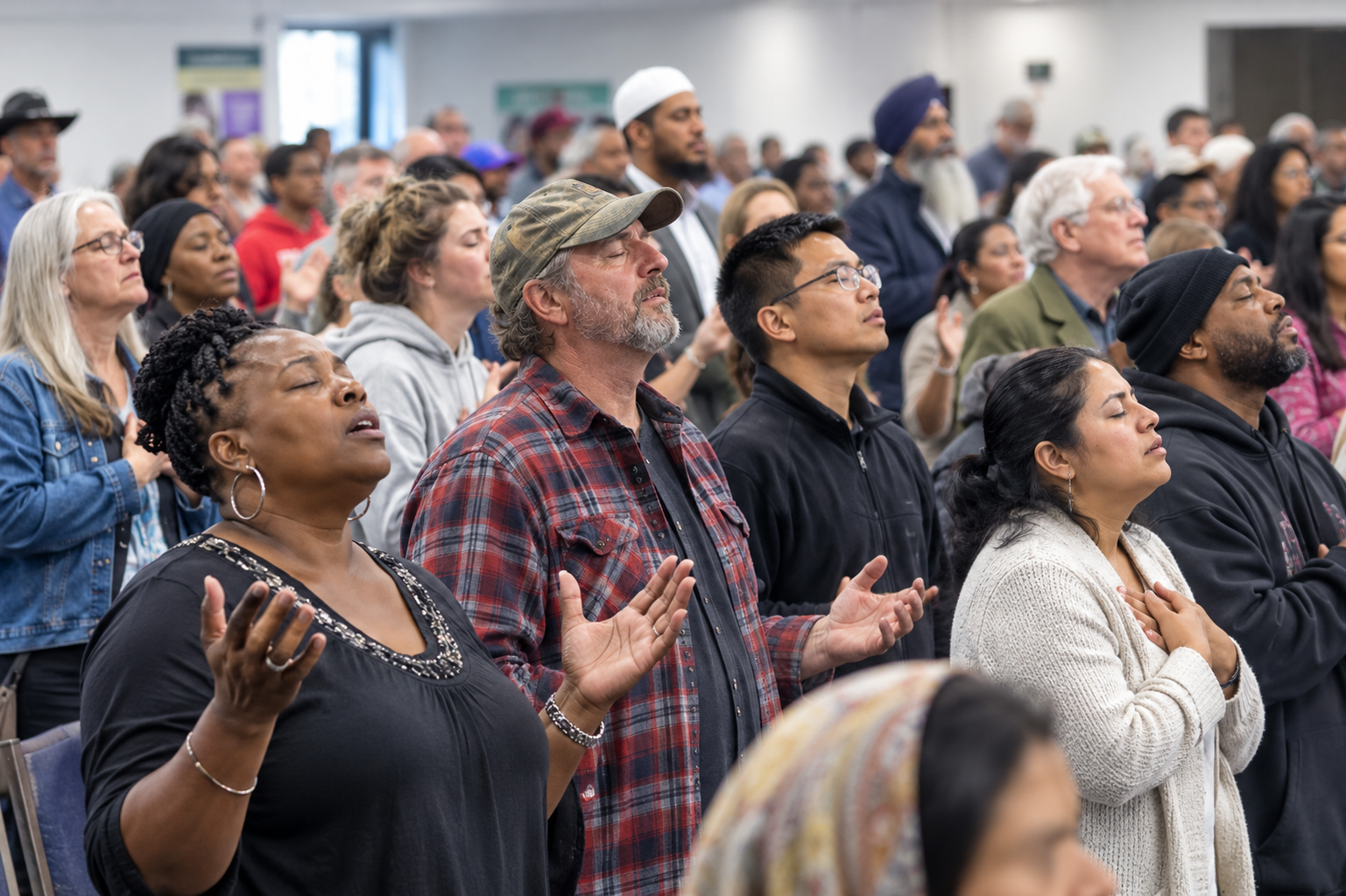
Grants Pass residents could see a formal system for selecting speakers to deliver opening invocations at City Council meetings under a proposal scheduled for consideration Wednesday, October 21. The measure would establish participation rules, a public invitation process and protections for people who choose not to join in prayer.
The proposal follows an October 19 workshop agenda that included revisions to the city’s comprehensive fee schedule, procedures for evaluating the city manager and invocation policies. City staff recommends approval of the invocation resolution, which would place responsibility for recruiting and scheduling speakers with the city recorder or a designated staff member.
Wednesday’s meeting begins at 6 p.m. in Council Chambers at 101 NW A Street. If approved by the council and mayor, the policy would take effect immediately. Public invitations for participating congregations would follow within 30 days, with annual invitations issued around November 1 thereafter.
The invocation proposal would formalize a practice that city staff says began in early 2025. According to the staff report, the practice was recently questioned under the First Amendment, prompting development of written procedures intended to protect religious freedom and establish how speakers are invited and scheduled.
Under the draft, no council member, city employee or attendee would be required to participate. The policy expressly calls for equal treatment of people who participate and those who decline. Speakers would deliver their invocations voluntarily and would receive no compensation.
Speakers would represent established religious congregations within the Grants Pass urban growth boundary. Congregations outside that boundary could also participate if attended by a city resident who supports their involvement. An authorized congregation representative could deliver the invocation or designate another speaker.
City staff would verify the religious organization’s status and the representative’s authority during scheduling. The city recorder or a designee would maintain the participant list and arrange appearances.
The proposal would require public invitations through newspaper notices, the city website and city social media accounts. Responses would be submitted through the website. Participating congregations would be added to an email list and receive invitations directly in subsequent years unless they requested removal.
Scheduling would proceed on a first-come, first-served basis. Each responding congregation would receive an opportunity before the rotation repeats, allowing multiple participating groups to appear over the course of the council’s meeting schedule. Respondents could indicate a preference for particular meeting dates.
Invocations would be limited to three minutes. The draft asks speakers to avoid attempts to convert attendees or disparage other faiths or beliefs, while allowing them to speak according to their conscience. City officials and employees would have no advance involvement in reviewing invocation content and could not deliver an invocation while acting in an official capacity.
If a scheduled speaker does not appear, or no speaker can be arranged at least 48 hours before a meeting, the mayor could offer a moment of personal reflection or prayer before council business proceeds. Staff identifies no cost associated with adopting the policy.
The resolution states that the city does not intend to affiliate itself with a particular faith or express a preference for a religious denomination. Eligibility in the draft centers on established religious congregations. It does not expressly create a separate application process for unaffiliated residents or secular organizations.
The proposal cites religious freedom protections under the First Amendment and Article I, Sections 2 and 3 of the Oregon Constitution. In its 2014 Town of Greece v. Galloway decision, the U.S. Supreme Court upheld the prayer practice before it while addressing religious discrimination in speaker selection and protection against coerced participation.
The fee schedule review concerns charges collected for city services. Grants Pass compiles those charges in a comprehensive schedule that is updated through ordinances or resolutions. The published schedule identifies January 1, 2026, as its effective date. Monday’s agenda listed revisions for discussion but did not specify proposed amounts, affected services or an implementation date.
The manager evaluation discussion concerns how the council reviews administrative performance. Oregon law allows certain employment-related evaluations in executive sessions when the employee does not request an open hearing. Final decisions must occur outside executive session, and the evaluation exception cannot be used to conduct a general closed-door review of agency goals, operations or programs.
Residents planning to participate by telephone in Wednesday’s meeting must contact the city recorder by noon that day. Registered participants are scheduled to receive connection information by 3 p.m. The recorder’s office can be reached at 541-450-6000 or kfrerk@grantspassoregon.gov.