


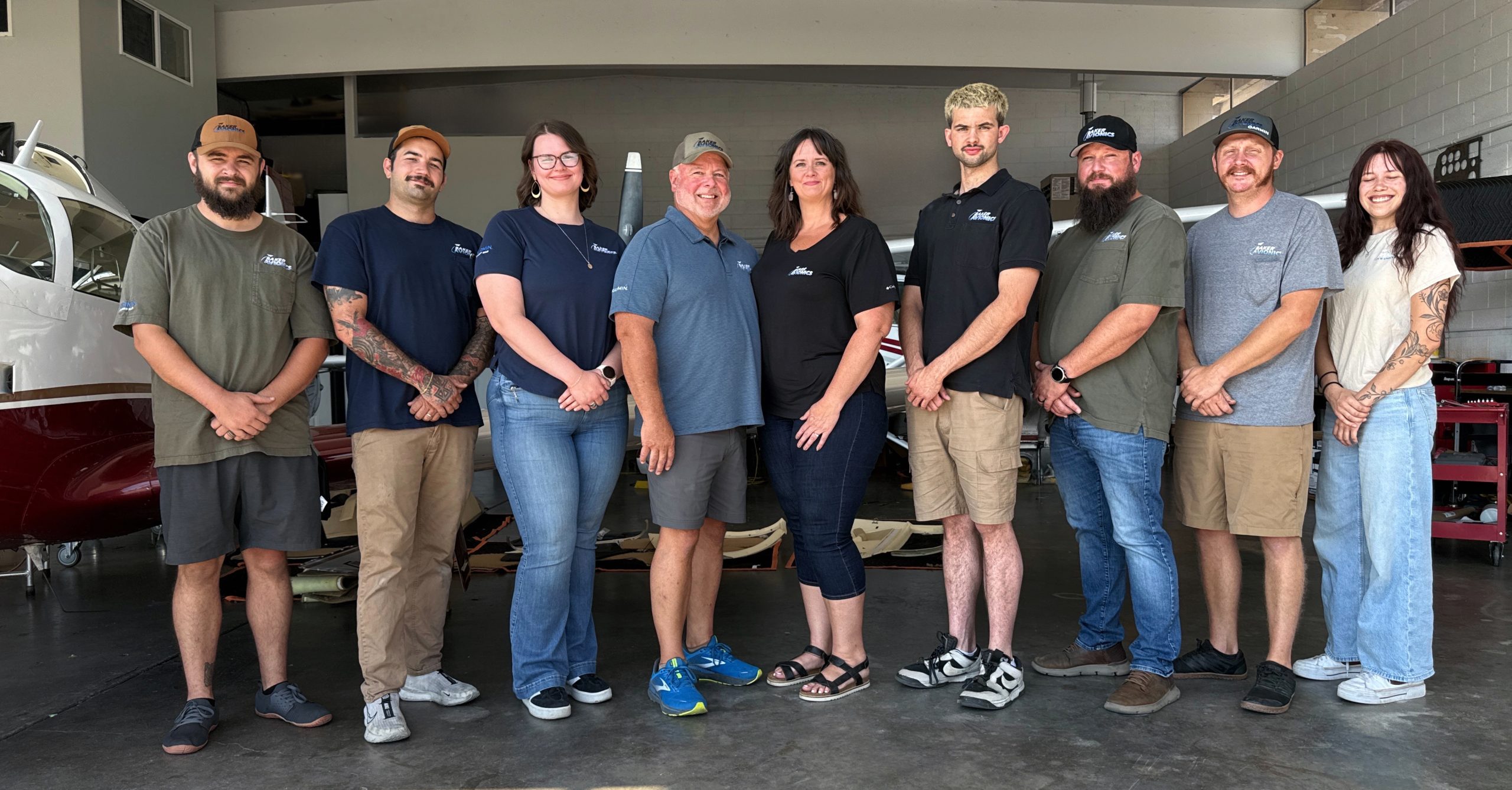
At the Grants Pass Airport in Merlin, a locally owned aviation business is charting a bold course toward the future. Baker Avionics LLC, a Service-Disabled Veteran and Woman Owned Business, has already earned national recognition in the aviation world. Now, they’re preparing to launch an over a million-dollar expansion that promises to elevate both their operations and the local economy.
Founded in 2019 by Greg and Leah Baker, Baker Avionics operates as an FAA Certified Repair Station with both Airframe and Limited Powerplant certifications. Ranked among the top 3–10% of Garmin dealers worldwide, the company specializes in avionics installation, bi-annual certifications, troubleshooting, repairs, and custom aircraft panel fabrication. They also provide mobile services for clients who need on-site work.
Their reputation has taken off far beyond Southern Oregon. While they serve local pilots, their client list includes firefighting and utility helicopter companies like Marble Mountain Helicopter and Lohman Helicopter, aviation clubs up and down the West Coast, and private and corporate aircraft owners from as far away as Idaho, Washington, California, Nevada, and Arizona. Roughly 90% of their customers travel from outside the region, making each service appointment a small economic boost for local hotels, restaurants, and businesses.
The company’s CAD Panels Division has become an industry asset in its own right, designing and fabricating custom aircraft panels for customers nationwide. Many of these are shipped by mail order, but the in-house team also installs them on-site, blending precision engineering with hands-on craftsmanship.
Equally important to the Bakers is the company’s role in workforce development. They hire locally and invest in in-house training, preparing employees for FAA licensing and long-term aviation careers. Veterans and individuals transitioning from military service are a special focus, reflecting Greg Baker’s own service background and the company’s commitment to giving others a career runway in aviation.
Now, Baker Avionics is ready for its next phase of growth. The company is pursuing a $1.2 to $1.5 million expansion to construct a new 120-by-100-foot hangar and office facility at the Grants Pass Airport. The plan includes consolidating all operations under one roof, enabling them to service larger piston and turbine aircraft as well as helicopters. The expansion would also allow their CAD Panels Division to bring powder coating and advanced manufacturing in-house, streamlining production and adding new capabilities.
Workforce training is central to the expansion plan. The new facility will not only increase capacity for apprenticeships but also introduce a formal internship program, giving aspiring aviation technicians valuable hands-on experience. By doing so, Baker Avionics aims to generate more high-skilled, well-paying jobs in Josephine County. Currently, the average installation can take six to eight weeks, and with space for only two planes, work can quickly back up. Expanding to accommodate up to eight aircraft at once would significantly boost productivity, reduce turnaround times, and ultimately put more safe, fully equipped planes back in the air.
To help bring the project to life, the company requested $300,000 in Economic Development funding from Josephine County. They were awarded $150,000—an important contribution, but still only a fraction of the total cost. The Bakers are now pursuing additional funding sources to bridge the gap, remaining determined to see the expansion through to completion.
The community impact could be significant. By drawing more aircraft and specialized aviation work into the area, the new facility is expected to stimulate local spending on lodging, dining, and fuel. Over the next decade, the increased aviation traffic could also encourage other aviation-related businesses to invest in Josephine County, further developing the airport as a regional hub.
In an industry where many small shops struggle to survive, Baker Avionics has managed not only to hold its ground but to climb steadily higher. With a national reputation for precision work, a local workforce trained for tomorrow’s aviation needs, and an ambitious vision for growth, they’re proving that big things can happen in small-town hangars—especially when those hangars are about to get a lot bigger.