


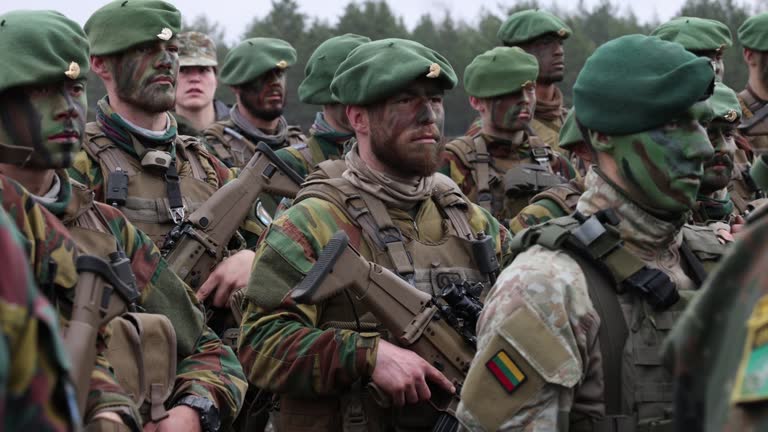
Lithuania, a small Baltic nation situated on NATO’s eastern flank, has announced new defensive preparations designed to guard against the possibility of military aggression from neighboring Russia. The plan underscores the growing unease in Eastern Europe as Moscow’s invasion of Ukraine continues into its fourth year and tensions with NATO remain high.
The strategy, recently detailed by Lithuanian defense officials, lays out a system of layered protections across the country’s southeastern border. This stretch of land runs adjacent to Belarus and the Russian exclave of Kaliningrad, two territories that analysts say could play a critical role in any potential conflict between Russia and NATO.
At the center of Lithuania’s plan is the creation of a defense zone extending roughly 30 miles deep into its territory. Within this zone, the military has identified key choke points, bridges, and roadways that could be targeted or demolished to slow an invading force. In addition, minefields are expected to be installed in strategic areas, further complicating any attempt at a rapid incursion.
Officials emphasize that the measures are defensive, not offensive. The goal is to prevent or delay an invasion long enough for allied reinforcements to arrive under NATO’s collective defense obligations. Lithuania, which regained independence from the Soviet Union in 1990, has been a NATO member since 2004 and has repeatedly called for greater allied presence in the Baltics, arguing that deterrence is only effective if potential adversaries recognize a credible threat of response.
Geography plays a critical role in the Baltic region’s security calculus. Lithuania shares a 420-mile border with Belarus, a close ally of Moscow that has allowed Russian forces to train and deploy on its territory. To the west, Lithuania borders Kaliningrad, a heavily militarized Russian enclave on the Baltic Sea that hosts advanced missile systems and one of the Russian Navy’s key bases. Between these two points lies the so-called Suwałki Gap, a narrow corridor of land that connects Lithuania and the other Baltic states to Poland and the rest of NATO. Military planners have long described the Suwałki Gap as a potential flashpoint in any East-West confrontation.
Lithuania’s defense ministry has not disclosed the full number of installations or the exact scope of the minefields, citing security reasons. However, officials have stressed that the measures align with NATO doctrine and are intended to reinforce the credibility of collective defense in the region.
The unveiling of the plan comes as NATO continues to rotate multinational battlegroups through Lithuania, Latvia, and Estonia. Germany, Canada, and the United Kingdom currently lead deployments in the Baltics, while the United States has increased its presence in Poland. These efforts, NATO leaders say, are designed to reassure member states and dissuade Moscow from testing the alliance’s resolve.
For Lithuania, the preparations are both symbolic and practical. They demonstrate the nation’s commitment to its own security while signaling to allies that it is taking steps to shoulder the burden of defense. At the same time, the plan serves notice to Russia that any aggression in the region would encounter immediate resistance.
As the conflict in Ukraine shows little sign of ending, Lithuania’s new defense measures reflect a broader regional trend: small states along Russia’s border are moving swiftly to harden their defenses and prepare for contingencies that only a decade ago seemed improbable.