


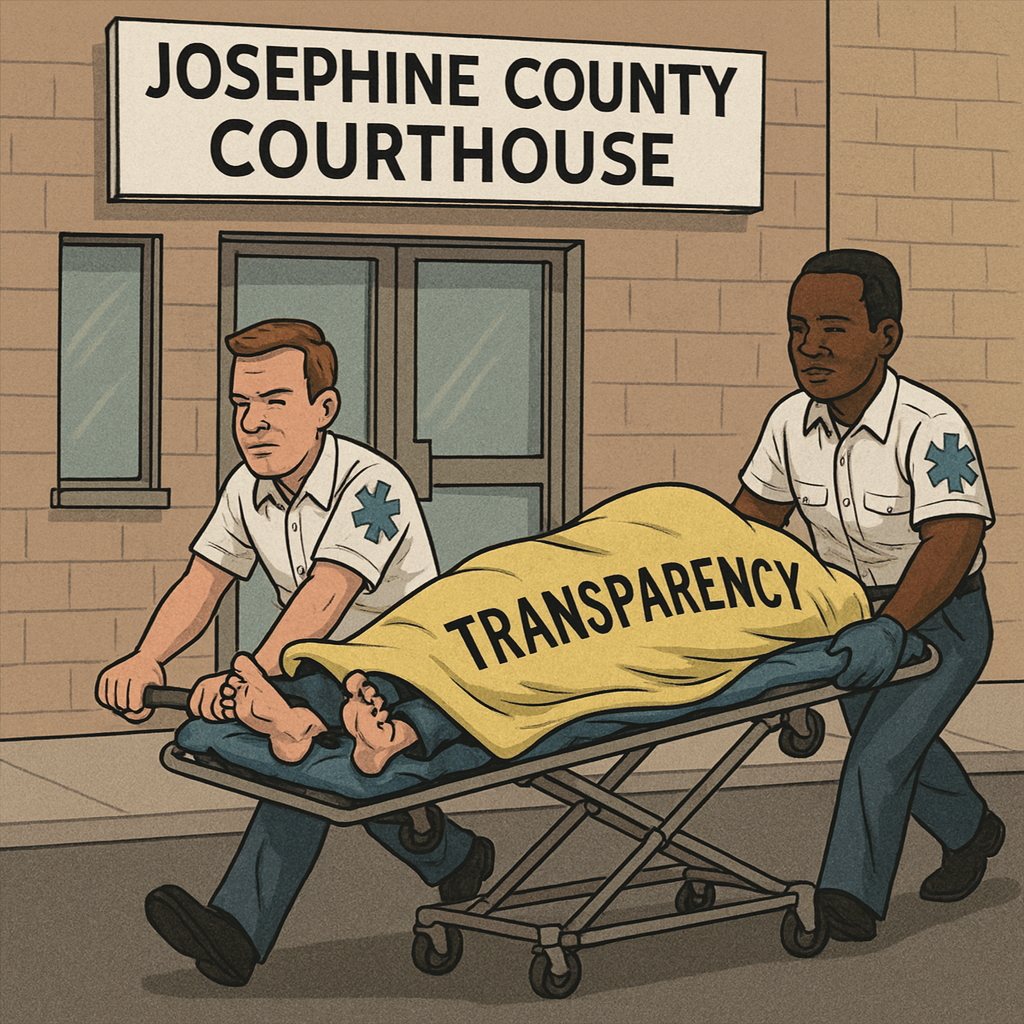
When a citizen or a newspaper submits a public records request in Oregon, the law is clear: it is a legal and protected action under the Oregon Public Records Law, codified in ORS 192.311 – 192.431. These statutes give every Oregonian the right to request access to public records held by state and local governments. No special qualifications are needed. No justification is required. Transparency is, by design, a tool for accountability in a democracy.
And yet, recent political statements by Grants Pass City Councilor Erich Schloegl—amplified by State Representative Dwayne Yunker—attempt to portray a lawful records request as a violation of privacy, even invoking HIPAA and the Privacy Act. Their framing suggests that the Grants Pass Tribune, which filed the request on behalf of a resident, had somehow crossed into illegality or misconduct by asking the county for documentation. That characterization is not only misleading—it is factually false.
Oregon law allows any person to request records that a public body may hold. The key word here is “public.” Agencies must either provide the requested records, cite exemptions that make disclosure illegal, or explain why they are not the custodians of the information. In the case of the Tribune’s request, Josephine County officials themselves responded by stating they were still determining whether they even had custody of such records. That is the proper and legal process.
What Schloegl and Yunker fail to acknowledge is that asking for records is not the same as obtaining them. A request does not, and cannot, override state or federal privacy protections. If the information sought falls under exemptions—such as medical records, VA disability claims, or pension details—the agency simply denies disclosure under ORS 192.355(2), which exempts records if their release would constitute an unreasonable invasion of privacy. The law itself protects veterans, employees, and private citizens from exposure of sensitive data.
HIPAA (the Health Insurance Portability and Accountability Act) applies to healthcare providers, insurers, and covered entities handling medical information—not to citizens or journalists filing records requests. Similarly, the Privacy Act of 1974 restricts how federal agencies release personal information. Neither law is triggered by the act of requesting information. Rather, they restrict government agencies from disclosing protected data without proper authorization.
This distinction matters. A citizen filing a request has not broken the law. The burden to safeguard protected information rests entirely with the government body holding the records. If Josephine County does not have legal authority to release pension or VA disability claim details, it will deny the request. That safeguard is built into the system. Suggesting otherwise is a distortion.
As the author of this article and as a Marine Corps veteran of the first Gulf War, I find these attacks especially disgraceful. To suggest that I, a veteran myself, am somehow targeting other veterans for political sport is not only wrong—it is despicable. The reality is simple: one veteran was asking questions about the possible misuse of veterans’ benefits by other veterans who hold public office. That is not an attack. That is accountability. If there is nothing to hide, then there is nothing to be upset about.
Calling this inquiry an assault on veterans’ privacy is a calculated deflection. What is truly offensive is the attempt by public officials to weaponize their military service as a shield against scrutiny. Veterans who serve in government should be honored for their sacrifice, but they are not above the law or beyond public accountability.
It is important to note that this records request was never made public by the Tribune. It was quietly filed, legally, and was still pending when Councilor Schloegl and Rep. Yunker themselves chose to broadcast it across social media. They are the ones who dragged this into the public arena—not the newspaper. That fact alone should tell the public everything it needs to know. Their outrage was not about protecting veterans. It was about steering the narrative, controlling the conversation, and retaliating against those who dared to ask questions.
The Tribune has a documented history of filing records requests to uncover misuse of funds, questionable hiring practices, and conflicts of interest inside Josephine County government. This latest request was no different. To paint it as an invasion of privacy is to ignore the reality: transparency is not comfortable for politicians who may have something to hide.
The irony is striking. By rushing to denounce the Tribune’s lawful request, Schloegl and Yunker have drawn more attention to the question itself—why such a defensive reaction? If there is nothing improper in veterans-turned-politicians receiving both benefits and public salaries, then the records would prove it, and exemptions would block disclosure of anything private. That is how the system works. What remains is the fact that officials have chosen to attack the press rather than simply let the process run its course.
No law was broken. No privacy statute was violated. No medical information or records were requested. The Grants Pass Tribune followed Oregon law precisely as written. Citizens have every right to ask for public records, and agencies have every right—and responsibility—to withhold exempt data. That balance is the cornerstone of government accountability.
The attempt to twist that balance into accusations of misconduct is not only false, but dangerous. It undermines trust in the press, discourages legitimate oversight, and shifts focus away from the very transparency the law was designed to protect.
Veterans’ privacy is safe under state and federal law. What is at risk is something else: the community’s ability to question those in power without fear of retaliation. And that, more than any records request, is what Josephine County should be paying attention to.