


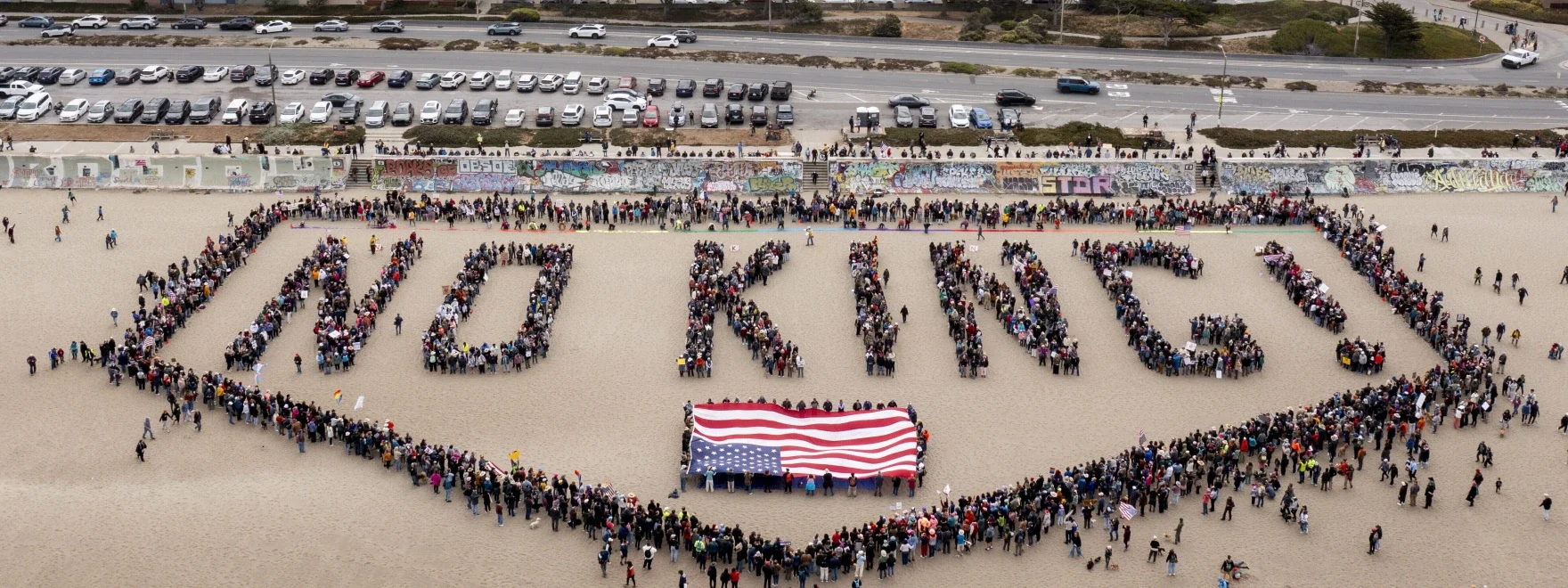
A wave of coordinated demonstrations under the banner of “No Kings” swept across the United States on Saturday, marking one of the largest days of public protest in recent American history. From major metropolitan areas to small towns, citizens gathered in a unified call for democratic accountability and restraint of executive power, signaling growing public unease over the direction of national leadership.
The events, organized independently but connected through shared messaging, unfolded in all 50 states, totaling more than 2,600 gatherings according to early estimates. In Washington, D.C., massive crowds filled streets surrounding the Capitol and National Mall. New York City, Los Angeles, Chicago, and San Francisco also drew substantial turnouts, each attracting tens of thousands of demonstrators. Smaller communities hosted peaceful rallies on courthouse steps, in public parks, and at local government centers, demonstrating the widespread reach of the movement.
Authorities across the country reported that the majority of the gatherings remained peaceful, with minimal reports of unrest or confrontation. In several cities, police departments noted the absence of major arrests and credited organizers for maintaining orderly behavior. The overall tone of the day reflected civic unity rather than hostility, as participants engaged in what many described as a visible exercise of democratic expression.
While each protest site carried its own tone, the unifying message was a rejection of authoritarian behavior in government. Demonstrators expressed concern about increasing federal power, expanded surveillance measures, and the erosion of institutional checks and balances. Central to the movement’s symbolism was the idea that no individual, regardless of office, stands above the principles of democracy and the rule of law.
The day was not without underlying tension. Civil liberties organizations voiced concerns over reports of government monitoring of the events, including possible use of facial-recognition systems, drones, and digital tracking tools. In several cities, observers noted a heavier than usual presence of federal law enforcement, particularly near sensitive government facilities. Despite these concerns, the day concluded without widespread incident or major clashes, underscoring the disciplined nature of the gatherings.
In cities such as New York, Atlanta, Portland, and Seattle, the atmosphere resembled a civic festival, filled with homemade banners, families, and musicians. Many participants viewed the event as a reminder of the power of peaceful assembly and collective expression. In more politically divided regions, turnout was smaller but symbolically significant, reflecting a growing national appetite for public dialogue about democracy, transparency, and power.
By evening, streets across the country had largely cleared, and organizers began to frame the day as a starting point rather than a single event. The question now facing the nation is whether this show of unity and civic engagement will translate into lasting political action or policy reform.
The “No Kings” demonstrations, while peaceful in execution, carried an unmistakable message—one that transcended party lines and echoed through the halls of government and across city streets. At its core, the protest reminded Americans that leadership, no matter how powerful, must always remain accountable to the people.