


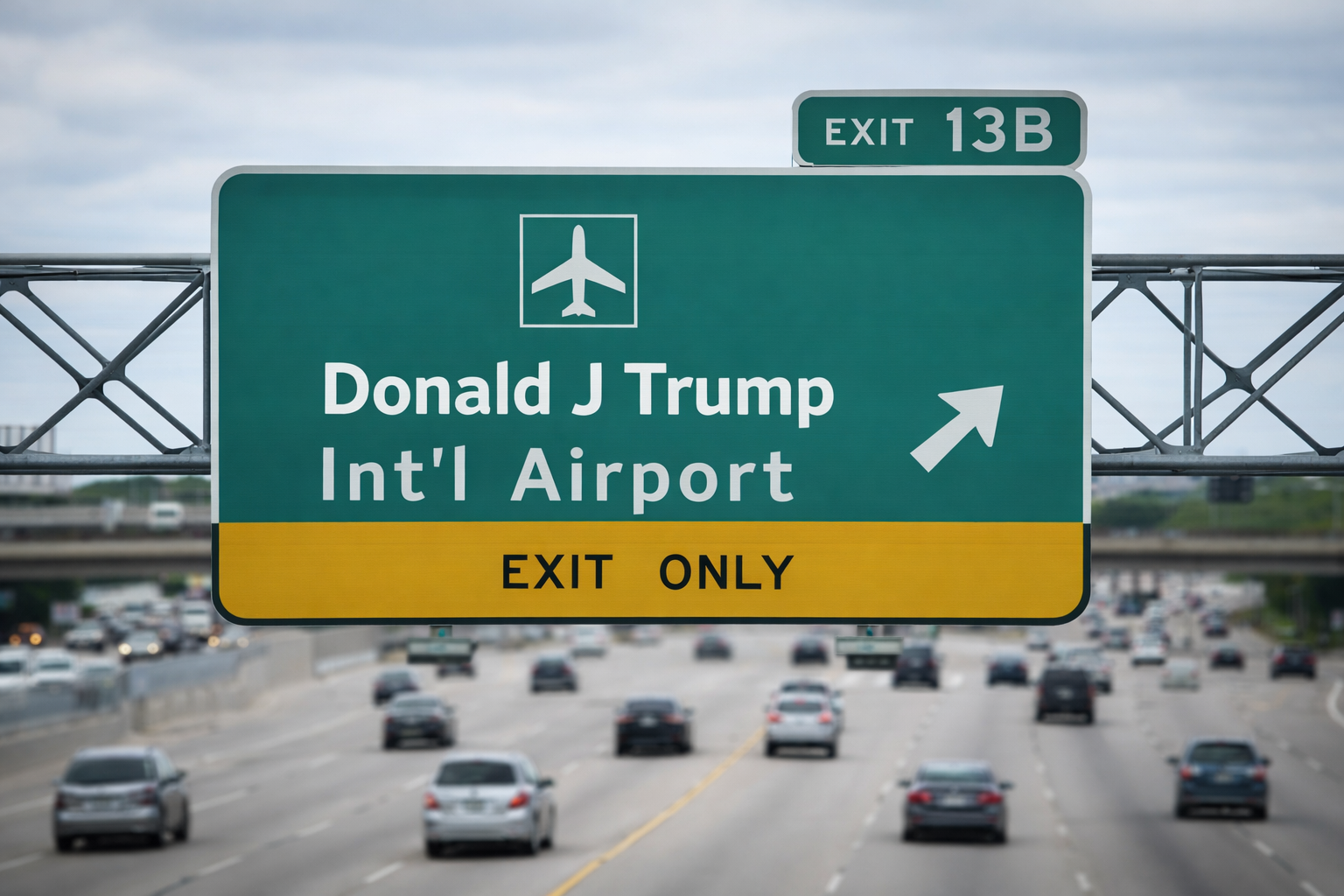
As lawmakers in Florida weigh whether to rename a major transportation hub after President Donald J. Trump, a parallel move by the president’s family business has quietly introduced a legal dimension that extends well beyond signage at a terminal entrance.
The company that manages and protects the Trump brand has filed federal trademark applications seeking rights to variations of the name Donald J. Trump International Airport and similar titles. The filings were submitted by DTTM Operations LLC, the entity responsible for overseeing intellectual property tied to the Trump name. The applications were made on what is known as an intent to use basis, a standard procedure that allows a business to reserve rights to a name before it is actively used in commerce, provided it can later demonstrate actual use.
The timing of the filings coincides with a bill moving through the Florida Legislature that would authorize renaming Palm Beach International Airport in honor of the president. That airport serves the region near Trump’s Mar a Lago residence and is a key commercial gateway for South Florida. The proposal remains subject to additional approvals, including coordination with federal aviation authorities and local government entities that manage the airport.
According to multiple national news outlets, the trademark applications extend beyond the physical naming of an airport. They cover a range of goods and services often associated with air travel, including merchandise and branded items that could be sold in airport settings. Legal analysts note that while it is common for private companies to secure trademarks for hotels, golf courses, and other commercial properties, it is far less typical for a private entity to file for trademark protection tied to a publicly owned airport before any official renaming has occurred.
Under United States trademark law, ownership of a name used in commerce can provide the holder with exclusive rights to control its commercial use in specific categories. Public infrastructure such as airports is typically owned and operated by governmental authorities, and their names are usually established through legislative or administrative action rather than through private trademark claims. If a public airport were to adopt a name protected by a private trademark, questions could arise about licensing agreements, control over branded merchandise, and the scope of commercial rights connected to that name.
Representatives of the Trump Organization have indicated in various reports that no licensing fee would be charged if the Florida airport were renamed after the president. However, trademark protection could allow the company to control how the name is used in connection with goods and services, including souvenirs and related branding opportunities. Intellectual property attorneys interviewed by national media outlets described the filings as unusual in the context of public facilities, noting that similar preemptive trademark claims have not historically accompanied the naming of airports after public figures.
The broader debate surrounding the proposed renaming touches on political symbolism as well as practical considerations. Supporters of the bill argue that naming the airport after the president would recognize his connection to the state and his national prominence. Critics question the appropriateness of renaming a major public facility after a sitting president and raise concerns about potential commercial entanglements between public infrastructure and private business interests.
Airport renaming efforts can involve significant logistical and financial steps, including changes to signage, branding materials, digital systems, and regulatory documentation. Federal agencies such as the Federal Aviation Administration must be notified of name changes to ensure consistency in aviation databases and navigation systems. Local governments typically bear the responsibility for implementation costs unless alternative arrangements are made.
For now, the trademark applications remain pending review by the United States Patent and Trademark Office, and the Florida bill continues through the legislative process. Whether Palm Beach International Airport ultimately adopts a new name remains uncertain. What is clear is that the intersection of public commemoration, private branding, and intellectual property law has introduced a new layer to a debate that might otherwise have centered solely on politics and public sentiment.
In an era when personal brands and public offices often intersect, the question is no longer simply who an airport should be named after. It is also who controls the commercial value of that name once it appears above the runway.