


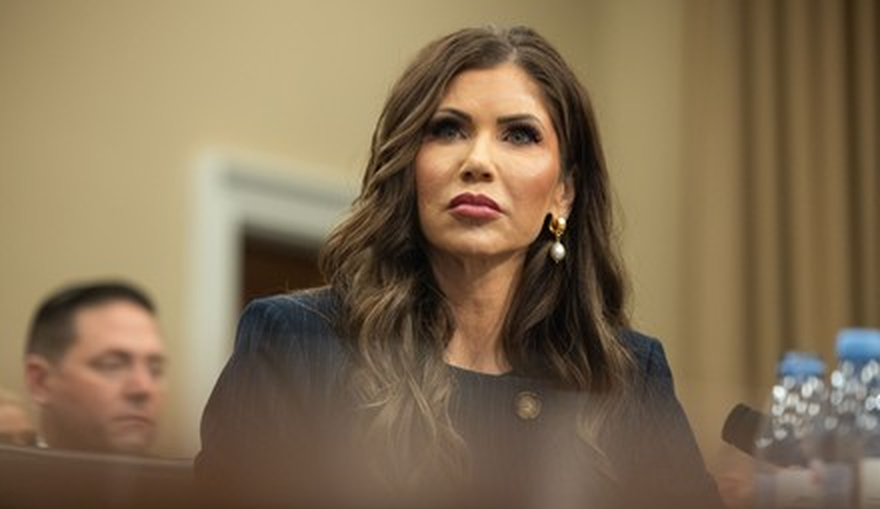
The leadership of the U.S. Department of Homeland Security shifted abruptly this week after President Donald Trump removed Kristi Noem from her role at the cabinet-level agency following weeks of bipartisan criticism and mounting controversy surrounding the department’s operations. The move brings an early end to Noem’s tenure overseeing one of the most complex and politically sensitive departments in the federal government.
United States Department of Homeland Security was established after the terrorist attacks of September 11, 2001 and is responsible for coordinating national security across a wide network of agencies. Its responsibilities include immigration enforcement, border security, disaster response, cybersecurity protection, and the oversight of organizations such as the Transportation Security Administration and U.S. Customs and Border Protection. Because of its broad reach and national security mandate, the position of Homeland Security secretary carries enormous political and operational pressure.
Noem, a former governor of South Dakota who joined the Trump administration as Homeland Security secretary early in the president’s second term, quickly found herself at the center of several contentious national debates. Her leadership coincided with a period of intensified immigration enforcement and an expansion of federal operations aimed at combating illegal immigration and organized criminal networks. Those efforts were praised by supporters who argued that stronger enforcement was necessary to protect the southern border and maintain domestic security. At the same time, critics raised concerns about the scale and methods of the enforcement actions, arguing that they sometimes led to wrongful detentions and aggressive tactics in civilian areas.
One of the most significant incidents fueling criticism involved a federal immigration enforcement operation in Minneapolis that ended in the deaths of two U.S. citizens. The incident sparked intense national attention and prompted questions from lawmakers and civil rights advocates about the planning and execution of the operation. Investigations into the circumstances surrounding the deaths intensified scrutiny of the department and placed Noem under growing pressure from both political parties.
Members of Congress began demanding more information about the incident and broader immigration enforcement policies under the department’s leadership. Hearings in Washington grew increasingly tense as lawmakers from both sides of the aisle questioned the department’s oversight procedures and operational transparency. The bipartisan criticism marked an unusual moment in a political environment where disagreements over immigration policy typically fall along party lines.
Additional controversy developed around a costly public communications campaign tied to the department. Reports about the scale of the campaign and the extent to which it highlighted the secretary personally raised concerns among some policymakers about the use of federal resources for messaging efforts. The issue added another layer of political friction during an already difficult period for the department.
Internal management challenges were also reported during Noem’s tenure. Accounts from current and former officials described a turbulent working environment within parts of the department, contributing to perceptions of instability at a time when federal security agencies were facing increasing operational demands. While leadership disputes are not uncommon in large federal agencies, the combination of management tensions and public controversies amplified the political pressure surrounding the secretary.
Against this backdrop, the White House moved to make a leadership change. President Trump announced that Markwayne Mullin would be nominated to replace Noem as the next head of the Department of Homeland Security, a move that will require confirmation by the United States Senate before the transition can be finalized.
Although she was removed from the cabinet position, Noem is expected to remain connected to the administration in a new diplomatic capacity focused on regional security cooperation across the Western Hemisphere. The reassignment signals an effort by the administration to shift leadership at the department while maintaining Noem within broader national security initiatives.
The change represents one of the most significant cabinet-level personnel moves since the beginning of Trump’s second term and underscores the ongoing political sensitivity surrounding immigration policy and federal law enforcement operations. Leadership of the Department of Homeland Security often becomes a focal point for national debate because the agency sits at the intersection of border control, civil liberties, disaster response, and counterterrorism.
As the Senate prepares to review Mullin’s nomination, attention is likely to remain fixed on the department’s direction and how federal authorities balance security enforcement with public accountability. The leadership transition arrives at a moment when immigration, border policy, and domestic security remain among the most closely watched issues shaping the national political landscape.