


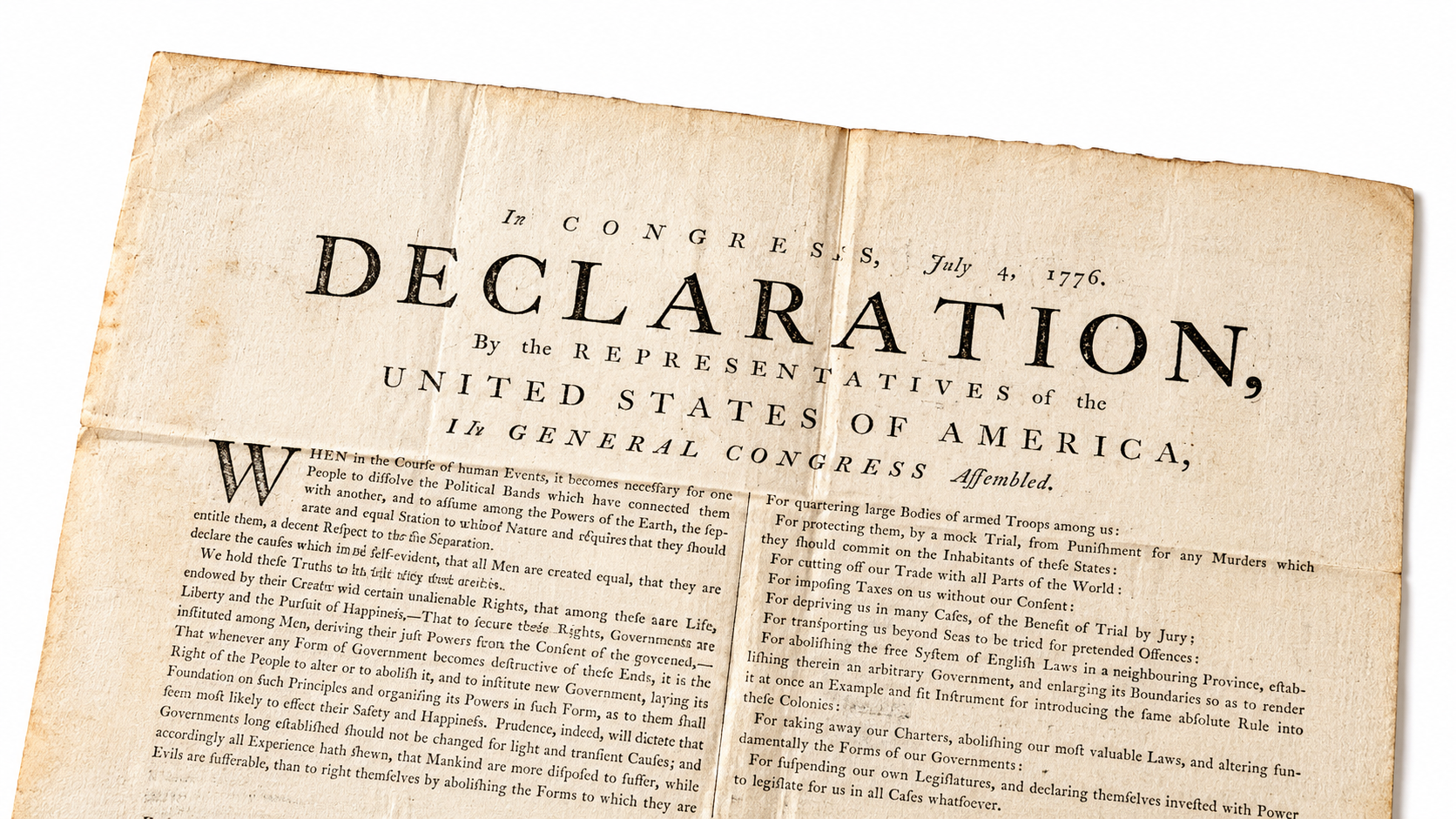
Nearly two and a half centuries after the United States declared its independence from Great Britain, an extraordinary chapter of Revolutionary War history has resurfaced in an unlikely place. A rare printed copy of the Declaration of Independence, believed to have disappeared during the earliest months of the American Revolution, has been discovered among long-forgotten records preserved inside the United Kingdom’s National Archives. The remarkable find has drawn international attention as the United States marks the 250th anniversary of its founding, offering historians a clearer understanding of how one of the nation’s most important documents traveled across the Atlantic and survived generations hidden in government records.
The discovery was made during a routine archival cataloging project conducted by volunteers and professional archivists working through thousands of eighteenth-century Royal Navy records. While examining paperwork connected to captured American vessels during the Revolutionary War, volunteer researcher Michael Scurr noticed a folded document that had been cataloged centuries earlier under the unremarkable description of “another document.” Upon closer inspection, it became immediately apparent that the paper was anything but ordinary.
Archivists soon confirmed the document was an authentic Exeter Declaration, one of the earliest printed editions of the Declaration of Independence produced after Congress approved the historic text on July 4, 1776. Rather than the original handwritten parchment displayed in Washington, D.C., this version represents one of the printed broadsides created to rapidly spread news of independence throughout the American colonies.
Historical records indicate the newly discovered broadside was printed in Exeter, New Hampshire, sometime between July 16 and July 19, 1776. At the time, printers worked quickly to reproduce the Declaration so that military commanders, colonial leaders, newspapers and citizens could read the announcement declaring the thirteen colonies free and independent states. Speed was essential because communication depended entirely upon horseback riders, ships and printed publications carrying news from one community to another.
Only eleven surviving examples of the Exeter printing are now known to exist, making the newly identified copy exceptionally significant. More remarkably, it is the first authenticated Exeter Declaration ever found outside the United States, adding another unique dimension to its historical importance.
Its journey from New Hampshire to Britain tells an equally compelling story.
Researchers determined the document was being transported aboard the American privateer Dalton, an armed vessel commissioned during the Revolutionary War to capture British merchant ships. Commanded by Captain Eleazer Johnson, the ship sailed across the Atlantic later in 1776. Historians believe the printed Declaration may have served not only as an official document but also as a reminder of the political ideals motivating the crew during their dangerous mission.
The voyage came to an abrupt end on Christmas Eve in 1776 when the Royal Navy intercepted and captured the Dalton off the coast of Portugal. Under British naval procedures of the era, every captured vessel was required to surrender its papers and cargo to government authorities so prize claims could be processed. The Declaration was collected with the ship’s other records, transported to England and ultimately deposited within government archives.
What followed was an extraordinary period of historical silence.
For nearly 250 years, the broadside remained safely preserved among thousands of naval documents without attracting attention. The paper escaped destruction not because anyone intentionally safeguarded it as a priceless American artifact, but because British administrative procedures required captured wartime records to be retained as official government files. Ironically, the same bureaucracy created to document Britain’s naval victories ultimately preserved one of America’s most recognizable founding texts.
The National Archives says the discovery provides historians with an unusually complete chain of custody, allowing researchers to reconstruct the document’s path from a New Hampshire printing press to an American privateer, through its wartime capture, and finally into permanent archival storage. That level of documented provenance is rarely available for surviving Revolutionary War artifacts.
The find also illustrates that significant historical discoveries continue to emerge despite centuries of scholarly research. While many assume the American Revolution has been exhaustively documented, millions of archival pages remain uncataloged or only briefly described in repositories around the world. Modern preservation efforts, digitization projects and volunteer cataloging programs continue uncovering overlooked documents that expand historians’ understanding of the eighteenth century.
Following authentication, conservators carefully examined and stabilized the fragile paper before placing it on public display as part of Britain’s Revolution 250 exhibition, allowing visitors to view one of the earliest surviving printed versions of America’s founding declaration.
Although the wording of the newly discovered broadside matches other known Exeter printings, its historical value extends well beyond the text itself. The document provides physical evidence of how revolutionary ideas moved across oceans during a time of war, demonstrates the role printed publications played in shaping public understanding of independence, and illustrates how military conflict inadvertently preserved pieces of history that otherwise may have disappeared.
As preparations continue for commemorations marking the 250th anniversary of American independence, the discovery serves as a reminder that the story of the Revolution continues to evolve. Even after two and a half centuries, new evidence still emerges from archive shelves, offering historians fresh opportunities to trace the remarkable journey of the documents that helped shape the birth of the United States.