


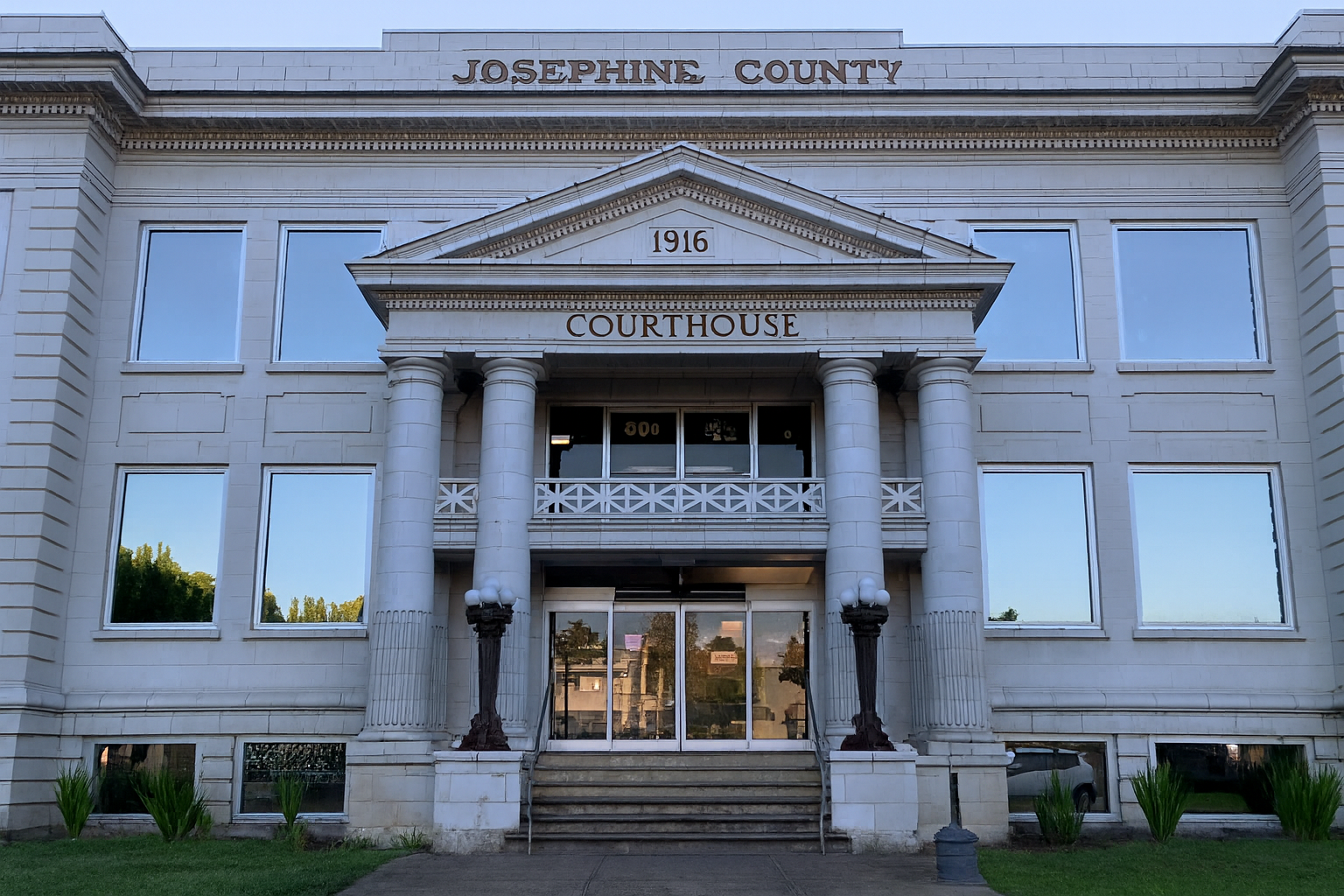
A formal public records appeal filed with the Josephine County District Attorney is bringing questions surrounding government transparency, public access to official records, and the legal responsibilities of local government back into public view as officials are asked to review whether county records were improperly withheld from disclosure.
The appeal, prepared by Stephen E. Fitch and intended for delivery before the stated July 8, 2026, deadline, asks the District Attorney to review Josephine County’s handling of a public records request involving a series of incidents at county facilities and public meetings. The filing requests an order directing the county to release records that Fitch contends have been improperly withheld and to reconsider the denial of any associated fee waiver.
According to the appeal, the requested records concern government actions involving public meetings, courthouse facilities, public forums, security responses, trespass-related actions, cease-and-desist notices, communications involving county employees, and documentation surrounding incidents in which Fitch alleges he was removed, excluded, or otherwise restricted while participating in public affairs.
The filing argues that the requested records are directly tied to the conduct of public officials and public employees rather than private individuals, making their disclosure a matter of public interest. Fitch contends that government accountability requires public access to records documenting how public authority was exercised and whether those actions complied with the law.
In the appeal, Fitch states that he attended public meetings as a member of the public, waited to be recognized, was selected to speak during the designated public comment period, completed his remarks within the allotted time, and departed after speaking. He maintains that he did not disrupt the proceedings and characterizes his participation as lawful public engagement.
“I was a member of the public exercising my rights,” the appeal states. “I peacefully waited my turn. I was selected to speak. I spoke during my allotted public-comment time. I left.”
The appeal challenges what it describes as the county’s reliance on employee protection, security, or safety exemptions as the basis for withholding records. Fitch argues that such exemptions should not be broadly applied to prevent public review of government conduct, particularly when the records involve decisions made by public officials while carrying out official duties.
Among the issues raised in the filing are questions surrounding who authorized security actions, removals, exclusions, trespass notices, or other restrictions, what legal justification was cited for those decisions, whether county employees acted within the scope of their lawful authority, and whether any records were created, altered, withheld, deleted, or selectively disclosed.
The appeal further requests a review of whether any exemptions cited by the county are being used to shield employee conduct from public oversight rather than to protect legitimate security interests.
Fitch also asks the District Attorney to determine whether actions taken against him occurred after he exercised what he describes as protected speech through public comment, criminal complaint activity, requests for governmental redress, or other forms of public participation.
Rather than seeking unrestricted disclosure of every document, the appeal acknowledges that certain records may legitimately contain sensitive security information. However, it argues that any exempt material should be narrowly redacted while the remaining portions are released to the public.
“I am not requesting hidden security vulnerabilities for an improper purpose,” the appeal states. “I am requesting records necessary to review government conduct directed at me as a member of the public.”
In addition to challenging the withholding of records, the filing disputes any denial of a fee waiver associated with the public records request. Fitch argues that the subject matter extends beyond a private dispute because it involves public employee conduct, public meeting access, governmental authority, alleged retaliation, and the public’s ability to evaluate how local government exercises its powers.
According to the appeal, disclosure of the requested records would allow the public to better understand what occurred during the reported incidents, identify who authorized official actions, and determine whether county authority was exercised appropriately.
The filing asks the District Attorney to order Josephine County to produce the requested records, disclose all reasonably segregable non-exempt information where limited redactions are justified, identify each withheld record or category of records, specify the exemption claimed for every withheld document or portion of a document, explain why disclosure would not serve the public interest, and review the county’s denial of any fee waiver or fee reduction.
The appeal also seeks an order directing the county to preserve all potentially responsive evidence while the matter is under review. That preservation request includes surveillance video, elevator footage, emails, incident reports, security communications, public meeting records, trespass documentation, cease-and-desist records, and communications relating to Fitch’s reported removal or exclusion from public forums.
Another section of the filing addresses what Fitch describes as earlier confusion involving the proper avenue for appealing a county records denial. He states that the appeal is being submitted directly to the Josephine County District Attorney because the records dispute involves a county government body, and he identifies the District Attorney as the appropriate authority to review the matter under Oregon’s public records process.
To support the appeal, Fitch includes an exhibit list identifying the original records requests, county responses, correspondence regarding claimed exemptions, fee waiver documents, evidence establishing filing deadlines, supporting communications, proof of delivery, and materials documenting the sequence of events surrounding the underlying incidents.
The filing concludes with a request for the District Attorney’s Office to acknowledge receipt of the appeal by providing a date-and-time stamp confirming that the documents were received before the July 8 deadline. The requested acknowledgment is intended to establish that the appeal was timely filed and formally submitted for review.
If accepted for review, the appeal will require the District Attorney to examine the county’s handling of the records request, evaluate the legal basis for any claimed exemptions, and determine whether additional disclosure is required under Oregon’s public records laws. The outcome could influence not only the disposition of the records sought in this case but also how future requests involving government accountability and public oversight are evaluated at the local level.