


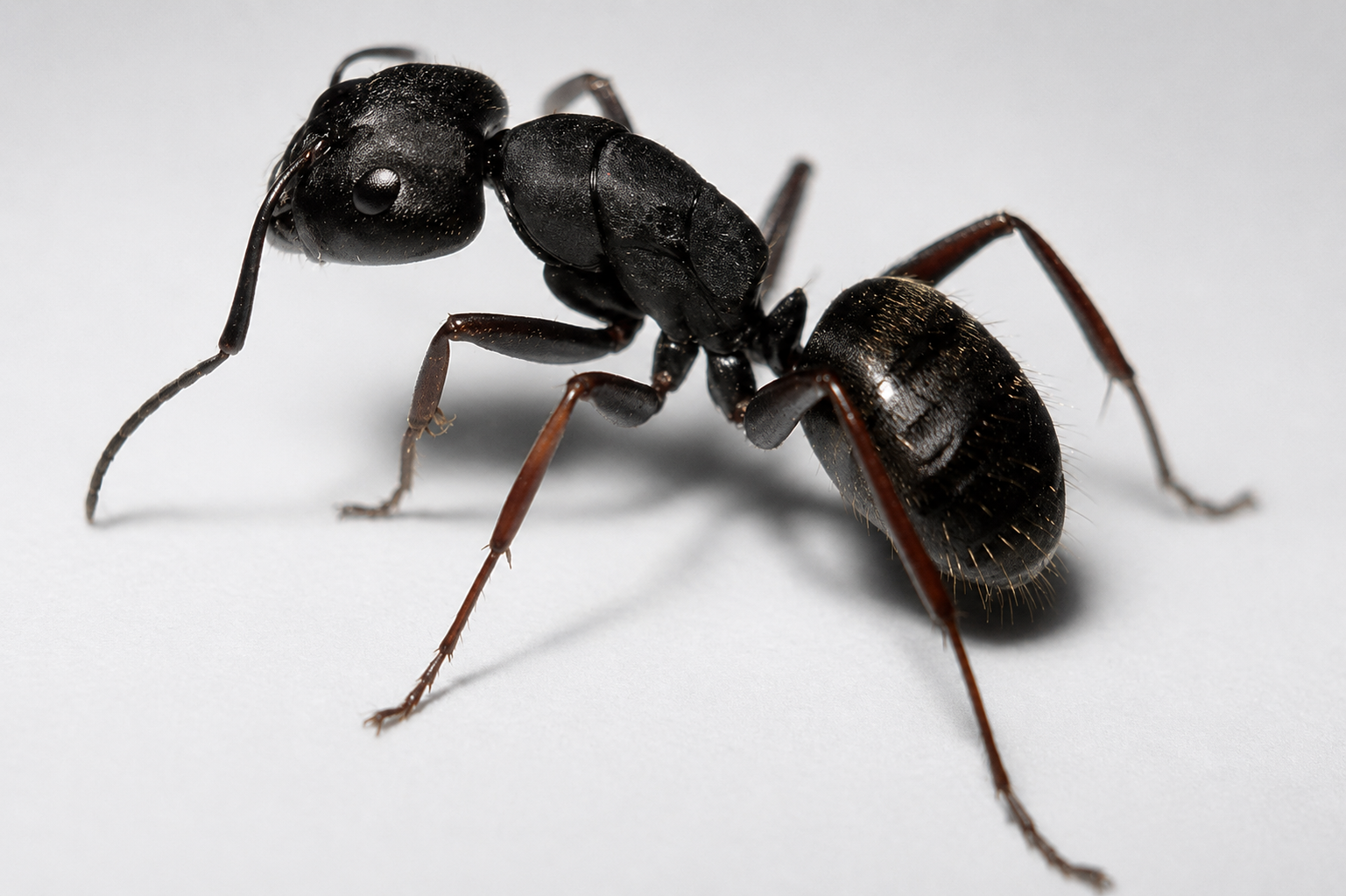
As summer temperatures climb across Southern Oregon, homeowners are once again finding large black ants making their way into kitchens, bathrooms, garages, crawl spaces, and other areas of their homes. While a single ant wandering indoors may appear harmless, repeated sightings should not be dismissed as a routine seasonal annoyance. In many cases, the insects are carpenter ants, a species capable of causing structural damage when colonies become established inside buildings.
Carpenter ants are among the largest ants found in Oregon, with workers commonly measuring between one-quarter and one-half inch in length. Most are glossy black, although some species found in the Pacific Northwest display dark reddish coloring. They are native to the region and are commonly found throughout Josephine, Jackson, Douglas, and neighboring counties, where forests, mature trees, and abundant moisture create ideal habitat.
Unlike termites, carpenter ants are not feeding on the wood itself. Their objective is to carve out smooth tunnels and chambers that serve as nesting sites for the colony. As the population grows, additional galleries are excavated, sometimes extending through wall studs, support beams, window frames, flooring systems, and other wooden structural components. Colonies often begin in wood that has already been softened by moisture, but they are capable of expanding into dry, sound lumber as nesting space becomes limited.
Water is one of the primary factors that attracts carpenter ants to residential structures. Roof leaks, plumbing leaks, damaged siding, poorly sealed windows, clogged gutters, damp crawl spaces, and inadequate attic ventilation can all create conditions that encourage nesting. Because the insects favor wood that has been weakened by prolonged moisture exposure, the appearance of carpenter ants inside a home may also indicate an underlying maintenance issue that has not yet been discovered.
Many infestations remain hidden for extended periods because the colony is concealed behind drywall, beneath flooring, inside crawl spaces, or within exterior walls. Homeowners frequently notice the ants long before they become aware of the damage taking place out of sight. By the time renovation work exposes the nest, substantial excavation may already have occurred.
Several warning signs can suggest that carpenter ants have moved beyond simply wandering indoors in search of food. Repeated sightings in the same area of the home, especially during evening hours, deserve attention. Small piles of coarse wood shavings beneath windows, door frames, or baseboards may indicate that nesting galleries are being expanded nearby. During the spring and summer, winged reproductive ants emerging indoors can signal the presence of a mature colony capable of producing additional nests.
Southern Oregon’s environment naturally supports carpenter ant populations. Dense forests, aging trees, fallen logs, woodpiles, landscape timbers, and tree stumps provide abundant outdoor nesting locations. Colonies established outside frequently send workers into nearby homes while searching for food and water. Tree branches resting against roofs, shrubs touching siding, stacked firewood placed directly against exterior walls, and untreated moisture problems can make that transition much easier.
Not every black ant found indoors is a carpenter ant. Oregon is home to several smaller ant species that invade homes while searching for food but present little or no threat to the structure itself. Correct identification is important before any treatment begins, since different species respond to different control methods. Size, appearance, nesting behavior, and the location where ants are consistently observed all provide valuable clues.
Preventing carpenter ants begins with reducing the conditions that allow colonies to become established. Promptly repairing roof and plumbing leaks, replacing water-damaged wood, improving ventilation beneath homes and inside attics, sealing exterior entry points, and trimming vegetation away from structures all reduce the likelihood of infestation. Firewood should be stored well away from the home, and dead trees or rotting landscape materials located near the foundation should be removed whenever practical.
Simply spraying ants that appear indoors rarely solves the problem. Surface insecticides may eliminate individual workers while leaving the colony untouched inside walls or in nearby outdoor nesting sites. Long-term control depends on locating the source of the infestation, eliminating the colony, and correcting the moisture conditions that attracted it in the first place.
For many homeowners, carpenter ants serve as an early indicator that something within the structure deserves closer inspection. Addressing the problem while colonies are still small can prevent extensive excavation, reduce repair costs, and eliminate conditions that allow additional infestations to develop. A handful of large black ants may seem insignificant on the surface, but overlooking the warning signs can allow hidden structural damage to continue long after the insects have disappeared from view.