


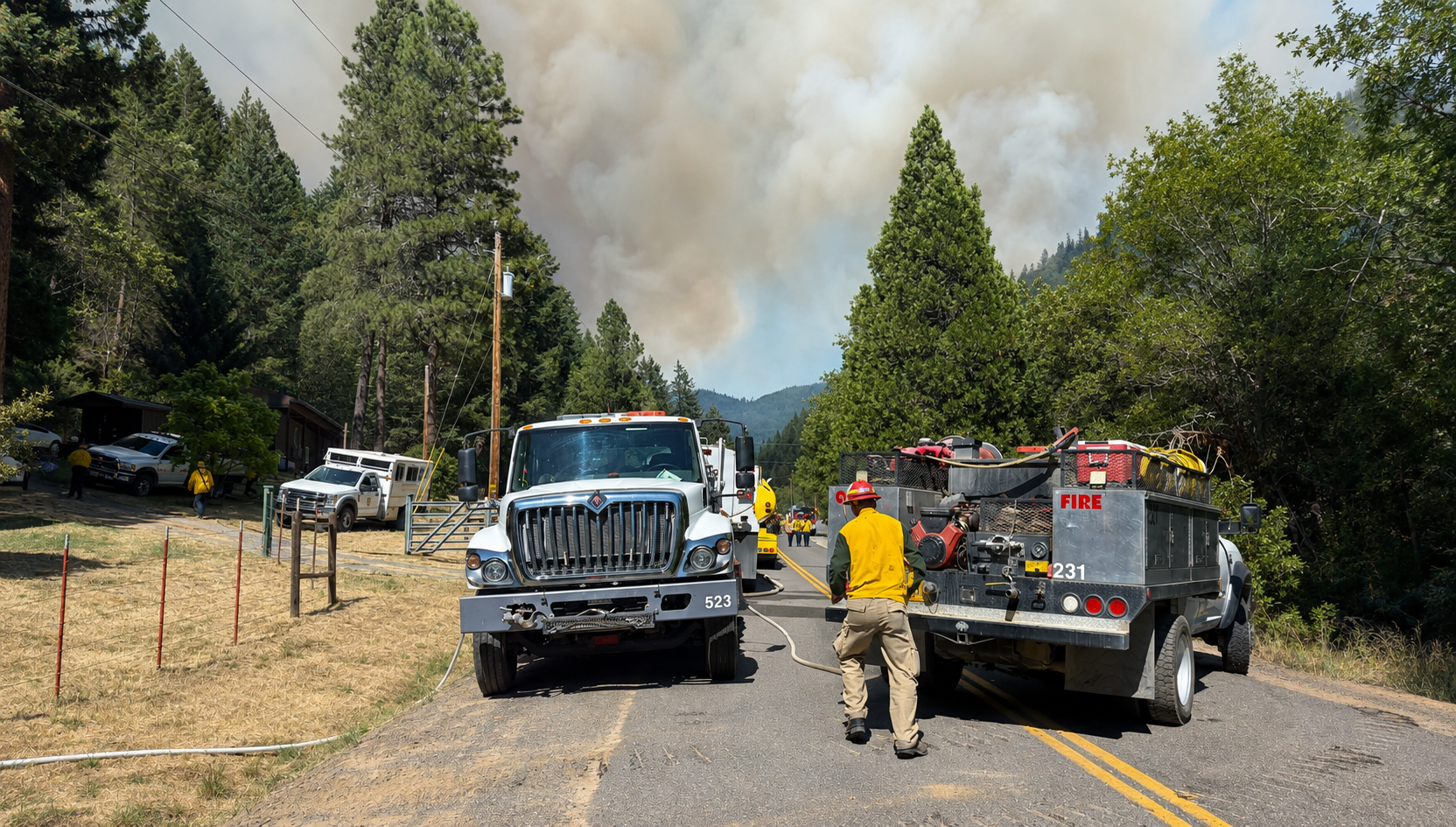
The East Evans Creek Fire has reached a significant milestone in Southern Oregon’s 2026 wildfire season, with fire managers reporting the blaze is now 66 percent contained. While the fire continues to burn within portions of its established perimeter, the latest containment figure reflects weeks of coordinated firefighting efforts that have steadily reduced the threat of uncontrolled fire growth and moved the incident into a new phase of suppression.
The wildfire has burned approximately 15,580 acres in the rugged hills west of Rogue River, where steep slopes, dense vegetation, prolonged drought conditions, and persistent summer heat combined to create challenging firefighting conditions from the earliest days of the incident. Although the acreage remains substantial, the increase in containment demonstrates that firefighters have successfully established and strengthened control lines around most of the fire’s perimeter, giving incident managers greater confidence that those sections will hold under expected weather conditions.
Containment is often misunderstood by the public. A fire that is 66 percent contained does not mean it has been extinguished or that only one-third of the fire remains burning. Instead, containment measures how much of the fire’s outer edge has been surrounded by completed control lines that firefighters believe will prevent the fire from escaping into unburned vegetation. Inside those containment lines, trees, logs, stumps, root systems, and heavy ground fuels may continue to burn for days or even weeks without posing an immediate threat to surrounding communities if they remain within secured boundaries.
As containment increases, the nature of firefighting operations changes considerably. During the early stages of a wildfire, crews focus on slowing the fire’s spread and protecting lives, homes, and infrastructure. Once a substantial portion of the perimeter has been secured, firefighters transition toward reinforcing containment lines and eliminating the hidden sources of heat that could reignite the fire if weather conditions become more favorable for fire activity.
Across the East Evans Creek Fire, firefighters continue extensive mop-up operations. Crews are digging into smoldering root systems, extinguishing burning logs, cooling hot spots, removing hazardous trees weakened by fire damage, and patrolling containment lines throughout the day. Specialized infrared technology is also being used to detect pockets of heat beneath the forest floor that cannot be identified by sight alone. Those lingering heat sources are then extinguished before they have an opportunity to produce new flare-ups.
The arrival of the Florida Complex Incident Management Team marks another transition in the incident. National incident management teams are routinely assigned to extended wildfires once initial suppression efforts have stabilized. Their role is to oversee long-term firefighting operations, coordinate personnel and equipment, manage logistics, and continue strengthening containment while local firefighting resources become available to respond elsewhere as new fires emerge across Oregon.
Despite the encouraging containment figures, fire managers continue urging caution. Southern Oregon remains under hot, dry summer weather, with critically low humidity and vegetation that can ignite quickly. Even a well-contained fire can experience isolated flare-ups as temperatures climb during the afternoon. Winds capable of carrying embers beyond established fire lines also remain a concern, requiring firefighters to patrol completed sections of containment continuously until the fire is fully secured.
Some evacuation notices remain in effect near the fire area as emergency officials continue evaluating conditions. Containment percentages alone do not determine when evacuation levels can be reduced. Officials also consider interior fire activity, hazardous trees, damaged infrastructure, road access, and the potential for changing weather before allowing residents to safely return home. Those decisions are made carefully to ensure communities are not placed back into harm’s way prematurely.
The firefighting effort continues to represent a broad partnership among local, state, and federal agencies. The Oregon Department of Forestry, Bureau of Land Management, U.S. Forest Service, Oregon State Fire Marshal, Jackson County emergency agencies, local fire districts, law enforcement personnel, and numerous mutual-aid resources continue working together under a unified command structure. Their coordinated response has been instrumental in steadily increasing containment while protecting nearby communities and critical natural resources.
Although 66 percent containment marks one of the most encouraging developments since the East Evans Creek Fire began, firefighters emphasize that their work is far from complete. The remaining uncontained sections of the perimeter continue receiving concentrated attention, while crews strengthen existing control lines and eliminate remaining hot spots across the fire area. Until containment reaches 100 percent and every section of the perimeter is considered secure, firefighters will remain on the line, monitoring conditions around the clock and working to ensure that one of Southern Oregon’s largest wildfires of the season continues moving toward full control.