


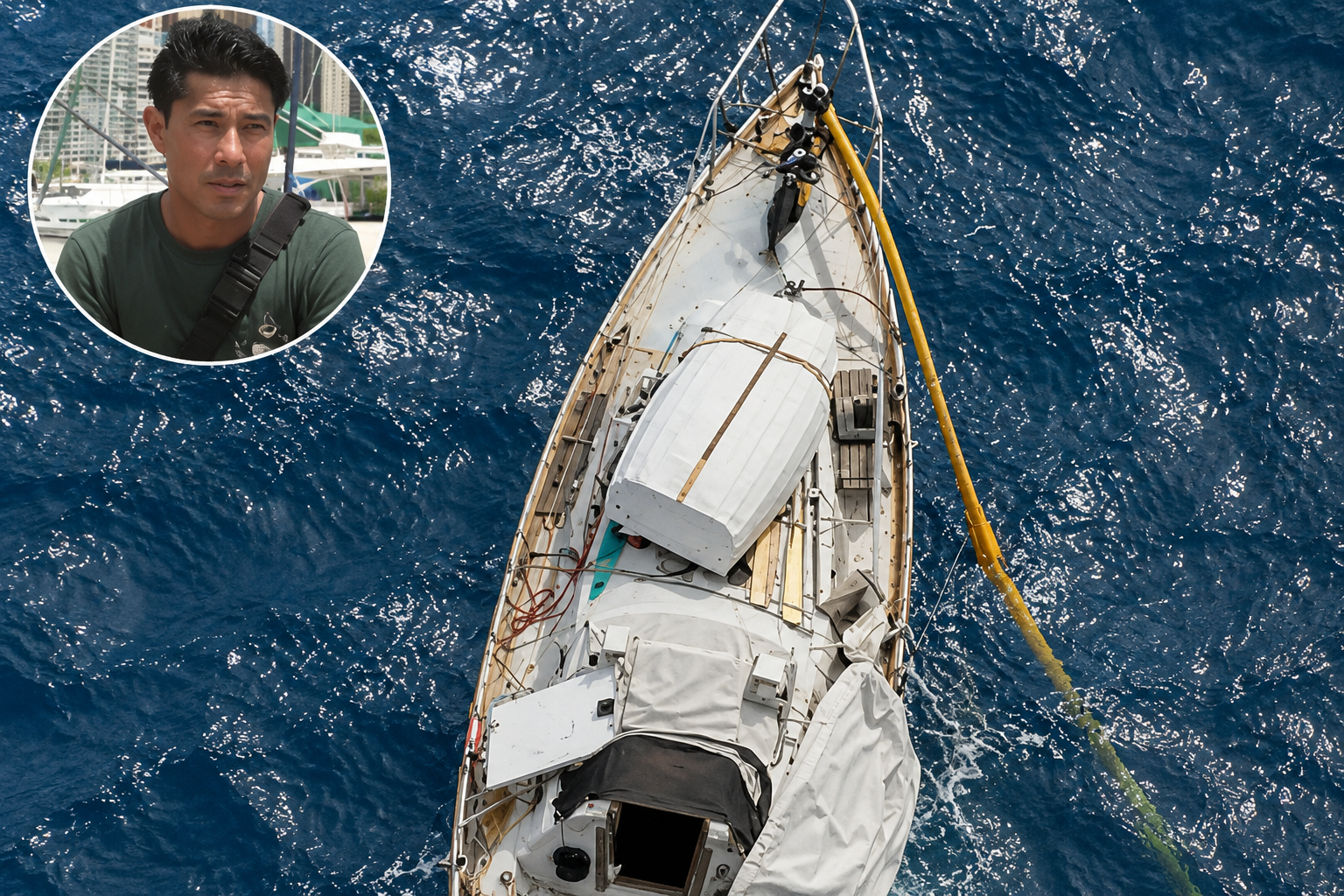
A California man who disappeared during a solo sailing voyage across the Pacific Ocean has been rescued alive after surviving more than a month at sea, bringing an extraordinary ordeal to an end and highlighting both the dangers of open-ocean navigation and the remarkable resilience of the human spirit.
Kaichi “Kai” Sato set sail from the Catalina Islands off the Southern California coast in early June with plans to complete a solo crossing to Hawaii, a journey spanning more than 2,000 miles across one of the world’s most expansive and unforgiving stretches of ocean. What began as an ambitious personal challenge quickly became a life-threatening battle for survival after severe weather crippled his sailboat hundreds of miles from land.
Roughly two weeks into the voyage, powerful conditions destroyed the vessel’s mast, eliminating its primary means of propulsion and leaving Sato with limited options. He attempted to continue under engine power and turn back toward the mainland, but eventually exhausted his fuel supply. At about the same time, his cellphone, which had served as his primary navigation and communication device, became unusable, leaving him isolated without a reliable way to call for assistance or determine his exact position.
With his boat disabled and drifting freely in the Pacific, ocean currents gradually carried both sailor and vessel farther from their intended course. Days turned into weeks as the sailboat floated across open water, where commercial traffic can be sparse and rescue opportunities exceedingly rare.
Despite the increasingly desperate circumstances, Sato refused to abandon his efforts to stay alive. Working with the limited materials available aboard the damaged vessel, he fashioned a makeshift mast using PVC pipe, kayak paddles and other salvaged equipment. The improvised rigging was far from perfect, but it provided enough control to slowly guide the disabled sailboat toward established shipping lanes used by commercial cargo vessels traveling between the U.S. mainland and Hawaii.
As the weeks passed, survival became an exercise in resourcefulness and determination. With his freshwater supply depleted, Sato developed an improvised method of collecting small amounts of drinkable water by using seawater, containers and plastic coverings to capture condensation produced by the sun. The process yielded only modest amounts of fresh water, but it proved sufficient to help sustain him during the prolonged ordeal.
His food supply also dwindled. He survived primarily on simple provisions carried aboard the boat while supplementing his meals with fish and squid that became available during the voyage. Every day required careful conservation of remaining resources while enduring the physical and emotional strain of prolonged isolation.
Equally significant was the psychological challenge. Alone on the open ocean with no certainty that anyone knew his location, Sato faced days of uncertainty and despair before resolving to focus entirely on surviving. That decision marked a turning point in the ordeal as he concentrated on repairing his vessel, conserving supplies and continuing to search for any opportunity that might improve his chances of rescue.
After drifting for more than a month, his perseverance was finally rewarded when crew members aboard a commercial cargo ship spotted the damaged sailboat approximately 900 miles from Hawaii. Recognizing that the vessel appeared disabled, the crew altered course and launched a rescue effort under challenging sea conditions.
Transferring a lone sailor from a small, weathered sailboat to a massive cargo ship required careful coordination. After multiple attempts, rescuers successfully brought Sato aboard, ending weeks of uncertainty and providing him with immediate medical attention, food, water and a safe place to recover.
Although he had lost weight and suffered from dehydration, reports indicated that Sato’s overall condition was far better than many would have expected after spending more than a month adrift in the Pacific. His rescue was widely celebrated by maritime officials, sailors and observers across the country as an extraordinary example of endurance under some of the most difficult circumstances imaginable.
The incident also serves as a reminder of the immense challenges associated with long-distance offshore sailing. Even experienced mariners can encounter rapidly changing weather, equipment failures and emergencies that develop hundreds or even thousands of miles from the nearest coastline. Modern safety recommendations encourage offshore sailors to carry multiple redundant communication and emergency signaling devices capable of transmitting distress signals through international satellite rescue networks, providing critical assistance should conventional navigation or communications fail.
Commercial shipping crews have long played an important role in maritime rescues around the world, often responding to vessels in distress when they are the closest capable responders. In Sato’s case, the vigilance of a cargo ship’s crew, combined with his own determination to remain alive, ultimately transformed what could have become a tragic disappearance into one of the year’s most remarkable survival stories.
As he continues recovering from his ordeal, Sato has indicated that the experience has not diminished his passion for sailing. Instead, his survival stands as a testament to perseverance, ingenuity and the enduring instinct to overcome even the most overwhelming odds.
For many Americans following the story, the rescue represents more than an extraordinary maritime incident. It is a powerful reminder that determination, adaptability and hope can endure even in the vast isolation of the Pacific Ocean, where one man’s refusal to surrender ultimately led him safely home.