


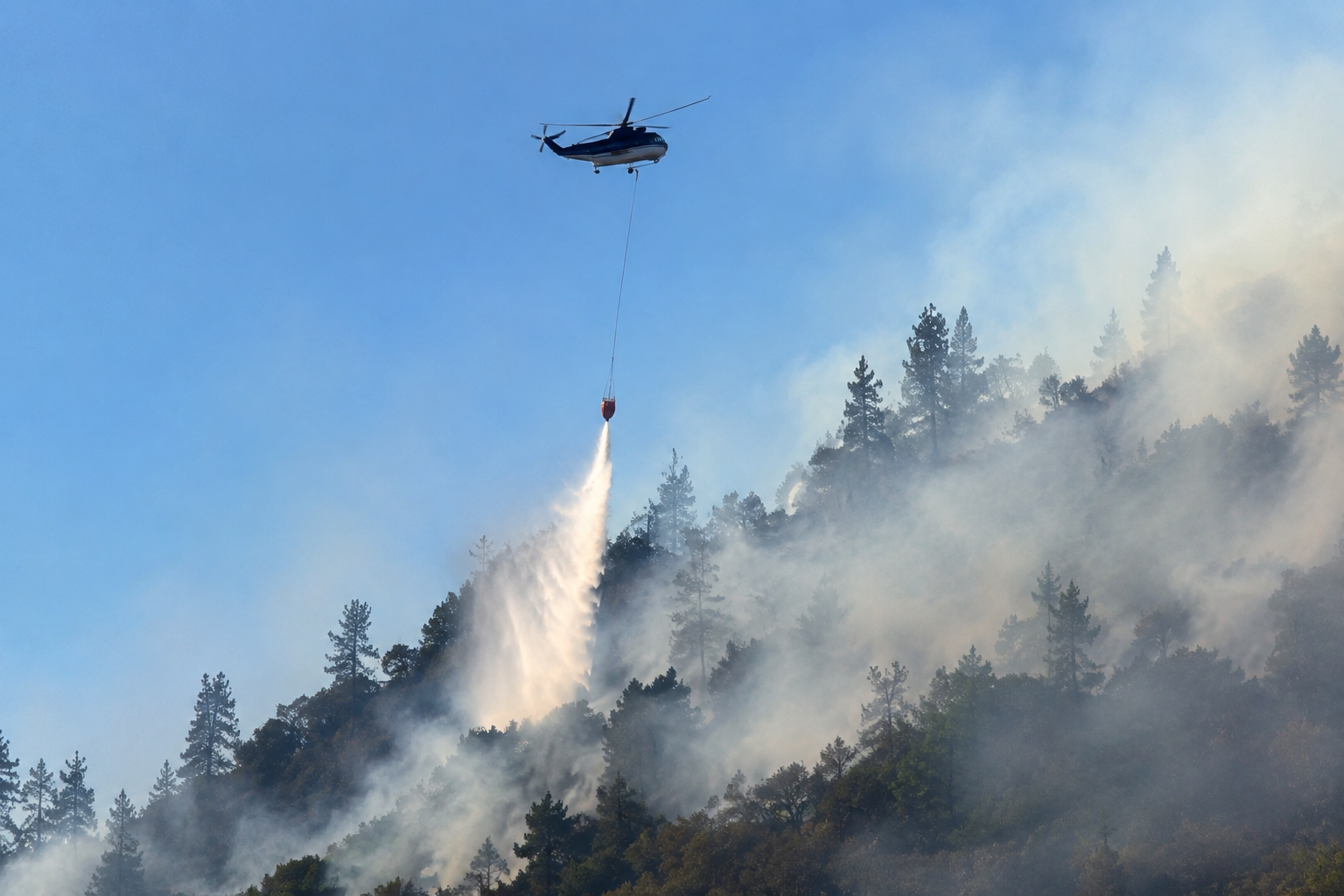
A wildfire that raced through dry grass and brush along Interstate 5 north of Grants Pass on Saturday drew one of the largest and most aggressive initial firefighting responses Southern Oregon has seen this fire season, as hundreds of firefighters, aircraft and heavy equipment converged on the rapidly expanding blaze to protect homes, slow its advance and secure threatened communities.
By late Saturday evening, the intense firefighting effort had produced encouraging results. Fire managers reported that crews had established containment line around approximately 75 percent of the fire, marking a significant turning point after several hours of relentless suppression operations on steep, wind-driven terrain.
The fire ignited Saturday afternoon near Interstate 5 at milepost 57 northbound and initially appeared to be a relatively small grass fire. Within a short period of time, however, hot weather, dry fuels and gusting winds transformed the incident into a fast-moving wildfire that demanded an immediate and substantial response from the Oregon Department of Forestry Southwest Oregon District and numerous partnering fire agencies.
As flames spread across the hillside, firefighters attacked the fire from every available angle. Ground crews worked through rugged terrain constructing containment lines while bulldozers carved protective barriers ahead of the fire’s advance. Water tenders supplied engines operating throughout the incident, while hand crews moved methodically across difficult slopes to secure fireline and extinguish burning vegetation.
The response from the air was equally extensive. Fire managers quickly deployed both of ODF Southwest’s Type 2 helicopters before ordering a third helicopter as fire activity intensified. Multiple Large Air Tankers and a Very Large Air Tanker soon joined the operation, delivering repeated retardant drops designed to slow the fire’s movement and provide firefighters on the ground additional opportunities to strengthen containment. Helicopters continued making bucket drops throughout the afternoon while Air Attack aircraft coordinated the complex aerial operation overhead.
As the incident continued to evolve, additional firefighting resources arrived from across the region. Multiple Type 6 wildland engines reinforced suppression efforts while two Modular Airborne FireFighting System aircraft added military-supported aerial firefighting capability during one of the busiest periods of Oregon’s wildfire season.
Fire officials estimated the blaze at approximately 60 acres during the late afternoon before revising that estimate upward to between 75 and 80 acres as more accurate mapping became available. Although the increase reflected improved assessment rather than explosive overnight growth, the fire’s rapid expansion underscored how quickly conditions can deteriorate during Southern Oregon’s peak fire season.
Despite the fire’s aggressive behavior during the afternoon, firefighters steadily shifted the momentum in their favor. By early evening, crews had constructed containment line around roughly 30 percent of the fire using a combination of hand-built and dozer-constructed fireline. As additional personnel arrived and aerial suppression continued, firefighters were able to strengthen those lines and reduce active fire behavior across much of the incident.
By Saturday night, fire officials reported that the most active fire behavior had become concentrated along a single portion of the fire’s upper flank, allowing suppression resources to focus on the remaining areas of concern while aircraft gradually reduced their operations.
Officials also confirmed that no additional structures had been lost after initial reports indicated one residence had been destroyed earlier in the incident. Firefighters remained committed to structure protection throughout the evening, successfully defending nearby homes while continuing to build containment around the fire’s perimeter.
Rather than scaling back operations after sunset, firefighters prepared for an equally demanding overnight assignment. Cooler nighttime temperatures and increasing humidity provided more favorable firefighting conditions, allowing fresh crews to capitalize on the progress already made during the day.
Five bulldozers, five water tenders and five twenty-person hand crews assumed overnight responsibilities, focusing on reinforcing containment lines, extinguishing hotspots, removing hazardous fire-weakened trees and securing every section of the established perimeter before warmer daytime conditions returned.
Fire managers also deployed an unmanned aircraft equipped with infrared imaging technology to map the fire more accurately and identify lingering hotspots hidden beneath smoke and vegetation. That information is expected to provide firefighters with a clearer picture of remaining problem areas as operations continue.
Throughout the incident, evacuation orders issued by the Josephine County Sheriff’s Office remained in effect for threatened areas surrounding the fire. Residents were urged to remain alert, continue monitoring official evacuation information and avoid returning to affected neighborhoods until authorities determine it is safe to do so.
A Temporary Flight Restriction also remains in place above the fire. Officials continue reminding the public that flying recreational drones anywhere near an active wildfire creates a serious safety hazard. Unauthorized drones can force firefighting aircraft to leave the airspace immediately, delaying suppression efforts during some of the most critical moments of an incident.
Although firefighters made substantial progress before nightfall, the work is far from complete. Fire crews will continue strengthening containment, extinguishing hotspots and monitoring the perimeter until the threat of additional fire spread has been eliminated. Updated fire mapping and revised acreage estimates are expected as infrared data collected overnight is analyzed.
For firefighters who have spent the summer battling one wildfire after another across Southern Oregon, Saturday’s incident served as another reminder that even a seemingly routine roadside grass fire can escalate into a major emergency within minutes. It also demonstrated the speed, coordination and determination of the region’s firefighting agencies, whose rapid response helped prevent an already dangerous wildfire from becoming far more destructive.