


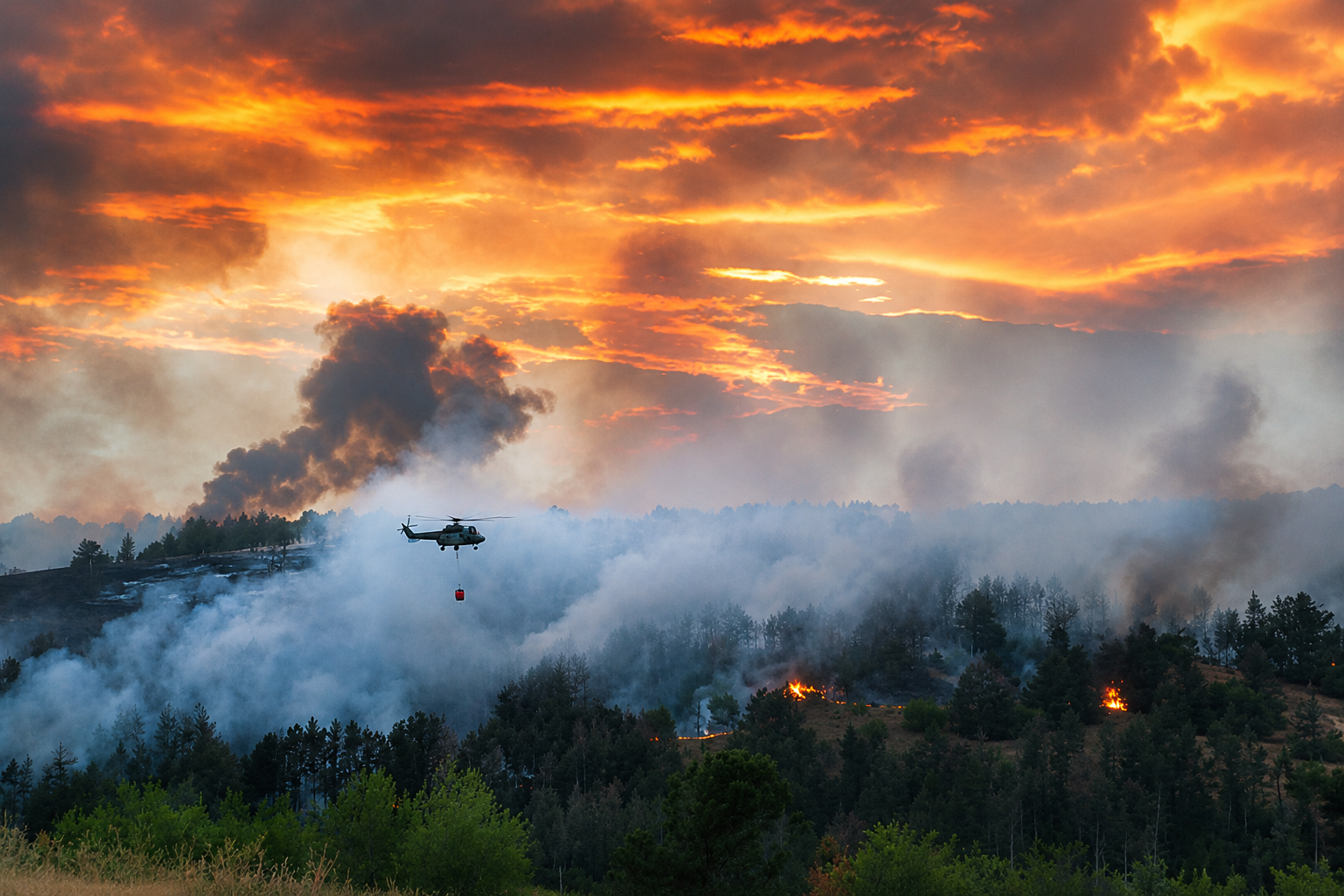
A rapidly expanding wildfire emergency in eastern Washington has forced one of the largest evacuations in the state’s recent history, leaving tens of thousands of residents displaced while hundreds of homes and businesses have been reduced to ash. The unfolding disaster near Spokane highlights the growing challenges facing communities across the Pacific Northwest as another intense wildfire season stretches firefighting resources across multiple states.
Emergency officials reported that approximately 60,000 people were placed under evacuation orders as several fast-moving fires swept across neighborhoods surrounding Spokane, Washington’s second-largest city. At least 600 homes, businesses and other structures have been destroyed, although that figure is expected to rise as firefighters gain access to additional burned areas and complete damage assessments. The fires remain active in several locations, preventing authorities from conducting comprehensive inspections throughout the affected communities.
The Spokane-area fires ignited during a period of exceptionally dangerous weather conditions that combined high temperatures, critically low humidity and wind gusts approaching 45 miles per hour. Those conditions allowed flames to spread rapidly through dry vegetation while wind-driven embers ignited new fires well ahead of the main fire front. Within hours, residential neighborhoods, commercial properties and open rangeland were engulfed, forcing emergency officials to issue widespread evacuation orders across the region.
Thousands of firefighters from local, state and federal agencies continue battling multiple fire fronts while aircraft, bulldozers and specialized incident management teams work to slow the advancing flames. Washington officials have activated the National Guard, requested additional federal assistance and accepted firefighting resources from neighboring states as crews attempt to protect homes and critical infrastructure. Emergency shelters remain open for displaced residents while utility companies work to restore electrical service to thousands of customers affected by damaged transmission lines and other fire-related outages.
Fortunately, despite the extensive destruction, authorities have not reported widespread fatalities directly linked to the Spokane-area fires. Emergency responders continue conducting search operations in evacuated neighborhoods while firefighters work to eliminate immediate threats before residents are allowed to return home. Officials caution that hazardous conditions, including unstable structures, downed power lines and lingering hot spots, continue to pose significant risks throughout the burn areas.
The destruction in eastern Washington reflects a broader wildfire crisis unfolding across the western United States. More than 390 square miles have burned throughout Washington during the current fire activity, with numerous fires remaining only partially contained or completely uncontained. Simultaneously, large fires continue burning across Oregon, Idaho, Montana, California, Utah and several other western states, creating unprecedented demands on firefighting personnel and equipment.
For residents of Oregon, the events unfolding north of the Columbia River carry particular significance. Oregon has spent much of the summer confronting its own major wildfires, including large incidents that have threatened communities, closed highways, reduced air quality and prompted evacuation notices in several regions. Southern Oregon, central Oregon and eastern Oregon have all experienced periods of heightened fire danger, with prolonged heat, persistent drought and gusty afternoon winds creating conditions favorable for rapid wildfire growth.
Although the Spokane fires have become one of the most destructive wildfire events of the season because of the concentration of homes lost in a densely populated area, Oregon has faced many of the same environmental challenges. Fire managers in both states continue monitoring critically dry forests and grasslands while warning residents that even a single spark can develop into a fast-moving wildfire under current conditions.
Smoke from large fires throughout Washington, Oregon and neighboring states has also become a regional concern. Changing wind patterns have carried smoke hundreds of miles across the Pacific Northwest, periodically reducing air quality in communities far removed from the active fire zones. Health officials continue encouraging individuals with respiratory or cardiovascular conditions to monitor local air quality advisories whenever smoke concentrations increase.
Meteorologists indicate that the wildfire threat is likely to continue until meaningful rainfall arrives across much of the Northwest. Forecasts continue calling for periods of hot temperatures, low relative humidity and occasional wind events capable of producing dangerous fire behavior. Even where firefighters have gained ground, officials warn that existing fires can quickly become active again if weather conditions deteriorate.
The emergency in Washington serves as another reminder that wildfire season has become an increasingly regional challenge rather than an isolated local event. As Oregon and Washington continue sharing firefighting resources, aircraft and specialized personnel, both states remain united by the same objective: protecting lives, defending communities and bringing some of the West’s most destructive wildfires under control before additional neighborhoods are threatened.