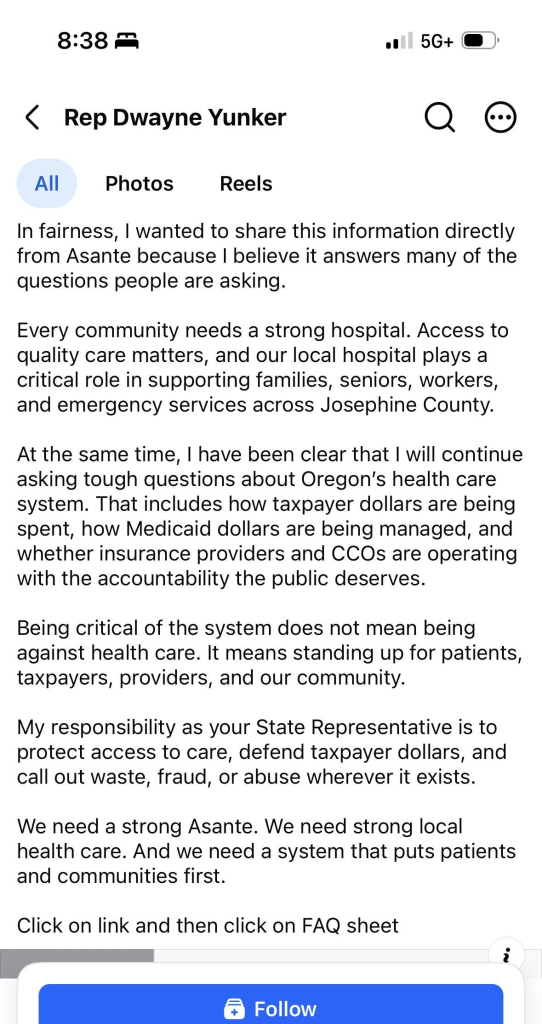
Oregon State Representative Dwayne Yunker has built a public social media presence around the authority, visibility and influence of elected office. Under the name “Rep. Dwayne Yunker,” he has announced state funding, discussed legislation, promoted government projects, commented on public policy and presented himself as the voice of House District 3 in Salem. He has also invited the public to react to questions involving taxes, elections, health care, transportation and local government.
That record makes the reported blocking of constituents and a local political organization more than an ordinary Facebook disagreement. It raises a serious question about whether an elected representative is using the reach of public office to invite favorable participation while shutting the door on criticism.
The Josephine County Democratic Party has accused Yunker of blocking its organizational Facebook account and the personal account of Communications Chair Erin Cook after the organization challenged material published on his page. Cook alleges that other constituents have also been blocked after disputing statements they believed were inaccurate, discriminatory or inflammatory.
Those remain allegations, and Yunker should be given an opportunity to answer them fully. The material supplied with the complaint, however, establishes that the account at issue has repeatedly been used to discuss Yunker’s work as a state representative.
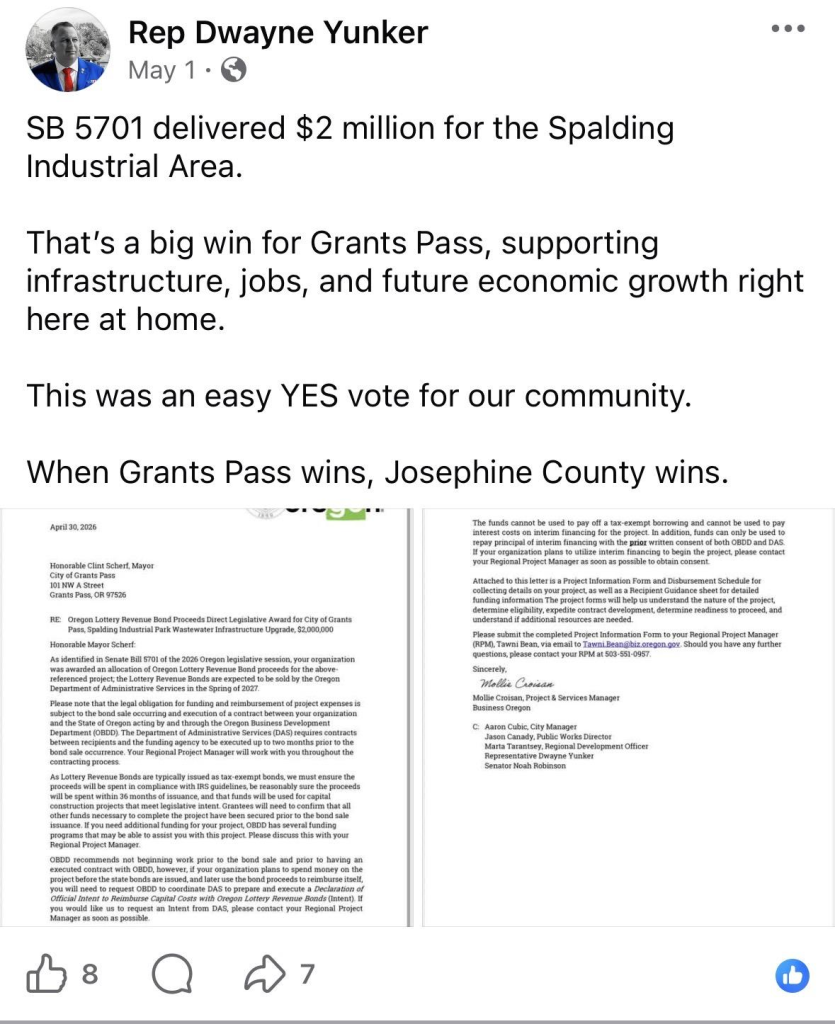
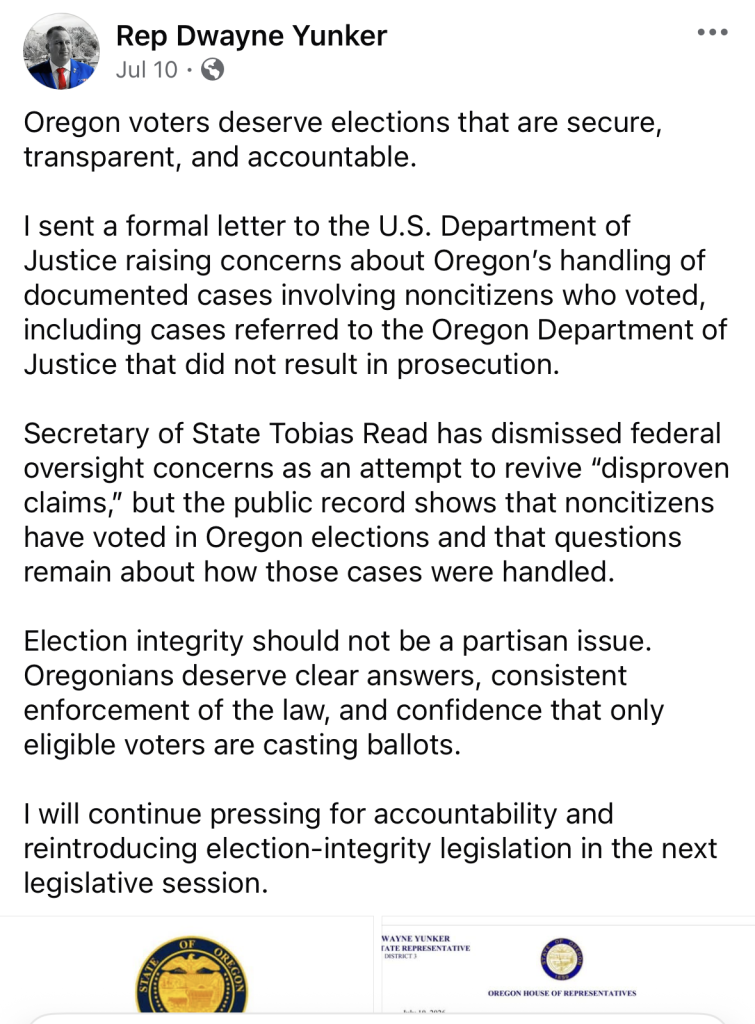
The exhibits show posts about legislative votes, public funding, state programs, election administration and government projects. In one post, Yunker announced that Senate Bill 5701 had delivered $2 million for the Spalding Industrial Area and described the funding as a victory for Grants Pass. In another, he discussed a formal letter he sent to the U.S. Department of Justice regarding Oregon elections and promised to introduce election legislation during a future legislative session.
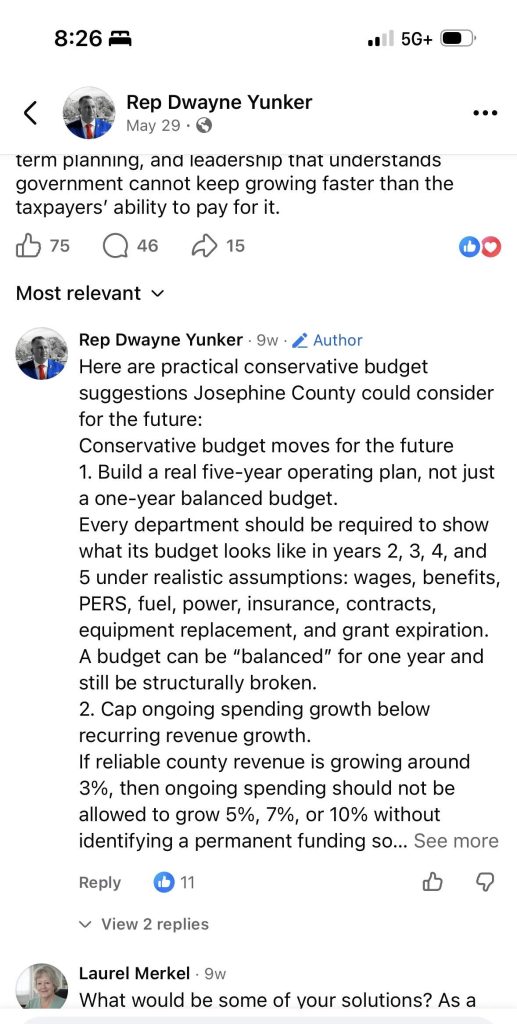
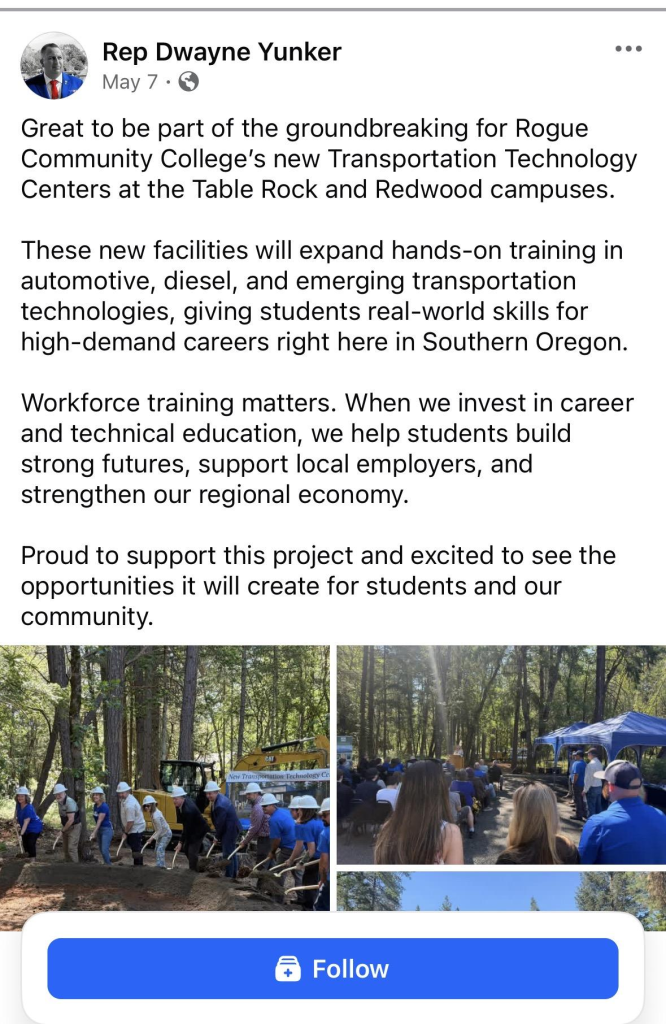
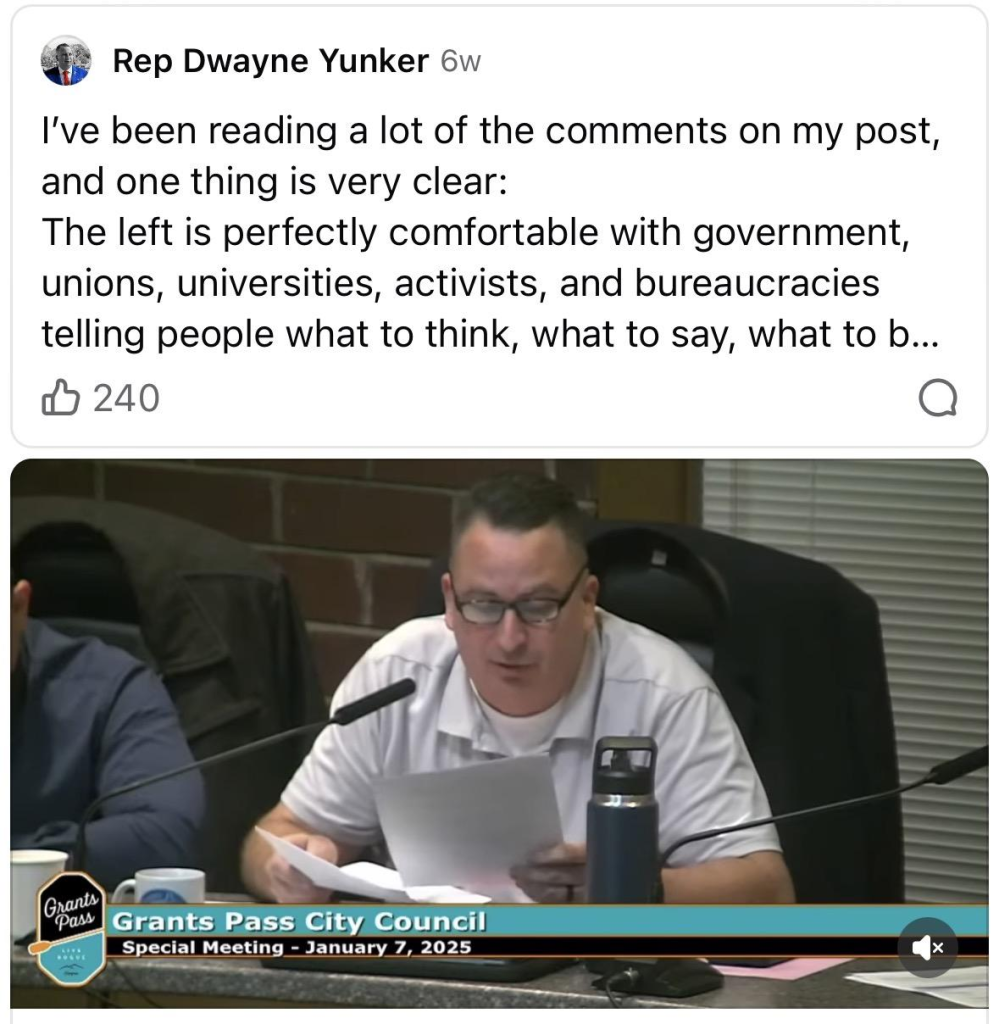
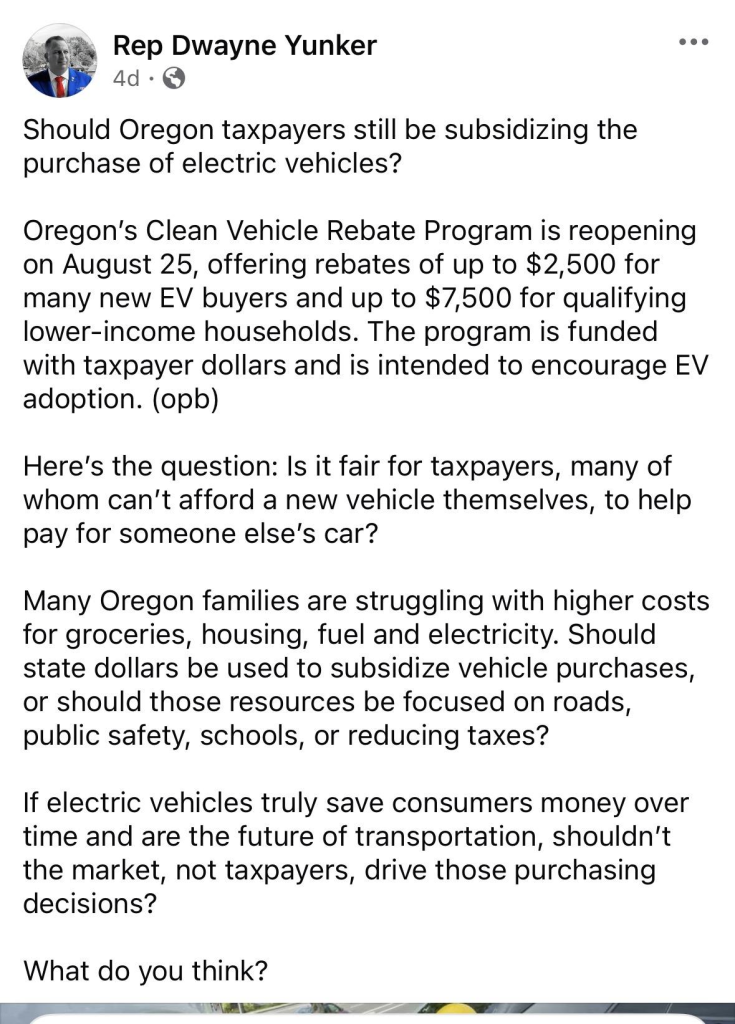
Other posts addressed Oregon’s electric vehicle rebate program, health care services provided by Asante, budget proposals for Josephine County and the groundbreaking of Rogue Community College transportation technology centers. Yunker also used the page to describe his responsibilities as a state representative and to explain what he believed government agencies should do.
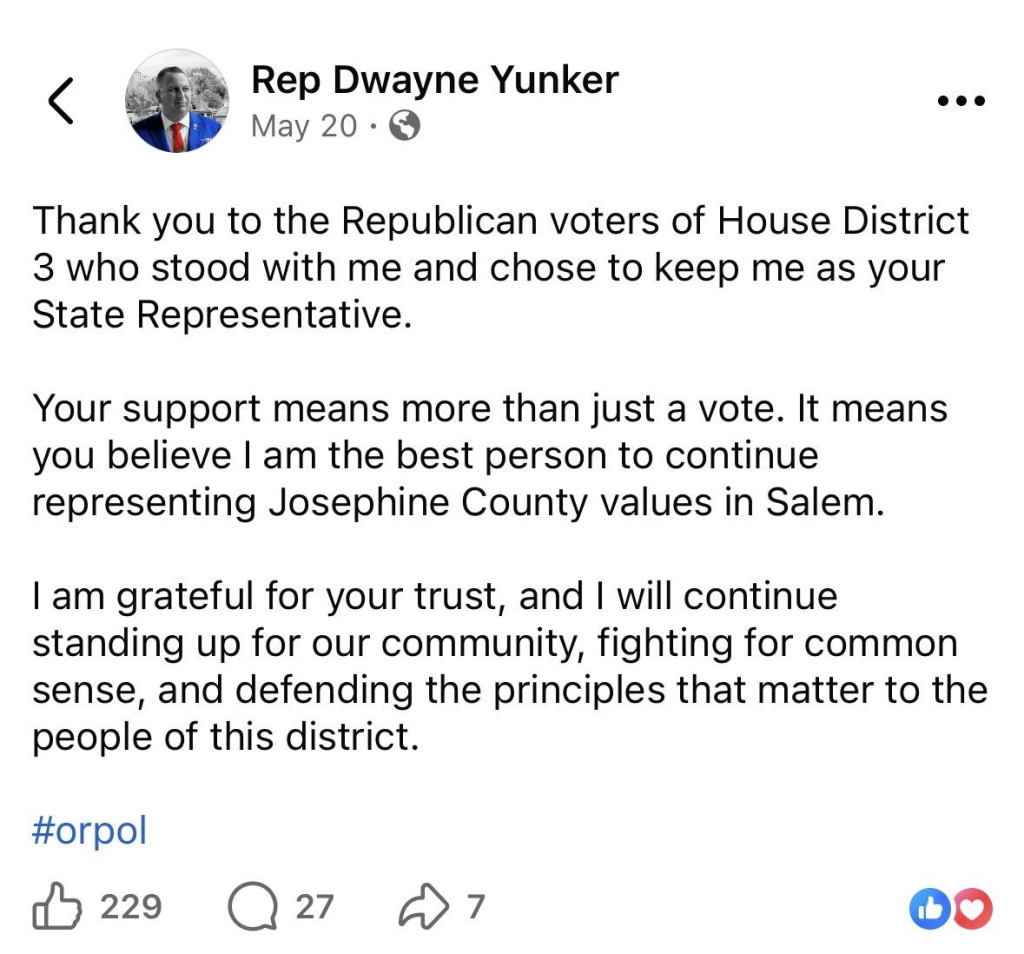
A May 20 post further illustrates the blended identity of the account. Writing under the title “Rep. Dwayne Yunker,” he thanked Republican primary voters for choosing to keep him as their state representative and pledged to continue representing Josephine County in Salem. The message was political, but it was inseparable from his elected title and continued service in office.
Yunker currently represents Oregon House District 3, encompassing Grants Pass and much of Josephine County, but his path to the Legislature began through an appointment rather than an election. On December 21, 2023, the Josephine County Board of Commissioners selected Yunker to fill the House seat vacated by former State Representative Lily Morgan. The appointment came on a 2 to 1 vote, with then commissioners John West and Herman Baertschiger casting the two votes that placed Yunker in the Legislature and Commissioner Dan DeYoung voting against his selection. Before moving to the state level, Yunker served on the Grants Pass City Council and has maintained a professional presence in the local real estate industry. He is also associated with Yunker Properties LLC in Grants Pass, where he is listed as the company’s registered agent. Yunker later continued his service in House District 3 through the electoral process.
The complaint argues that Yunker cannot use an account to announce government work, speak in his official capacity and invite public engagement, then transform it into a private campaign space merely by changing its description when criticism becomes inconvenient.
According to Cook’s letter, Yunker declared on June 14 that the Facebook page was an official campaign page rather than a forum for state business. The organization disputes that characterization, pointing to the continued use of the title “Rep. Dwayne Yunker” and the page’s extensive collection of posts addressing legislative duties and government actions.
The organization also alleges that this was not the first time Yunker blocked it. Cook said she previously contacted him after an earlier block and supplied information concerning First Amendment protections for people participating on official social media pages. According to Cook, access was promptly restored at that time.
Cook contends that the organization was blocked again after challenging a more recent post that it considered homophobic. She further alleges that her personal account was blocked and that Yunker later created another official social media page. The documents provided do not independently establish Yunker’s motive for creating another account, nor do they prove that every reported block occurred because of political disagreement. Those questions require a response from Yunker and a review of complete account records.
The constitutional issue is more precise than the complaint sometimes suggests. The U.S. Supreme Court did not rule in Lindke v. Freed that every social media account belonging to a public official automatically becomes a public forum. Instead, the court established a two-part inquiry. A public official’s social media conduct may constitute government action when the official has actual authority to speak for the government on the subject and purports to exercise that authority in the relevant posts.
The court also recognized the danger created by mixed-use accounts. Because blocking can prevent a person from participating across an entire page, an officeholder who combines official announcements with private or campaign speech may expose official communications to the consequences of a page-wide block. Simply calling an account private does not necessarily settle the matter. Courts examine authority, presentation, content and the manner in which the account is actually used.
That analysis places Yunker’s conduct under a legitimate public microscope. The page does not appear limited to family photographs, campaign fundraising or personal commentary. It contains statements about legislation, public money, government responsibilities and actions performed in his elected capacity. When a representative presents those subjects to the public, the ability of constituents to respond cannot be treated as a privilege reserved for those who agree.
An elected official has every right to establish reasonable rules against threats, harassment, spam and unlawful conduct. Public service does not require accepting abuse. But disagreement, fact-checking and criticism are not automatically harassment. Government officials are not entitled to convert public communication into a controlled applause line.
The letter asks Oregon House leadership and Legislative Counsel to examine the matter, direct the restoration of access, consider a formal reprimand and refer the conduct for an ethics review. It argues that official communication channels should not be “weaponized for selective censorship.”
Whether those particular remedies are warranted must be determined through a fair process. Legislative leaders would need to examine which accounts were blocked, when the restrictions occurred, what comments preceded them, how Yunker represented each page and whether the blocked users lost access to posts carrying official government information.
The material provided does not establish that Yunker violated the Constitution as a matter of law. That conclusion belongs to a court following a fact-specific inquiry. It does establish enough to warrant direct answers.
Yunker should explain who was blocked, why each block occurred, whether the restrictions remain in place and which of his pages he considers official, personal or campaign-operated. He should also explain why material involving state funding, legislative action and constituent policy discussions appeared on a page later described as campaign property.
The stronger issue stands without that comparison. A state representative entrusted with public authority should not blur the line between public service and political control, particularly when that ambiguity determines who may speak and who is silenced.
House District 3 residents do not surrender their right to question an elected representative because their criticism is uncomfortable, politically inconvenient or unwelcome. Yunker may ultimately demonstrate that the accounts were private, that the blocks were imposed for legitimate reasons or that the complaint mischaracterizes what occurred. Until he provides that explanation, the record presents a troubling picture of an officeholder using an account saturated with official business while attempting to reserve the power to exclude dissenters.
Public office demands more discipline than that. It requires transparency, consistency and respect for the constitutional limits attached to government authority. When an elected representative invites the public into a forum built around his official title and legislative work, he cannot reasonably expect accountability to disappear when the responses become critical.
Photo and Document Disclaimer: Images and screenshots accompanying this article are reproduced from materials provided to the Grants Pass Tribune and included as exhibits in correspondence concerning the matters reported herein. They are presented solely for news reporting, documentation, and public-interest purposes. The Grants Pass Tribune did not create the original social media posts, captions, photographs, or other content depicted in these images and does not independently adopt, endorse, or verify every statement appearing within them. Publication of these materials is intended to provide readers with relevant context concerning the subject of this report and should not be construed as an assertion of wrongdoing or a determination of any legal, ethical, or constitutional claim.