


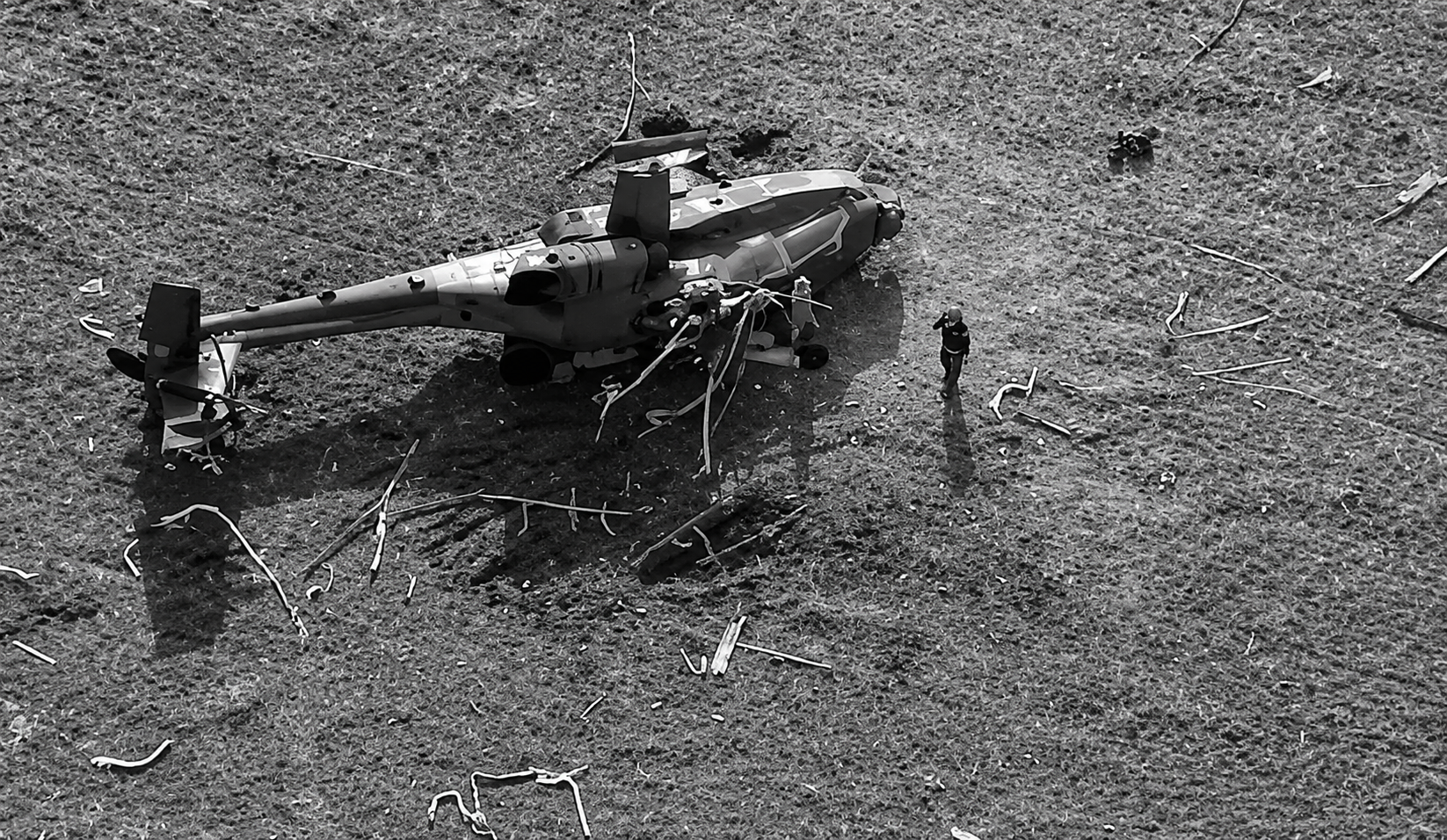
Two aviation crew members assigned to one of the largest wildfires burning in the western United States were killed after their heavy-lift firefighting helicopter crashed while working the Widemouth 2 Fire in central Utah, authorities confirmed Saturday.
The Sikorsky S-64 Skycrane went down Friday morning while supporting suppression operations on the Widemouth 2 Fire, a lightning-caused wildfire burning across the Fishlake National Forest and surrounding areas. The aircraft was operated by Helicopter Transport Services under contract with the U.S. Forest Service.
Federal aviation authorities reported that the helicopter crashed near Richfield with two people aboard. The accident occurred within an active wildfire environment where difficult terrain, smoke and rapidly changing fire conditions complicated the emergency response.
The impact ignited vegetation around the wreckage, creating an additional fire that subsequently burned into the existing Widemouth 2 Fire. Conditions surrounding the crash site were initially too dangerous for emergency personnel to safely reach the aircraft.
Firefighters and rescue personnel continued efforts to gain access while suppression operations remained underway throughout the area. Crews were eventually able to reach the wreckage Saturday, when authorities confirmed that both people aboard had died. Recovery operations were subsequently completed, and the remains were transported for examination.
The identities of the two crew members had not been publicly released immediately following confirmation of their deaths as authorities worked through notification procedures.
The crash occurred during an extensive aerial and ground campaign against a wildfire that has expanded dramatically since it was first detected July 27. The Widemouth 2 Fire was started by lightning and spread rapidly through portions of central Utah as firefighters encountered periods of extreme fire behavior, strong winds and dry vegetation.
By the weekend, the fire had burned approximately 115,000 acres, or nearly 180 square miles, with containment approaching one-quarter to slightly more than one-quarter of the perimeter as crews continued suppression work. Acreage and containment figures have changed repeatedly as mapping improves and firefighters establish additional control lines.
Hundreds of personnel have been assigned to the incident, supported by engines, heavy equipment and aircraft. The size and location of the fire have required a coordinated response involving federal, state and local agencies as crews work to protect communities, infrastructure and natural resources.
Heavy helicopters such as the Sikorsky S-64 occupy a specialized role in large wildfire operations. The aircraft is designed for heavy-lift missions and can be configured to carry substantial quantities of water for repeated drops over active fire areas. Its capabilities allow incident commanders to place water in locations that may be difficult for engines or firefighters on the ground to reach.
The cause of Friday’s crash has not been determined.
The National Transportation Safety Board is investigating the accident, with the Federal Aviation Administration also involved in the federal response. Investigators are expected to examine the wreckage and available operational information as part of the effort to determine what happened before the aircraft went down.
No official determination has been made regarding whether mechanical problems, environmental conditions, flight operations or another factor contributed to the crash. Aviation accident investigations can require months or longer to complete, particularly when aircraft wreckage is located within difficult terrain or an active wildfire area.
The Utah deaths occurred during a particularly hazardous period for wildfire personnel across the West.
In Oregon, 47-year-old Klamath Falls resident Jason Ensign was killed while operating a D-6 bulldozer during firefighting operations on the Wrights Spring Fire. Ensign was working in the Yahwee Plateau area when rapidly changing fire conditions cut the equipment operator off from his escape route to a designated safety zone. His death and the Utah aviation fatalities occurred within a short period as major wildfires challenged firefighting resources across several western states.
Idaho has also experienced substantial wildfire activity during the 2026 season. The Idaho Department of Lands, the state’s principal wildland fire protection agency, has been involved in responding to fire conditions within Idaho as federal, state, local and contracted resources are distributed throughout the region. Idaho officials reported nearly 243,000 acres burned statewide by early August, while the state has also taken emergency measures in response to wildfire activity and pressure on available resources.
There has been no confirmed information establishing that Idaho Department of Lands personnel or equipment were involved in the Widemouth 2 Fire or Friday’s helicopter accident.
Wildland firefighting across the West relies on an interconnected system of federal agencies, state forestry and land-management departments, local fire organizations and private contractors. Aircraft and specialized crews can be reassigned across state boundaries as incidents develop and resource needs change.
Operations on the Widemouth 2 Fire continued following the helicopter crash. Fire managers remained focused on strengthening containment lines and limiting additional growth while managing the continuing hazards created by the sprawling fire.
The investigation into the fatal helicopter crash is continuing. Federal investigators have not announced a probable cause or preliminary explanation for the accident.