


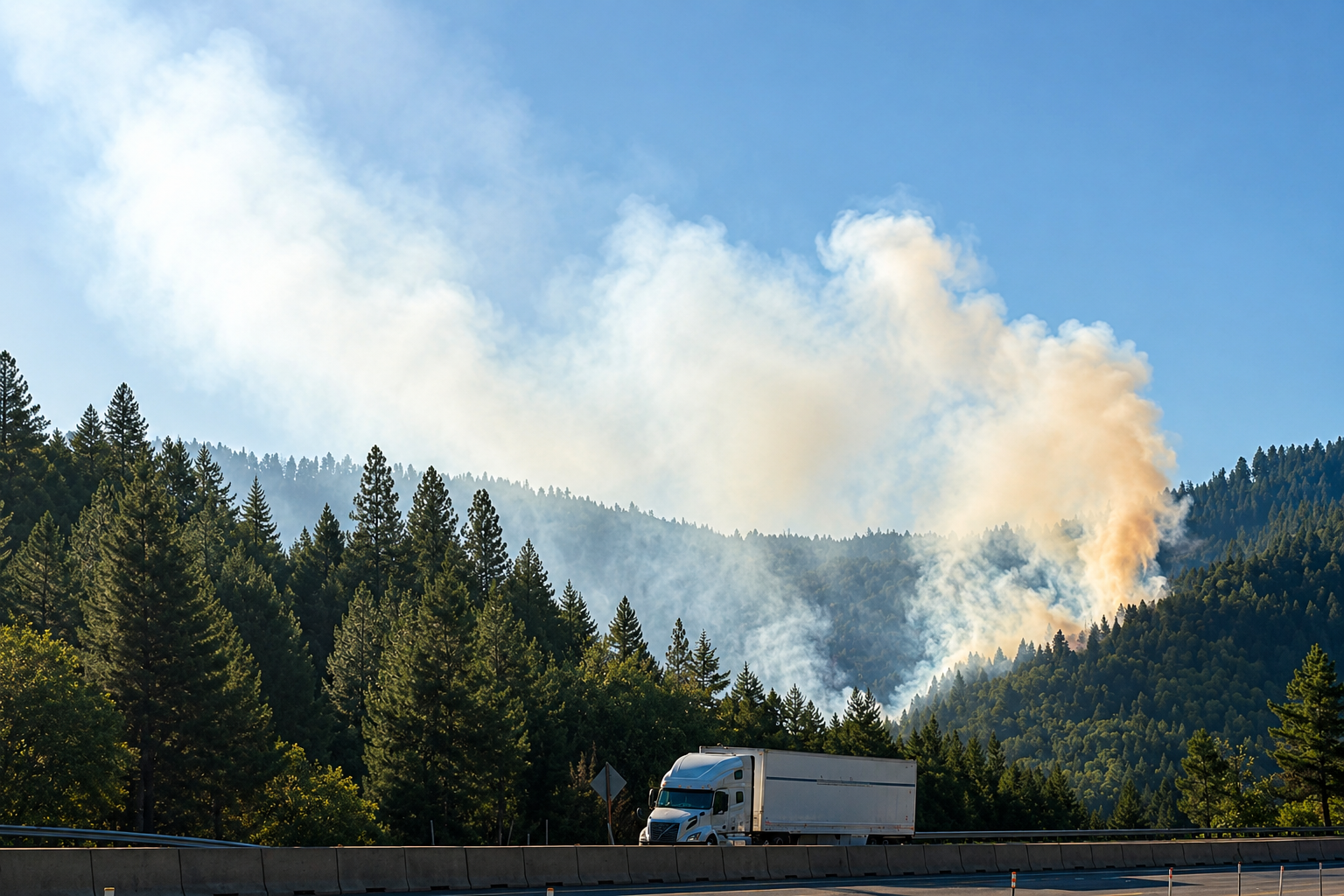
A wildfire climbing the steep hills above Interstate 5 near Wolf Creek Monday evening brought aircraft overhead, firefighters onto the slopes and another reminder that Southern Oregon remains firmly in the grip of fire season. Within hours, crews had stopped the Lower Wolf Creek Fire at just three acres. Nearly 100 miles to the east, however, hundreds of firefighters are confronting a vastly different battle as the Wrights Spring Fire continues across nearly 47,000 acres of Klamath County.
Between those two extremes, firefighters are steadily tightening their hold on the Woodrat Mountain Fire near Ruch while crews in the Illinois Valley continue securing the Fork State Park Fire near Cave Junction. Together, the incidents form the current wildfire picture across Southern Oregon, where some fires are moving toward mop-up while the region’s largest remains an expansive emergency involving evacuations, road closures and hundreds of personnel.
The newest fire erupted Monday along Interstate 5 near mile marker 76 northbound at Wolf Creek. Initially estimated at approximately one acre, the Lower Wolf Creek Fire was burning uphill through grass in steep terrain along Lower Wolf Creek Road when firefighters arrived.
Ground crews were joined by Air Attack and two Type 2 helicopters as the fire increased to an estimated five to 10 acres and burned at a moderate rate of spread. The response quickly began changing the trajectory of the incident.
By 6:35 p.m., firefighters had completed line around half of the estimated perimeter and placed hose around approximately 20 percent. Less than half an hour later, forward progression had been stopped and approximately 70 percent of the perimeter had fire line around it. Most aircraft were released as conditions improved, leaving one Type 2 helicopter available for reconnaissance and additional water drops if needed.
GPS mapping later provided a much more precise measurement than estimates made during the active initial attack. By 8 p.m., the Lower Wolf Creek Fire measured three acres and was holding within established lines.
The work did not end when darkness arrived. Two 20-person hand crews, two water tenders, one Type 3 engine and three Type 5 engines were assigned overnight to search for remaining heat, extinguish hot spots and strengthen the perimeter. No evacuation notices were reported, and the cause remains under investigation.
The successful initial attack at Wolf Creek stands in sharp contrast to conditions in Klamath County, where the Wrights Spring Fire has become Southern Oregon’s largest active wildfire.
The fire began Aug. 5 approximately two miles west of Sprague River and expanded rapidly across dry vegetation. By Monday it had reached 46,769 acres with no containment reported, transforming what began as another wildfire start into a major regional emergency. Approximately 555 firefighters and support personnel have been assigned to the incident.
Crews are working across an extensive perimeter to slow additional movement and build defensive lines between the fire and surrounding communities. Suppression work has included areas around Bliss Road, Skeen Ranch Road, Peter Steiner Road and Horton Reservoir, while structural firefighters have remained positioned near homes and other buildings that could be threatened by changing fire conditions.
Evacuation levels remain in place across portions of the affected area and have been adjusted as conditions change. Residents near Sprague River and surrounding Klamath County communities remain subject to emergency notifications and are being directed to current county evacuation information for the status of individual zones.
The fire has disrupted travel as well. Portions of Sprague River Road and Bliss Road have been closed, while fire-related restrictions remain in effect on affected lands within the Fremont-Winema National Forest. Emergency shelter has been available at Chiloquin Elementary School and Living Springs Fellowship in Bonanza, with the Klamath County Fairgrounds available for displaced livestock and large animals.
The Wrights Spring Fire has also become a deadly incident. Heavy-equipment operator Jason Ensign of Klamath Falls was killed Aug. 6 while operating a bulldozer after rapidly changing fire conditions overtook his position. Federal assistance has since been authorized to help Oregon with eligible firefighting costs. The cause of the fire remains under investigation.
Closer to the Rogue Valley, the Woodrat Mountain Fire tells a considerably more encouraging story than it did during its first hours.
The fire began Aug. 5 near Sterling Creek Road south of Ruch, spreading rapidly enough to threaten homes and eventually trigger Level 3 “Go Now” evacuation orders. It remains mapped at 282 acres but has reached 50 percent containment, with firefighters establishing hose around the perimeter and moving deeper into the burned area to extinguish lingering heat.
All evacuation notices associated with Woodrat Mountain have been lifted. With the immediate threat reduced and the fire increasingly secure, management has transitioned back to a local organization. Crews continue working through roots, stumps and other areas capable of holding heat long after open flames disappear. Its cause remains under investigation.
In Josephine County’s Illinois Valley, firefighters have also been securing the Fork State Park Fire after flames broke out Sunday near Cave Junction along the Redwood Highway corridor.
The fire began at an estimated three to five acres before increasing to approximately eight to 10 acres in grass and brush. Wind helped drive its early movement, bringing an aggressive response that included ground crews, heavy equipment and a Type 2 helicopter making water drops.
Level 2 “Be Set” evacuation notices were issued for nearby areas during the initial response. The fire also affected access to Illinois River Forks State Park, which partially reopened Monday while the southwestern portion remained temporarily closed because of the incident.
For communities across Southern Oregon, the four fires now represent four stages of the same wildfire season. At Wolf Creek, a fast initial attack kept a new ignition to three acres. Near Cave Junction, crews are securing another recent start. South of Ruch, neighborhoods that faced Level 3 evacuation orders days ago are no longer under evacuation notices. In Klamath County, meanwhile, the Wrights Spring Fire continues across tens of thousands of acres with communities still facing evacuation concerns and hundreds of firefighters working an extensive perimeter.
The distances between those fires may be considerable, but the conditions connecting them are not. August has left vegetation across Southern Oregon dry and capable of carrying fire, making the difference between a three-acre incident and a major wildfire dependent in part on terrain, weather, fuels and how quickly firefighters can safely reach and surround a new start.
Monday’s Lower Wolf Creek Fire demonstrated what can happen when that initial attack succeeds quickly. The Wrights Spring Fire, approaching 47,000 acres just days after it began, demonstrates the scale of the fight when it does not.