


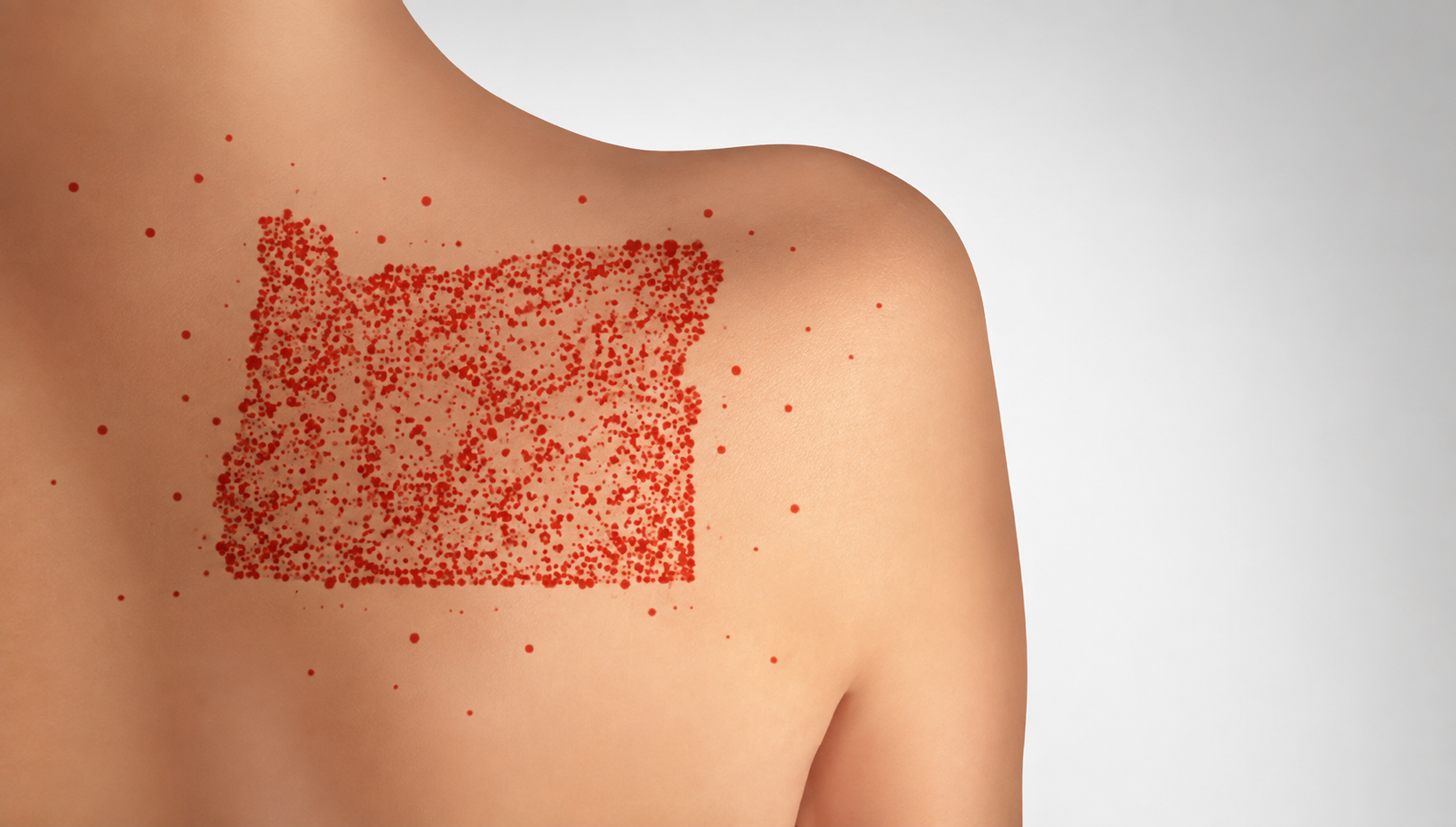
A disease the United States once pushed out of continuous circulation is making a consequential return, and Oregon is now experiencing its own share of a national measles resurgence that has already produced thousands of infections in 2026.
Oregon has recorded 45 confirmed measles cases this year, surpassing the 31 cases reported in 2024, which had been the state’s highest annual count since 1991. The increase places Oregon beyond a modern benchmark before the year is over and comes as the Centers for Disease Control and Prevention tracks widespread measles activity across much of the country.
The national figures provide the larger picture behind Oregon’s rising numbers. According to the CDC, 2,465 confirmed measles cases had been reported in the United States as of Aug. 6, already exceeding the 2,289 cases recorded during all of 2025. Cases have been reported across 47 jurisdictions, while 38 outbreaks have been identified during 2026. Approximately 94 percent of confirmed cases have been associated with outbreaks, indicating that much of the current activity involves clusters of transmission rather than isolated infections.
For a country that declared measles eliminated in 2000, those numbers represent a substantial reversal from the period when sustained domestic transmission had been interrupted. Elimination never meant measles had disappeared permanently from the United States. Travelers can carry the virus into the country, and once introduced, it can spread rapidly wherever enough susceptible people are present.
Oregon’s experience demonstrates how quickly that vulnerability can become a local public-health issue. The state entered 2026 with its first confirmed cases reported in Linn County, followed by additional cases and evidence of measles virus detected through wastewater surveillance. Oregon health authorities have since continued tracking infections and issuing notices when confirmed patients may have exposed others in public or medical settings.
Recent exposure notifications have included health-care facilities in the Portland metropolitan area. Such notices are not declarations that everyone present became infected. They identify locations and periods when an infectious person was present, allowing people who may have crossed paths with that individual to review their vaccination history, monitor their health and contact medical providers if symptoms develop.
The reason for that level of caution lies in the biology of measles itself. The virus is extraordinarily contagious and spreads through the air when an infected person breathes, talks, coughs or sneezes. Infectious particles can remain suspended in an enclosed space for as long as two hours after the infected individual has departed. Among susceptible people with close exposure, transmission can occur at rates approaching 90 percent.
That means an infected person does not need to shake hands, share food or have prolonged physical contact with someone else to transmit the disease. A shared indoor environment can be enough under the right conditions, particularly when people without immunity are present.
Symptoms do not necessarily appear immediately. According to public-health guidance, illness generally develops seven to 21 days after exposure and commonly begins with fever, cough, runny nose and red or irritated eyes. The recognizable measles rash usually follows, beginning around the face or head and spreading downward across the body.
Transmission can begin before that rash provides an obvious warning. People with measles are generally considered infectious beginning approximately four days before the rash appears and continuing for about four days afterward. That window gives the virus an opportunity to spread while an infected person may believe he or she has an ordinary respiratory illness.
Measles can also produce complications beyond its familiar rash and fever. Pneumonia is among the more serious complications, while inflammation of the brain can occur in rare cases. Infants and young children, pregnant people, adults older than 20 and people with weakened immune systems face greater risks of serious illness.
The CDC continues to identify vaccination as the most effective protection against infection. One dose of the measles, mumps and rubella vaccine is approximately 93 percent effective at preventing measles, while two doses are approximately 97 percent effective. No vaccine provides absolute protection, but infections among appropriately vaccinated people remain uncommon.
The resurgence is occurring while childhood vaccination coverage has declined nationally. CDC figures show MMR coverage among kindergartners fell from 95.2 percent during the 2019-20 school year to 92.5 percent during 2024-25. The difference may appear small, but measles spreads so efficiently that maintaining approximately 95 percent vaccination coverage is considered important for preventing sustained community transmission.
Oregon’s 45 confirmed cases should also be viewed carefully in historical context. The current total has surpassed the 31 cases recorded in 2024, previously Oregon’s highest annual number since 1991. It would not be accurate, based on that comparison alone, to describe 2026 as the worst measles year in Oregon history. What the numbers do establish is that the state has moved beyond its highest annual total in more than three decades.
Health authorities are also asking residents to use caution if symptoms develop after a possible exposure. Someone who believes measles is possible should call a physician, clinic, urgent-care center or hospital before arriving. Advance notice allows medical personnel to arrange an entrance and examination process designed to prevent an infectious patient from exposing other patients, employees and visitors.
For Oregon residents, the 2026 numbers mark a measurable change in a disease that many Americans have rarely encountered firsthand. Forty-five confirmed cases in Oregon are unfolding within a national count already measured in the thousands, while outbreaks continue across most of the country.
The CDC’s figures make clear that measles is no longer merely a disease Americans read about in history books or associate primarily with outbreaks elsewhere in the world. It is circulating again in the United States, Oregon’s case count has surpassed its recent record, and understanding how the virus spreads, what symptoms look like and what to do following a possible exposure has become relevant public-health information for communities across the state.