


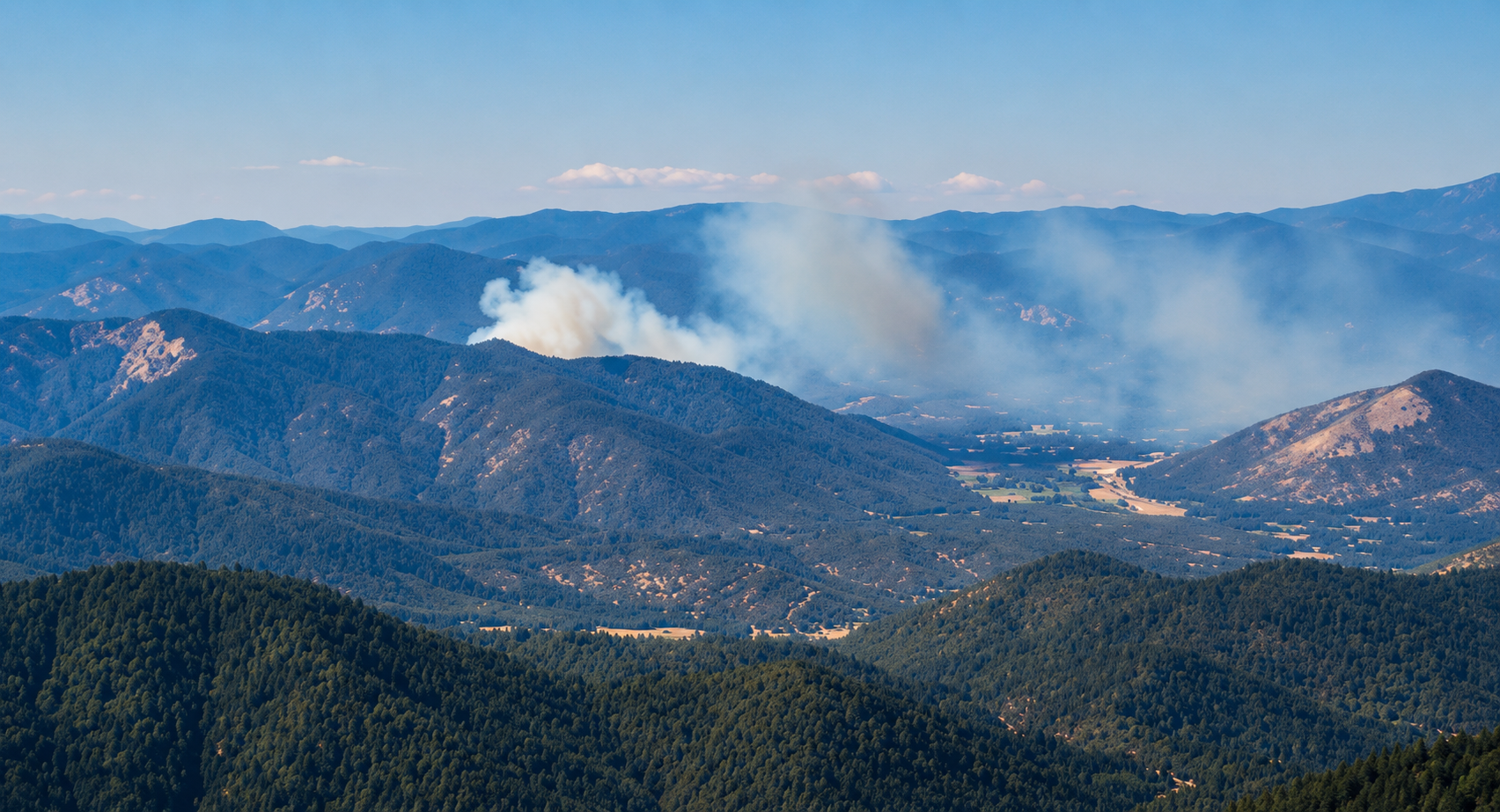
A fast-moving wildfire that began Thursday afternoon along Interstate 5 north of Rogue River grew from a series of reported grass fires into a major firefighting operation within hours, sending smoke across the corridor, triggering evacuations and drawing a large response of ground crews and aircraft into steep terrain above one of Southern Oregon’s busiest transportation routes.
By 5:30 p.m. Thursday, August 13, the Oregon Department of Forestry was referring to the incident as the Fielder Mountain Fire, with Air Attack estimating its size between 100 and 200 acres. Heavy smoke over the fire was making an exact measurement difficult, while firefighters continued confronting spot fires and challenging terrain as they worked to establish and strengthen suppression lines.
The rapid escalation unfolded during a matter of hours. The first reports involved multiple grass fires along northbound Interstate 5 near Mile Marker 51, north of Rogue River. Firefighters from ODF and partner agencies responded while two Type 2 helicopters were dispatched to assist crews on the ground.
By 3:20 p.m., the incident was estimated at approximately five to 10 acres, and firefighters had begun an aggressive initial attack. Air Attack was dispatched along with the helicopters as emergency vehicles and firefighting resources moved into position along the interstate.
At approximately 3:50 p.m., officials estimated the fire had expanded to between 20 and 30 acres. Wind was driving the flames, and firefighters were reporting spotting, a dangerous form of fire spread in which burning material is carried beyond the main fire perimeter and ignites new areas ahead of the advancing flames.
The growing fire brought a steadily expanding force into the Rogue River area. Hand crews, engines, bulldozers and water tenders joined the suppression effort, while helicopters worked overhead. Two large air tankers and a lead plane were also ordered to reinforce the aerial attack as firefighters attempted to slow the fire before it could advance farther through the surrounding terrain.
Less than half an hour later, at 4:15 p.m., the estimated acreage had climbed to approximately 75 acres. Hot and windy conditions continued to challenge firefighters, who concentrated heavily on the fire’s right flank while coordinating ground operations with aircraft working above them.
Evacuations were issued as the fire expanded, bringing the emergency beyond the immediate fireline and into surrounding communities. Residents in affected areas were directed to follow the Jackson County Sheriff’s Office for current evacuation information as conditions continued changing during the afternoon.
By 4:40 p.m., officials estimated the fire at approximately 100 acres. Firefighters reported progress along the right side of the incident, where the line extending from the area in which the fire began along the right flank was holding. Aircraft continued making retardant drops while helicopters delivered water onto portions of the fire inaccessible or difficult for ground crews to reach.
The response continued growing alongside the fire. Additional resources were ordered as firefighters attempted to reinforce areas where suppression work was succeeding while confronting sections where terrain, wind and spotting complicated efforts to establish control.
Shortly after 5:30 p.m., the incident had entered another stage. Air Attack estimated the Fielder Mountain Fire at between 100 and 200 acres, although thick smoke prevented crews overhead from obtaining a more precise measurement. Firefighters were pushing hose lays uphill from the bottom of the fire, an arduous operation through steep country that required crews to advance equipment and water delivery systems upward while continuing to address spot fires.
Aircraft remained heavily involved, conducting bucket and retardant drops in support of firefighters working below.
The complexity of the incident prompted officials to order Oregon Department of Forestry Incident Management Team 1. The move brings additional command and management capacity to the fire as the suppression operation expands, while allowing local district resources to remain available for new fires that could ignite elsewhere.
That additional capacity is particularly important during active fire conditions across Southern Oregon, where local engines, crews and aircraft must remain prepared to respond quickly when new smoke reports emerge. A large incident can consume substantial personnel and equipment, making expanded incident management an important part of maintaining firefighting coverage beyond the immediate perimeter.
The fire also created significant problems along Interstate 5, the primary north-south highway connecting Southern Oregon communities and carrying commercial, local and interstate traffic through the Rogue Valley. Heavy congestion developed along I-5 and surrounding roads as firefighting equipment moved through the area and motorists encountered smoke, emergency operations and increased traffic.
Officials urged motorists to avoid the area unless travel was necessary, both because of congestion and because firefighters and emergency vehicles require dependable access to the incident. Travelers who must use the corridor should remain prepared for changing conditions and emergency activity near the highway.
For residents near the fire, evacuation information remains one of the most important pieces of the developing emergency. Because evacuation boundaries can change as fire behavior changes, residents should rely on the Jackson County Sheriff’s Office and Josephine County Sheriff’s Office for current evacuation notices and instructions rather than earlier reports that may no longer reflect conditions on the ground.
What began Thursday as reports of grass fires beside Interstate 5 had developed by early evening into a 100-to-200-acre wildfire requiring extensive ground forces, multiple aircraft and an ODF incident management team. Firefighters remained engaged on the mountainside as smoke continued to obscure portions of the incident, with crews advancing hose lines uphill, aircraft working above them and suppression resources concentrating on preventing further spread.
The Fielder Mountain Fire remained an active and evolving incident Thursday evening, with its final acreage, containment status and the full extent of evacuation areas still subject to change as firefighters continued operations north of Rogue River.