


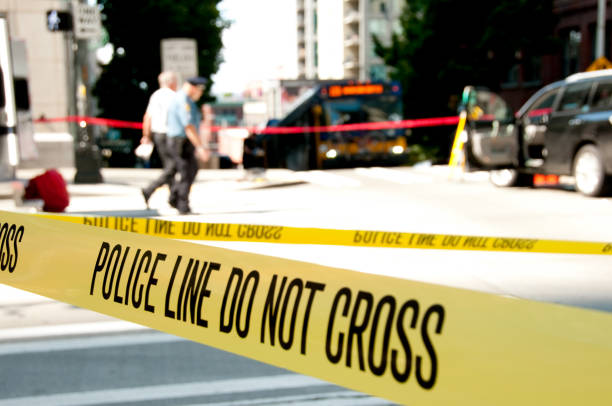
A series of unrelated shootings stretching from Connecticut to Kentucky, Virginia and Chicago left families grieving, children among the wounded and investigators searching for answers during a violent August weekend that brought gunfire into a nightclub, a community celebration, a university campus and neighborhoods across one of the nation’s largest cities.
The violence continued into early Sunday morning in Hartford, Connecticut, where one person was killed and four others were wounded in a shooting on Wethersfield Avenue. Hartford police responded at approximately 1:40 a.m. to the area of SoulBaila, where officers encountered a large crowd and found an unresponsive person. Emergency medical personnel pronounced the victim dead at the scene. The person’s identity had not been publicly released as authorities continued the process of notifying family members and investigating the circumstances surrounding the shooting.
The four surviving victims arrived at area hospitals following the gunfire. Police identified them as a woman, two men in their 30s and a man in his 20s. One of the men in his 30s remained in critical condition, while the other three victims were reported in stable condition. Hartford police investigators were examining evidence indicating the victims may have been struck by gunfire from a single weapon, although authorities had not announced an arrest or publicly established a motive by Sunday evening.
Hartford’s Major Crimes and Crime Scene divisions were handling the investigation as detectives worked to determine what happened among a crowd estimated at approximately 100 people. With many potential witnesses in the area at the time, police were seeking information that could help reconstruct the moments before and after the shooting.
Hundreds of miles away in Lexington, Kentucky, another gathering was shattered by gunfire Saturday evening at Charles Young Park. Police responded shortly before 7 p.m. during East End Day, a community event that had brought residents and families together. Five people were shot, and the Fayette County Coroner’s Office later identified the person killed as 16-year-old Di’Zhon Robertson.
The four surviving Lexington victims included two children, ages 4 and 14, along with two adults. Authorities reported that their injuries were not considered life-threatening. Police had not publicly identified a suspect as of Sunday, but officials said investigators did not believe there was an continuing threat to the public. Detectives continued gathering evidence and requesting information from people who witnessed the shooting or might know what led to the violence.
The Lexington shooting carried an especially painful dimension because it unfolded during an organized community gathering and claimed the life of a teenager. What began as an event intended to bring neighbors together became an active crime scene as emergency responders treated victims and investigators began the painstaking work of determining who fired the shots and why.
Earlier Saturday, Virginia State University near Petersburg, Virginia, was dealing with the aftermath of another shooting that wounded five people and temporarily disrupted activity on campus. The gunfire erupted at approximately 1:30 a.m. near university housing, prompting a lockdown while law enforcement officers searched the campus and surrounding area.
The victims ranged in age from 17 to 23. One person suffered critical injuries, while four others sustained injuries that were not considered life-threatening. Authorities said one of the five victims was a Virginia State University student. The other four were not affiliated with the university.
Police later arrested 19-year-old Camron Harris of Henrico, Virginia, who authorities said was not a Virginia State University student. Investigators located Harris hiding in a closet inside a campus dormitory more than 14 hours after the shooting. He was taken into custody and faced multiple felony charges, including malicious wounding and use of a firearm during the commission of a felony. Authorities continued investigating the circumstances surrounding the shooting and whether anyone else was involved.
While police worked individual crime scenes in Hartford, Lexington and Virginia, Chicago experienced a broader wave of shootings spread across numerous neighborhoods. By Sunday, police reported that at least 39 people had been shot during the weekend, with six people killed. The Chicago numbers represented multiple separate incidents rather than a single mass shooting, requiring detectives throughout the city to investigate different circumstances, locations and possible suspects.
Among the Chicago cases was a drive-by attack that wounded four people, two critically. Other shootings occurred throughout the weekend as police responded to scenes involving victims of different ages and circumstances. Because investigations and hospital conditions remained fluid Sunday, the city’s weekend totals remained subject to change.
The shootings in Connecticut, Kentucky, Virginia and Illinois were not believed to be connected. Each unfolded under different circumstances and remains its own criminal investigation. Together, however, they produced a weekend in which dozens of people were wounded and multiple families were confronted with sudden loss.
Behind every number is an individual whose life was interrupted or ended, along with relatives, friends, classmates, neighbors and witnesses left to absorb what happened. For those who survived, recovery may continue long after crime-scene tape disappears and investigators complete their work.
As Sunday drew to a close, significant questions remained unanswered. Hartford detectives were still working to identify a suspect and determine what precipitated the nightclub shooting. Lexington police continued searching for information in the killing of a 16-year-old during a community gathering. Virginia authorities were building their case following an arrest while investigating the circumstances surrounding the university shooting. Chicago detectives faced numerous separate investigations across the city.
For communities separated by hundreds of miles, the weekend ended with remarkably similar work ahead: treating the wounded, identifying those responsible, supporting families who lost loved ones and determining how gatherings that began as ordinary parts of American life became scenes of gunfire within a matter of seconds.