


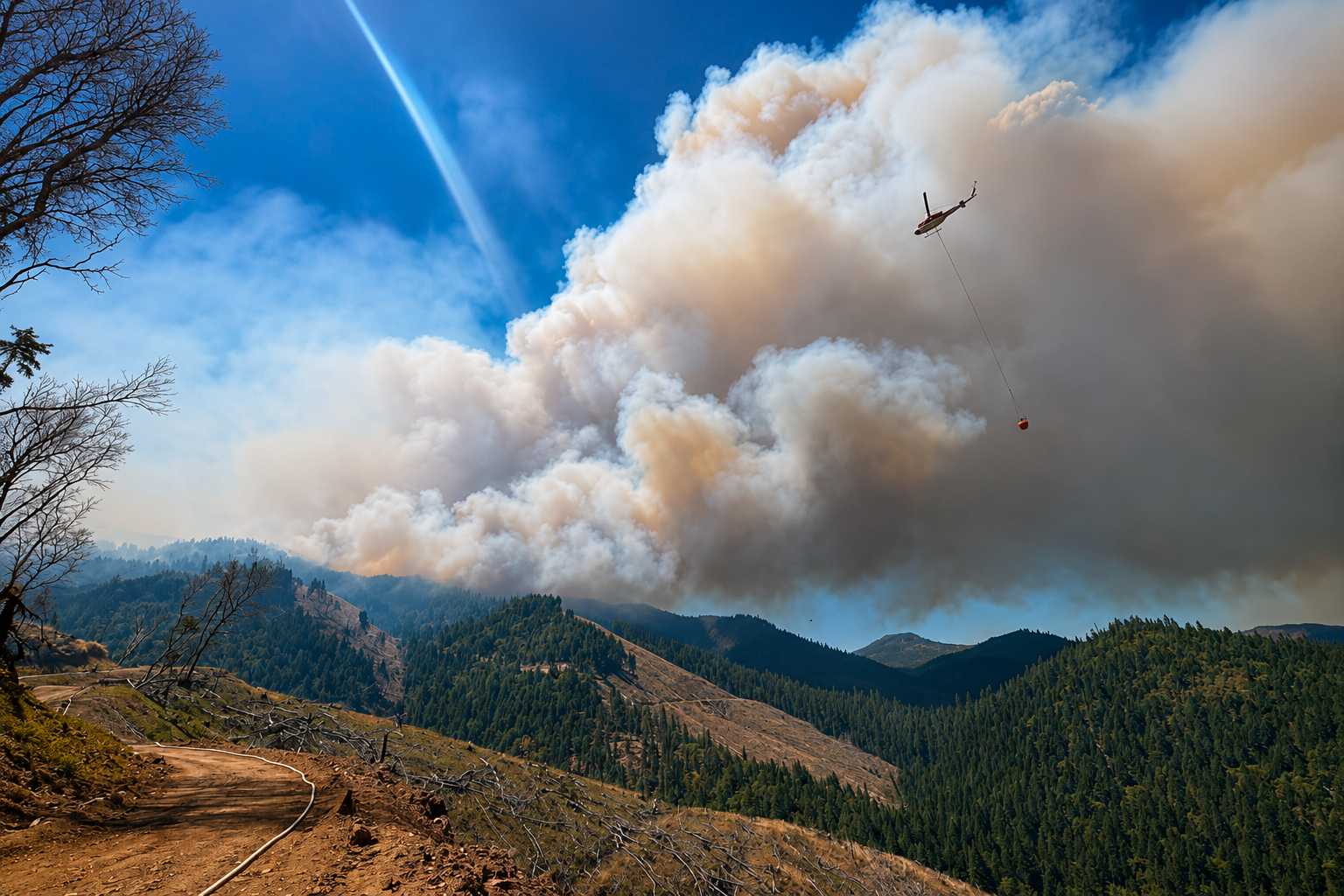
Oregon is appealing FEMA’s denial of firefighting assistance for the East Evans Creek Fire, which forced evacuations north of Rogue River and brought crews from across the state into Jackson County.
The fire broke out July 10 northeast of Rogue River and spread quickly enough to overwhelm the resources available to local firefighters. Gov. Tina Kotek invoked Oregon’s Emergency Conflagration Act that day, authorizing the state fire marshal to mobilize crews and equipment from across Oregon. State and local agencies spent the following weeks protecting structures, assisting evacuees and working to contain the blaze.
Oregon applied for a Fire Management Assistance Grant, which can reimburse up to 75 percent of eligible costs for fighting a fire that threatens to become a major disaster. FEMA denied the application on July 22. The state appealed, and seven members of Oregon’s congressional delegation sent a September 24 letter urging the agency to reverse its decision.
At issue is the public cost of a major firefighting response. State and local agencies sent personnel and equipment into Jackson County while homes were under evacuation orders and the fire was still advancing. If FEMA approves the appeal, federal funds could cover a portion of qualifying expenses already incurred. Officials have not publicly identified how much Oregon is seeking for the East Evans Creek Fire.
The fire had grown beyond 15,700 acres when Oregon made its initial request, according to the congressional delegation’s account of the state’s application. More than 3,100 structures were threatened, hundreds of homes were under Level 3 “Go Now” evacuation orders, and one unoccupied structure had been lost. The delegation also cited danger to businesses, roads, communications equipment, utilities and other infrastructure.
Those conditions form the core of Oregon’s appeal. The 3,100 structures were threatened by the fire; the figure is not a count of buildings destroyed. Oregon argues that the danger confronting those properties, together with the evacuations and the scale of the response, warranted federal assistance while firefighters were working to prevent greater losses.
The grant could reimburse eligible public firefighting expenses, including certain costs for equipment, supplies, field camps and the mobilization of crews. It would not provide direct payments to homeowners or businesses affected by the fire. Approval also would not mean FEMA pays the entire bill: the program covers up to 75 percent of costs that qualify under its rules.
FEMA approved Oregon’s July grant requests for the Lower Dry Creek Fire in Umatilla County, the Akawa Butte Fire in Deschutes and Jefferson counties, and the Grasshopper Fire in Wasco County. It denied requests for both East Evans Creek and the Rowe Creek Complex. The differing decisions led Oregon officials and members of Congress to seek an explanation of how the agency evaluated the fires.
In a July 28 letter, Sens. Jeff Merkley and Ron Wyden said FEMA had indicated that East Evans Creek and Rowe Creek did not meet the criteria for a major disaster declaration. The senators challenged that reasoning, arguing that a Fire Management Assistance Grant is designed for a blaze threatening destruction on that scale. They asked FEMA to identify the standards and information it used in denying the two applications.
That account of FEMA’s reasoning comes from the senators’ letter. A detailed FEMA denial setting out the agency’s full rationale for East Evans Creek was not available in the public material reviewed for this article. The three approvals show that FEMA found those applications eligible; they do not, on their own, establish why the two denials differed. Each request must be assessed against the conditions documented when the state applied.
The September 24 letter asks FEMA to reconsider East Evans Creek specifically. Merkley and Wyden signed it with U.S. Reps. Suzanne Bonamici, Val Hoyle, Andrea Salinas, Maxine Dexter and Janelle Bynum. They described weeks of work by Oregon Department of Forestry personnel, state fire marshal teams, local fire departments, law enforcement officers and emergency managers to protect property, maintain services and help residents under evacuation orders.
Oregon’s response to the fire began well before the federal funding dispute. Kotek’s conflagration declaration followed a request from Jackson County fire officials for additional help with life safety and structure protection. Her office determined that the threat exceeded the capabilities of local personnel and equipment. The declaration brought more firefighting resources to the area; it did not guarantee reimbursement through FEMA’s separate grant program.
That separation now carries financial consequences for the agencies involved. Crews were deployed while the fire posed an immediate danger, regardless of whether the federal government would later help pay eligible costs. A successful appeal would shift part of that expense to FEMA. If the denial stands, Oregon and the responding agencies will receive no reimbursement for East Evans Creek through this grant. Without a publicly released claim total, the amount at stake remains unknown.
The case also raises a question for states seeking federal help during active wildfires: how FEMA judges a fire’s potential for major destruction when firefighters are still working to stop it. Oregon says the conditions at East Evans Creek met the grant standard at the time of its application. FEMA’s decision on appeal will determine whether the agency agrees.
For now, the July 22 denial remains in place. The September 24 congressional letter supports Oregon’s appeal but does not award the grant or release federal money. Jackson County’s firefighters have completed the response at issue; FEMA has yet to decide whether it will share the eligible cost.