


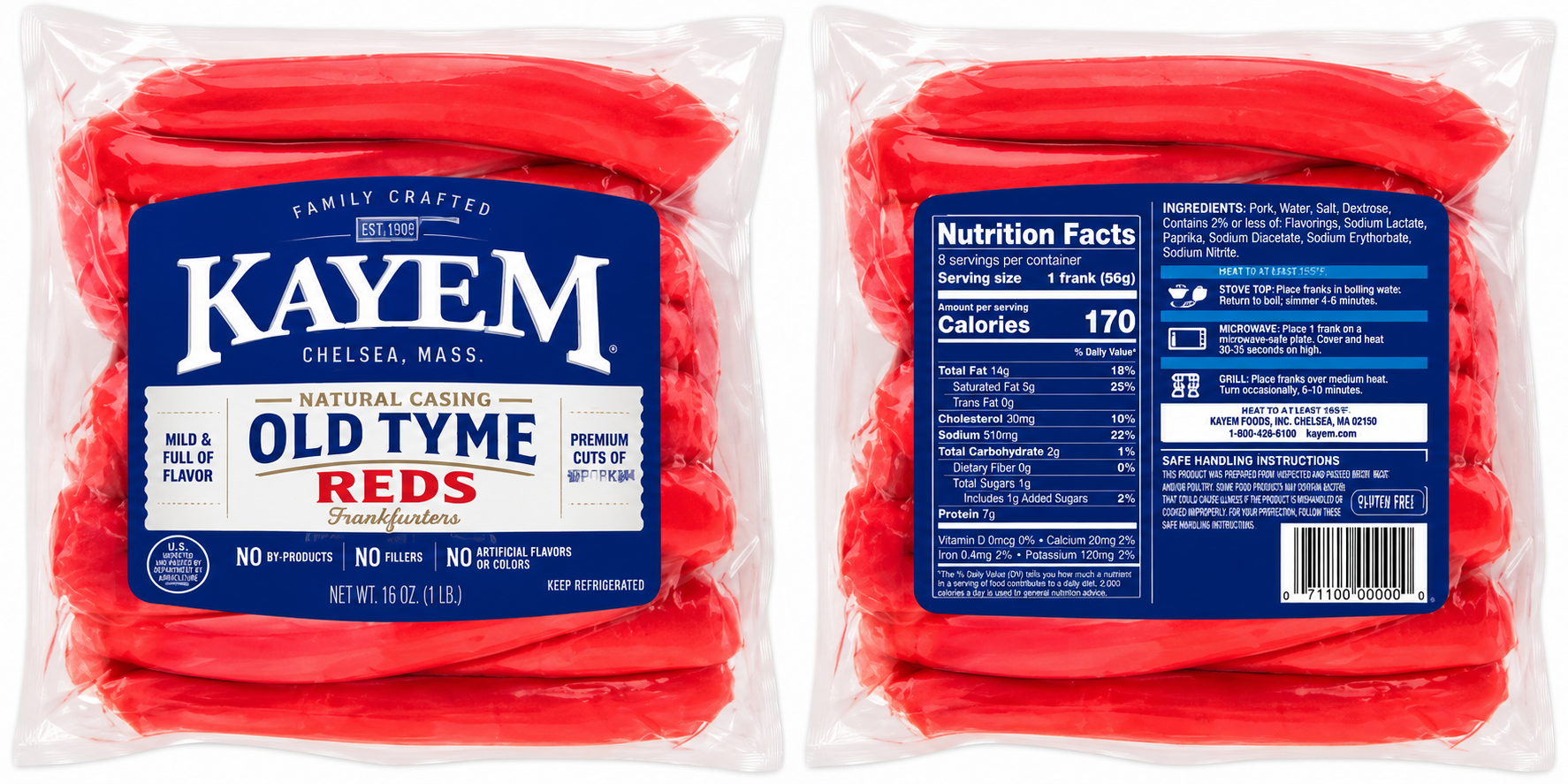
A refrigeration failure at a Massachusetts food processing company’s warehouse has prompted one of the nation’s largest meat and poultry recalls of 2026, placing more than 1.5 million pounds of hot dogs, bacon, turkey, sausages, deli meats and other fully cooked products under the federal government’s highest food safety risk classification. The affected products were distributed to retailers and food-service operations across the United States.
The U.S. Department of Agriculture’s Food Safety and Inspection Service announced October 17 that Kayem Foods Inc., headquartered in Chelsea, Massachusetts, was recalling approximately 1,584,361 pounds of ready-to-eat meat and poultry products following the discovery of improper storage temperatures at one of the company’s warehouses. Federal regulators classified the recall as Class I, a designation reserved for situations in which consuming an affected product carries a reasonable probability of serious adverse health consequences or death.
The recall encompasses a substantial assortment of refrigerated foods manufactured between March 31 and October 7, 2026. The products were stored and shipped between June 7 and October 14, potentially placing affected merchandise into commercial distribution channels for several months before the refrigeration problem was identified.
The investigation began October 1, when a retail customer reported receiving products that were unusually warm upon delivery. Kayem Foods subsequently examined its storage operations and discovered that a warehouse cooling system had malfunctioned, allowing temperatures to fluctuate outside appropriate refrigeration conditions.
The company determined that the temperature deviations could have permitted the growth of harmful microorganisms in products intended for human consumption. Because the affected merchandise included fully cooked meats ordinarily consumed without additional preparation, federal officials determined that removing the products from circulation was necessary.
Although the recall carries the USDA’s most serious risk classification, federal regulators reported no confirmed illnesses associated with the affected products as of the October 17 announcement. The recall was initiated because of the potential for bacterial growth resulting from improper storage conditions, rather than a confirmed outbreak involving a particular pathogen.
Kayem Foods is a fourth-generation, family-owned meat processing company that manufactures products distributed under several established regional and national brands. The recall extends well beyond the company’s signature hot dogs and includes products sold under the Kayem, Al Fresco, Triple M, McKenzie, Deutschmacher, Jordan’s, Essem and Winnisimmet St. Butchery names.
Among the affected merchandise are traditional beef and pork hot dogs, Fenway Franks, kielbasa, bratwurst, smoked sausages, chicken sausages, breakfast sausages, thick-cut bacon, smoked bacon, ham, turkey breast, bologna, liverwurst, corned beef, smoked brisket, meatballs and other prepared meat products.
Several varieties of Al Fresco chicken sausage are included, such as spinach and feta, roasted garlic, sweet Italian, apple maple, roasted pepper and Asiago, smoked andouille, jalapeño and other flavored varieties. Kayem-branded products include several hot dog varieties, thick-cut bacon, smoked brisket and prepared deli meats.
The affected merchandise was manufactured in multiple package sizes, including smaller consumer packages and larger quantities intended for restaurants, institutional kitchens and commercial food-service operations.
Federal officials identified three USDA establishment numbers associated with the recalled merchandise: EST. M/P 7839, EST. P 20935A and EST. M 9520. These identifying numbers appear within the USDA inspection mark on affected packaging.
The USDA has also released product descriptions, packaging photographs and Universal Product Code information to assist with identification. Consumers must compare individual product details with the federal recall records because not every product sold under an affected brand name is necessarily included.
The geographical reach of the recall extends throughout the United States and internationally to Hong Kong. Federal officials confirmed that affected merchandise was shipped to retail and food-service locations nationwide, although the agency’s initial announcement did not identify every individual retailer or commercial customer receiving the products.
Walmart identified affected products sold at selected stores in Connecticut, Maine, Massachusetts, New Hampshire, New York, Pennsylvania, Rhode Island and Vermont. Market Basket, a regional supermarket chain operating in the northeastern United States, also published recall information involving Kayem products.
Federal inspectors continue to conduct recall effectiveness checks intended to determine whether distributors and retailers received proper notification and whether affected products have been removed from sale.
The recall involves ready-to-eat products, including commercially prepared meats purchased for immediate serving, reheating or use in sandwiches and other meals. Improper refrigeration can allow harmful bacteria to multiply, and returning affected merchandise to refrigeration does not necessarily eliminate organisms that may have developed during inadequate storage.
Certain bacteria associated with refrigerated ready-to-eat foods, including Listeria monocytogenes, can present serious health consequences for pregnant women, older adults and individuals with weakened immune systems. Other foodborne pathogens may cause gastrointestinal illness, fever, abdominal discomfort, vomiting and diarrhea.
Federal officials have not identified Listeria or another specific bacterium as a confirmed contaminant responsible for the Kayem recall. The action concerns the possibility of microbial growth resulting from the documented refrigeration malfunction.
The Centers for Disease Control and Prevention estimates that foodborne illnesses affect millions of Americans annually, with vulnerable populations facing greater risks of hospitalization and serious complications.
Federal officials have expressed concern that some affected merchandise may remain in household refrigerators and freezers. Consumers who purchased products included in the recall have been instructed not to eat them, regardless of whether the packaging appears intact or the food has an acceptable smell or appearance.
The USDA advises consumers to discard recalled products or return them to the place of purchase. The agency has not recommended attempting to make the affected merchandise safe through additional cooking or reheating.
Consumers should also clean refrigerator shelves, storage containers, utensils and other surfaces that may have contacted recalled products, particularly where packaging has leaked or food has been handled outside its original container.
Kayem Foods initiated its voluntary recall October 16 and acknowledged that the malfunction occurred within its warehouse refrigeration operations. The company reported that corrective measures had been implemented and that wholesale and retail customers were being contacted directly with instructions for identifying and removing affected merchandise.
The company is working with federal regulators as the recall proceeds. USDA inspectors are monitoring the removal process, including whether affected merchandise remains available for purchase and whether commercial customers have received the necessary information.
The financial consequences of the recall have not been publicly established. The withdrawal of more than 1.5 million pounds of food involves a substantial volume of commercial inventory, but the total value of recalled merchandise, transportation expenses, disposal costs and other business losses has not been disclosed.
For consumers seeking additional information, Kayem Foods has established customer assistance through its telephone number, 800-426-6100, and email address, info@kayem.com. The USDA Meat and Poultry Hotline is available at 888-674-6854 for questions involving recalled products and food safety.
Individuals who believe they became ill after consuming potentially affected merchandise are advised to contact a healthcare professional. Consumers may also report suspected food safety problems through the USDA’s electronic consumer complaint system.
As of October 21, the recall involves more than 1.58 million pounds of ready-to-eat meat and poultry products distributed nationwide, with no confirmed illnesses identified in the federal announcement. USDA inspectors continue conducting recall effectiveness checks as Kayem Foods works with distributors and retailers to remove the affected merchandise from commercial circulation.