


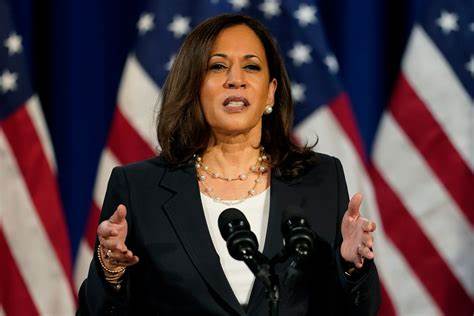
Vice President Kamala Harris is facing increasing scrutiny as questions mount regarding her readiness for the presidency. Amid campaign missteps, awkward public statements, and challenges during interviews, critics and political analysts alike are raising concerns about her ability to connect with voters and project leadership on the national stage.
Over the past few months, Harris has found herself in the spotlight for all the wrong reasons. Several interviews had to be edited, with some attributing these revisions to her perceived difficulty in clearly articulating positions. Her reliance on teleprompters during public speeches has drawn attention, with some critics suggesting that it highlights a lack of confidence or preparedness. Harris’s verbal missteps, such as speaking in vague or repetitive terms during interviews, have contributed to the perception that she struggles to effectively communicate her ideas.
These missteps have been compounded by notable gaffes. During a recent appearance on The View, Harris made a controversial statement that she “would not change anything” about the Biden administration’s policies over the past four years. For many independent voters, this remark seemed tone-deaf, especially in light of ongoing concerns about the economy, inflation, and the public’s dissatisfaction with certain aspects of the administration. Critics argued that Harris missed an opportunity to acknowledge the challenges and offer potential solutions.
Harris’s challenges extend beyond public gaffes. Despite her historic position as the first female vice president and the first person of Black and South Asian descent to hold the office, her campaign efforts have not gained the momentum many Democrats had hoped for. Polls suggest that Harris continues to lag behind other potential Democratic candidates for the presidency, with even some members of her own party questioning whether she is the right candidate to lead after Biden.
One of the consistent criticisms has been her difficulty connecting with voters, particularly those who are moderate or independent. Harris’s background as a prosecutor and attorney general once appeared to bolster her credentials as a leader, but some argue that her legalistic approach lacks the relatability necessary to win over the broader electorate. This has become especially apparent in town halls, where her responses to voter concerns have sometimes been perceived as out of touch.
Communication has been a persistent hurdle for the vice president. Critics note that while her policy positions align closely with President Biden’s, her delivery often falls flat. Some political strategists have pointed out that Harris appears more comfortable in controlled environments, but struggles when speaking extemporaneously. This has led to speculation that her team carefully manages her public appearances to avoid potential pitfalls.
Furthermore, Harris’s tendency to speak in generalities, often repeating phrases or offering circular responses, has left some voters frustrated. These communication struggles, coupled with the editing of interviews to minimize blunders, have become a focal point for those questioning her capability to lead.
For her detractors, Harris’s performance on the national stage signals that she may be out of her element. The vice president has been criticized for a perceived lack of depth on key issues and an over-reliance on prepared talking points. In a political landscape where voters increasingly demand authenticity and clarity, Harris’s approach has left her vulnerable to accusations of being disconnected from the realities many Americans face.
In a highly polarized political environment, the pressure is on Harris to demonstrate that she can effectively lead and unify a divided country. However, recent blunders have only fueled concerns that she may not be equipped to rise to that challenge.
Despite the criticisms, Harris has her supporters, many of whom argue that she is being unfairly targeted. Some claim that the intense scrutiny she faces is partly due to the historic nature of her vice presidency and the high expectations that come with it. Her defenders also point to the challenges of navigating the vice presidency—a role that traditionally involves significant responsibility but limited direct authority—as a complicating factor in how her performance is perceived.
However, even within her own party, there are calls for Harris to sharpen her public image and policy messaging. As the 2024 election season heats up, Harris faces the dual challenge of defending the Biden administration’s record while carving out her own identity as a leader. Whether she can effectively bridge that gap and address concerns about her qualifications remains to be seen.
With public opinion playing a critical role in determining her political future, Harris must find a way to regain confidence and establish herself as a viable candidate for higher office. If she hopes to convince the American public—and particularly undecided and independent voters—that she is ready for the presidency, she will need to demonstrate not only mastery of policy but also the ability to inspire and connect with a broad base of voters.
For now, the question remains: Can Kamala Harris overcome these hurdles and position herself as a leader prepared to take the helm of the nation, or will her recent struggles continue to cast doubt on her readiness for the role? Only time will tell.