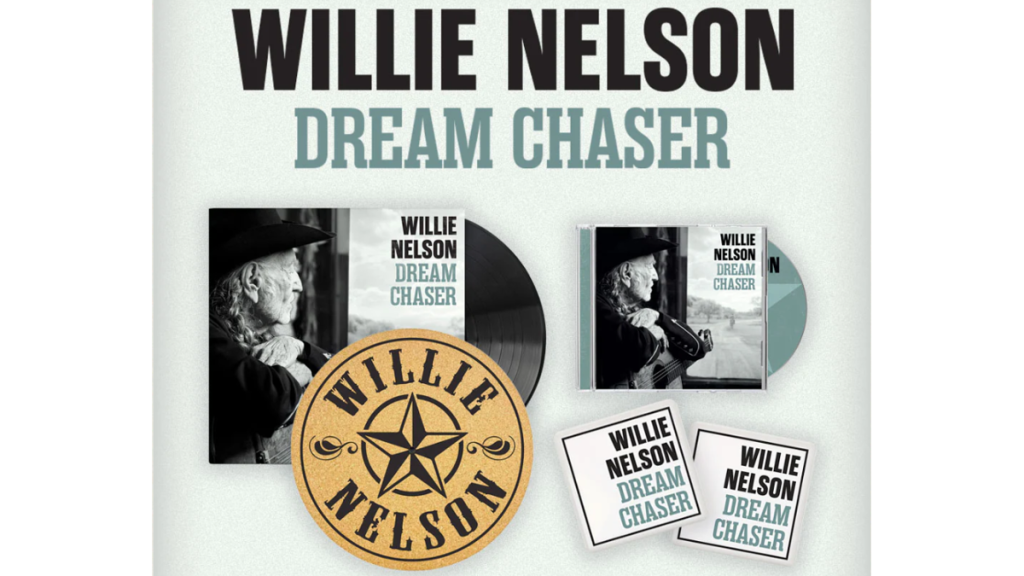
Willie Nelson is preparing to release a new studio album, Dream Chaser, a project that arrives not as a farewell, but as a continuation of one of the most enduring careers in American music. Approaching his 93rd birthday, Nelson remains active in the studio and on the road, adding new work to a catalog that already spans more than six decades.
Scheduled for release in late May, Dream Chaser will become Nelson’s 79th solo studio album and roughly his 156th overall recording. The scope of that output is difficult to overstate. Few artists reach even a fraction of that volume, and fewer still continue producing original material with consistency at this stage of life.
The new album is expected to feature ten tracks built around themes that have long defined Nelson’s writing, including reflection, resilience, and the passage of time. The title track has already drawn attention for its measured tone and sense of perspective, offering a continuation of the understated storytelling that has anchored his work for decades. The record also includes a rare collaboration with Bob Dylan, bringing together two of the most influential figures in modern songwriting in a way that underscores the weight of the release.
Nelson’s ability to sustain this level of productivity is matched by his continued presence on stage. A limited series of spring tour dates is planned in support of the album, reinforcing a pattern that has defined his career from the beginning. Recording and performing have never been separate pursuits for Nelson. Each has informed the other, creating a cycle that has carried forward year after year without interruption.
Measured strictly by age, Nelson is not the oldest artist to release new music. Tony Bennett set a benchmark with a studio album at 95, and others have reached even higher milestones under more limited circumstances. Yet those comparisons only partially capture what distinguishes Nelson’s current moment. His work has not paused and resumed. It has continued, steadily, across decades, with new releases arriving in a rhythm that reflects sustained creative engagement rather than occasional returns.
That continuity places Dream Chaser in a category that extends beyond novelty or record-setting. It is part of an active body of work that remains in progress. Nelson is not revisiting earlier material or relying on legacy alone. He is still writing, still recording, and still shaping new songs that reflect where he is now.
The significance of that effort is not confined to statistics. Nelson’s influence on American music has long been established, from his role in reshaping country music’s boundaries to his contributions as a songwriter and performer across genres. What stands out today is the consistency of that voice. The phrasing, the pacing, and the perspective that defined his earlier recordings remain intact, now informed by a lifetime of experience.
Dream Chaser arrives as another entry in a catalog that continues to expand in real time. It reflects an artist who has maintained a direct connection to his craft, not as an occasional exercise, but as a constant. In an industry where longevity is often measured in revivals and retrospectives, Nelson’s path has followed a different course, one defined by ongoing work rather than return.
As the album’s release approaches, the broader context becomes clear. Nelson may not hold the record as the oldest artist to issue new material, but his continued output at this level places him among the most enduring figures the industry has produced. The achievement lies not only in reaching this age, but in continuing to create with purpose once there.