


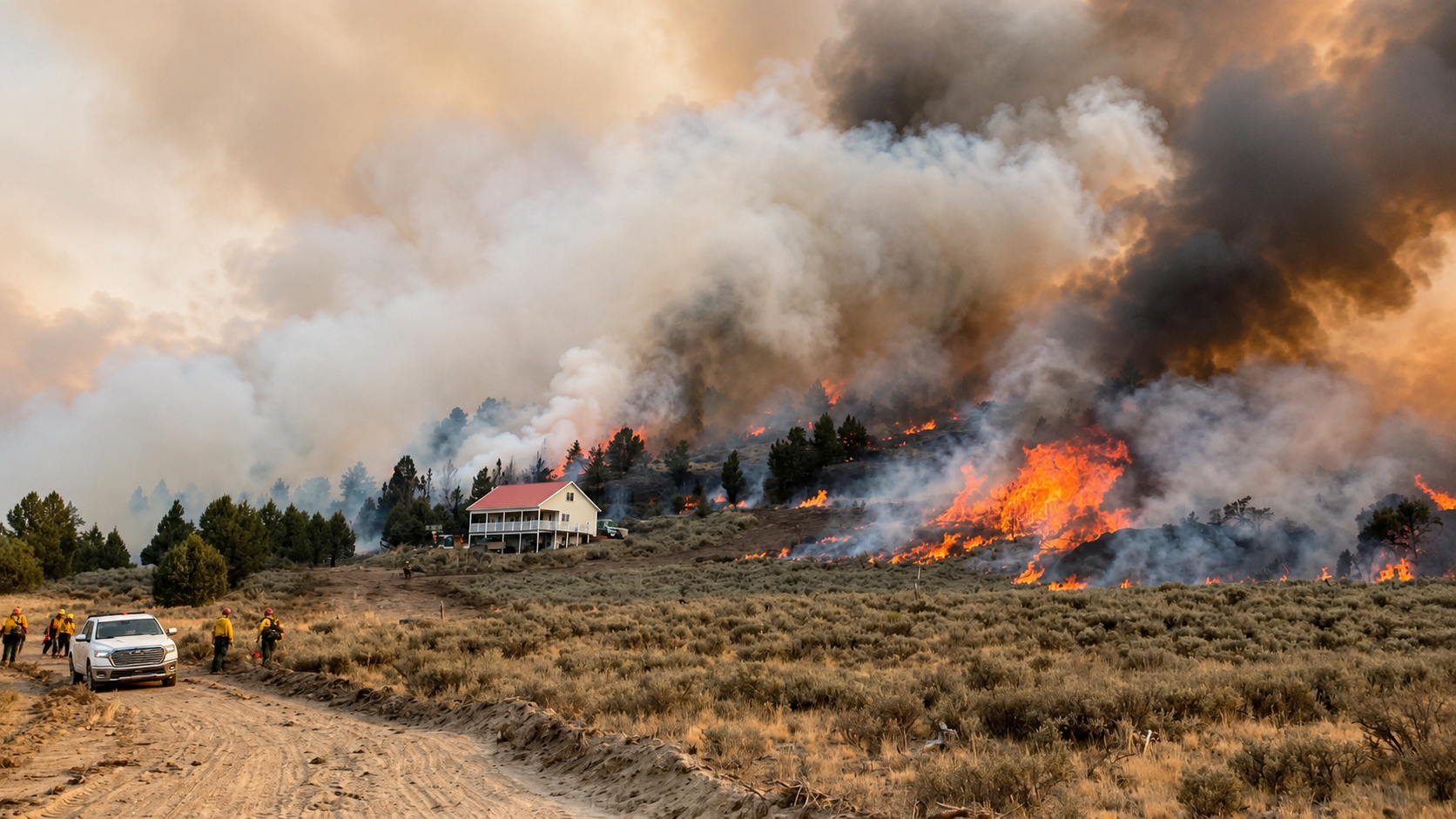
A sprawling wildfire stretching across the remote rangelands of southeastern Oregon and southwestern Idaho has grown beyond 555,000 acres, placing hundreds of firefighters, ranching communities and tribal lands at the center of one of the largest active wildfire responses in the region this summer. The Big Grass Fire was reported at approximately 555,146 acres Tuesday, August 11, with containment estimated at 35 percent as firefighters continued working across an enormous perimeter spanning portions of Malheur County, Oregon, and Owyhee County, Idaho. The fire has been burning since late July and has consumed hundreds of thousands of acres of grass, sagebrush and grazing country along the Oregon-Idaho border.
The scale of the incident has produced a major interstate firefighting operation. By Tuesday, approximately 1,286 personnel were assigned to the fire, representing a substantial increase in resources as fire managers concentrated crews and equipment on portions of the perimeter where active fire continued to threaten additional land. Northwest Complex Incident Management Team 10 assumed command of the Big Grass Fire at 6 a.m. Tuesday, marking another stage in the management of an incident that has expanded far beyond the boundaries of a typical rangeland fire. The transition places the increasingly complicated operation under a team equipped to coordinate the personnel, equipment, logistics, public safety responsibilities and interagency resources required for a wildfire of this magnitude.
Much of the northwestern portion of the Big Grass Fire has been contained, allowing firefighters to concentrate increasingly on areas where significant work remains. Crews have been securing fire lines and addressing large pockets of unburned vegetation within the broader fire perimeter. Those islands of remaining grass and other fuels present an ongoing challenge because fire can become established inside them and create additional activity even after surrounding sections of the perimeter have been secured. Protecting remaining grazing land has also become an important part of the firefighting operation. Southeastern Oregon and southwestern Idaho contain vast expanses of working rangeland where cattle operations depend on seasonal forage. A wildfire covering more than half a million acres can therefore leave consequences extending well beyond the immediate emergency, affecting livestock operations, fences, grazing allotments, wildlife habitat and the ability of ranchers to use burned landscapes after the flames are extinguished.
The greatest immediate concern Tuesday was along the southeastern portion of the fire, where firefighters were concentrating efforts on preventing further movement toward the Duck Valley Indian Reservation. The reservation, home to the Shoshone-Paiute Tribes, straddles the Idaho-Nevada border south of the primary fire area. The fire’s proximity has elevated protection of Duck Valley and surrounding lands into one of the central objectives of the firefighting operation. Crews have been working to strengthen defensive positions and limit additional southeastward growth as changing winds, dry vegetation and terrain continue to influence fire behavior.
The threat to Duck Valley has also created some confusion over the name of the wildfire. The incident is officially known as the Big Grass Fire. Duck Valley is a threatened geographic area and tribal community rather than the name of a separate wildfire associated with the current incident. The Big Grass Fire began in late July and rapidly expanded through dry grass and sagebrush country. The landscape of southeastern Oregon and southwestern Idaho can allow rangeland fires to travel tremendous distances when vegetation is critically dry and winds align with the fire’s direction of movement. Unlike wildfires burning primarily through dense forests, grass and sagebrush fires can advance rapidly across open terrain, producing long fire fronts that require substantial numbers of personnel to contain.
At more than 555,000 acres, the Big Grass Fire encompasses an area approaching 870 square miles. Its footprint is considerably larger than many American cities and demonstrates the extraordinary geographic scale confronting firefighters. Containing an incident of that size requires considerably more than extinguishing visible flames. Crews must establish, strengthen and patrol miles of containment lines while watching for spot fires, interior burning and sections where wind could push flames across existing control features.
The fire has already prompted evacuations and threatened hundreds of structures during its progression. Earlier incident reporting indicated that 159 people had been evacuated as conditions worsened, while hundreds of residential and other structures were considered threatened. Conditions and evacuation designations can change quickly as firefighters gain control in one area while encountering increased activity elsewhere. Public access to portions of the affected region has also been restricted. The Bureau of Land Management established emergency closures on public lands associated with the Big Grass Fire in both Oregon and Idaho as the incident expanded. The closures are intended to protect the public while allowing firefighters, engines and other emergency resources to operate without unnecessary traffic in active fire areas.
The geographic setting adds another level of complexity. The Oregon-Idaho border country affected by the fire is sparsely populated compared with metropolitan areas, but the absence of large population centers does not diminish the consequences of such an enormous burn. Ranches can be separated by significant distances, roads are limited in some areas, water sources may be widely dispersed and firefighting resources can require considerable travel time to move from one section of the incident to another.
The land itself is also economically important. Ranching remains deeply connected to the communities of southeastern Oregon and southwestern Idaho, and the loss of extensive grazing acreage can create problems that continue long after containment is achieved. Burned fencing may require replacement, livestock may have to be relocated, forage can be lost for extended periods and ranchers may need alternative grazing arrangements while damaged land begins recovering. Wildlife habitat will also be part of the longer-term assessment. Much of the region consists of sagebrush-steppe habitat supporting numerous species adapted to the high desert environment. The severity and pattern of the burn will help determine how quickly different portions of the landscape recover and what rehabilitation work may eventually be necessary.
For firefighters, those longer-term questions remain secondary to containing the active incident. With approximately 35 percent containment reported Tuesday, substantial portions of the Big Grass Fire remained unsecured. Containment does not mean that 35 percent of the acreage has stopped burning. Instead, it represents the portion of the fire perimeter where firefighters have established control lines that officials believe can reasonably be expected to prevent further spread under anticipated conditions.
That measurement is especially important with a wildfire covering more than half a million acres because even when large sections become relatively quiet, unsecured portions of the perimeter can continue producing significant growth. Firefighters must also monitor contained sections to ensure that heat, wind and burning material do not create new problems behind established lines. More than 1,200 personnel assigned to the incident Tuesday reflected the amount of work still required. Firefighting operations on an incident of this scale can include hand crews, engines, water tenders, heavy equipment, aviation resources, medical personnel, communications specialists, logistics staff, fire behavior analysts and other support personnel working across a command structure spanning two states and multiple jurisdictions.
The Big Grass Fire has become more than an Oregon wildfire or an Idaho wildfire. Its enormous footprint has turned it into a regional incident requiring coordination across state lines, federal public lands, private ranching country and tribal interests. As Wednesday begins, the southeastern flank near Duck Valley remains one of the areas receiving the closest attention. Firefighters will continue attempting to strengthen containment lines, secure vulnerable sections of the perimeter and protect unburned rangeland while preventing the fire from advancing toward populated and culturally significant areas.
For residents of Oregon and Idaho, particularly those living or working throughout the southeastern Oregon and southwestern Idaho rangelands, conditions surrounding the Big Grass Fire remain subject to change. Evacuation notices, public-land closures, road conditions and fire behavior can shift as weather and suppression efforts alter the direction and intensity of the incident. After burning for nearly three weeks, the Big Grass Fire has transformed an ignition in remote high-desert country into a wildfire covering more than half a million acres and demanding one of the region’s largest firefighting deployments. Although progress has been made along portions of its immense perimeter, the arrival of a new incident management team, the deployment of nearly 1,300 personnel and the continued focus on protecting Duck Valley underscore the amount of work that remains before the fire can be considered contained.