


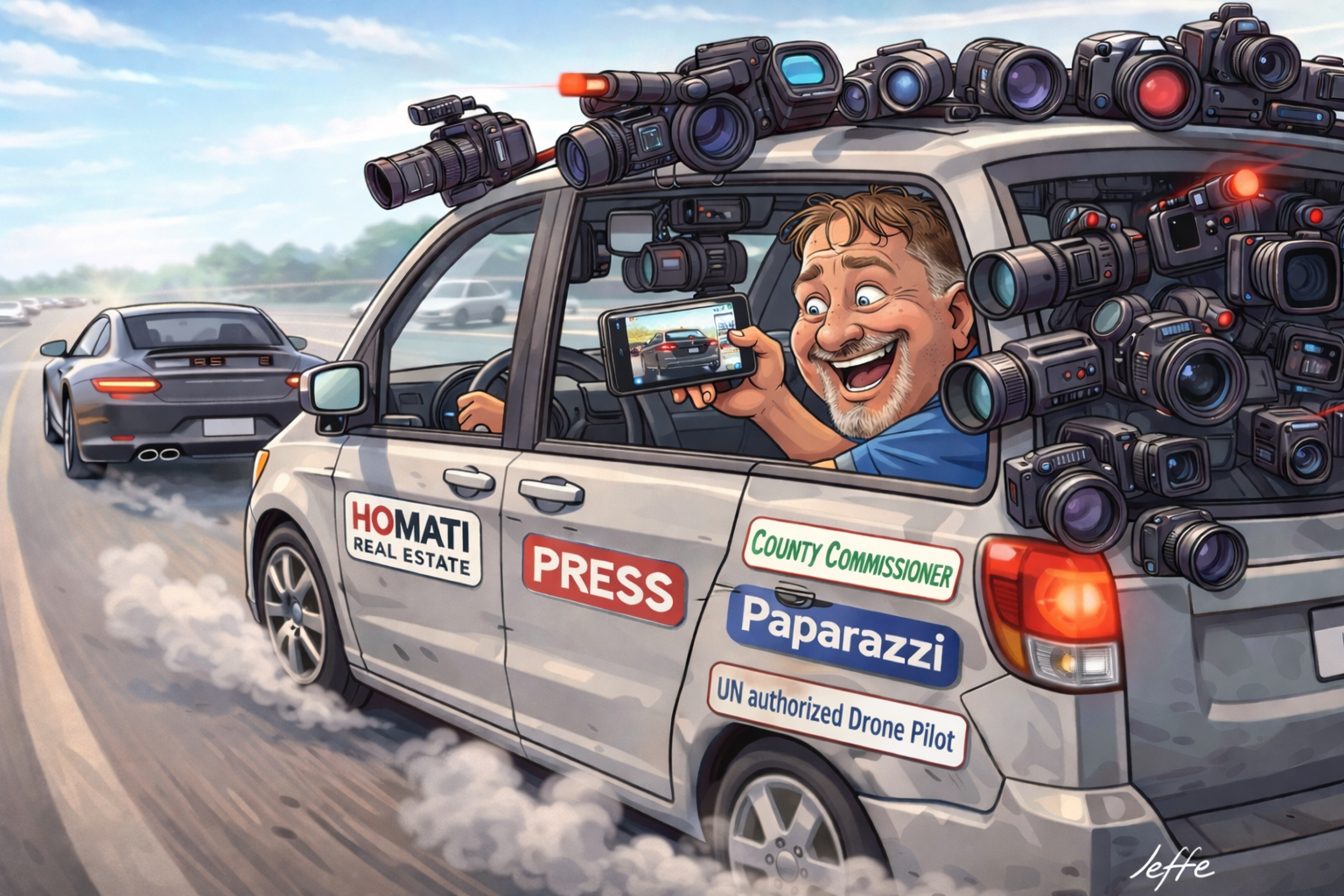
I have spent nearly two years dealing with Josephine County Commissioner Chris Barnett in courtrooms, through filings, motions, and legal maneuvering that have tied up my life, my finances, and my time. Lawsuits have a way of bleeding into every corner of existence, and when you are the publisher and owner of a local newspaper, those disputes are never just abstract legal arguments. They are personal, they are constant, and they linger. What happened on December 22, 2025, on Redwood Highway felt like yet another chapter in that ongoing ordeal, only this time it spilled out of paperwork and into real world danger.
At approximately 3:45 p.m., I was driving northeast toward Grants Pass, merging onto Redwood Highway like any other resident trying to get from point A to point B. I was not attending a public event. I was not filming anyone. I was not provoking anything. I was simply driving running some personal errands enjoying the little sun we had this week. What followed did not feel random. It felt targeted.
A vehicle behind me began driving erratically, swerving and accelerating in what appeared to be an attempt to close the distance. It then rode my bumper far too closely for comfort, almost like a police vehicle attempting to intimidate at highway speeds, before pulling alongside my driver’s door, matching my speed exactly and creeping even closer. Anyone who has driven knows that moment when instinct takes over, when something feels wrong and your attention sharpens because safety suddenly feels uncertain. That moment lasted far too long.
When I finally looked over, I saw Commissioner Barnett holding a mobile device pointed directly at me, clearly recording video while driving. He appeared to be yelling, cursing, and making an obscene gesture towards me. I did not engage beyond a brief reaction of slowly extending my own middle finger and focused on getting away from the situation. The problem was that he did not disengage. He stayed alongside me, still filming, still pacing, still focused on me instead of the road.
This is where the issue goes beyond a traffic violation and into something more unsettling. I am not famous. He is not paparazzi. I am the publisher and owner of the Grants Pass Tribune, and that context matters. Given our history, given the lawsuits, given his repeated refusal to tell the truth in public and legal settings, this did not feel like a coincidence. It felt like intimidation. It felt like stalking.
People do not like being videotaped while they are driving, and most people would find that deeply unnerving. When the person doing the filming is an elected official with a personal history of conflict, it becomes creepy in a way that is impossible to dismiss. This was not about safety awareness or documentation. It was about fixation. The behavior was prolonged, deliberate, and directed at one individual. Perhaps Mr. Barnett’s apparent obsession with me and my vehicle is something better addressed in a therapist’s office, because it clearly crosses the line into unhealthy fixation.
Oregon law is clear about distracted driving, and it exists for good reason. Recording video while operating a vehicle on Oregon is illegal, and dangerous. Careless and aggressive driving endangers everyone on the road, not just the intended target. When a county commissioner ignores those laws, it raises serious questions about judgment. When that same commissioner does so while focusing on someone he has been legally entangled with for years, it raises questions about motive and mental fitness for office.
I made a last moment turn at the Allen Creek Road light to separate from him and end the encounter. No one should have to take evasive action simply to escape an elected official’s attention. No one should feel fear because a public servant decides to act like a jealous teenager with a camera. Maybe he liked my car. Maybe it was ego. Maybe it was something else entirely. Whatever the reason, the behavior was inappropriate, unsafe, and deeply unsettling.
This is just one incident of several that are now being handled through formal channels, with documentation, law enforcement involvement, and legal remedies focused on safety and accountability. That is where it belongs. But the broader issue remains. Public officials are expected to behave like adults, especially when they are behind the wheel. When they do not, when their actions feel creepy and stalker-like, the public has every right to know.
This is not about politics. It is about conduct. It is about boundaries. And it is about drawing a firm line between public service and personal obsession, before someone gets hurt.