


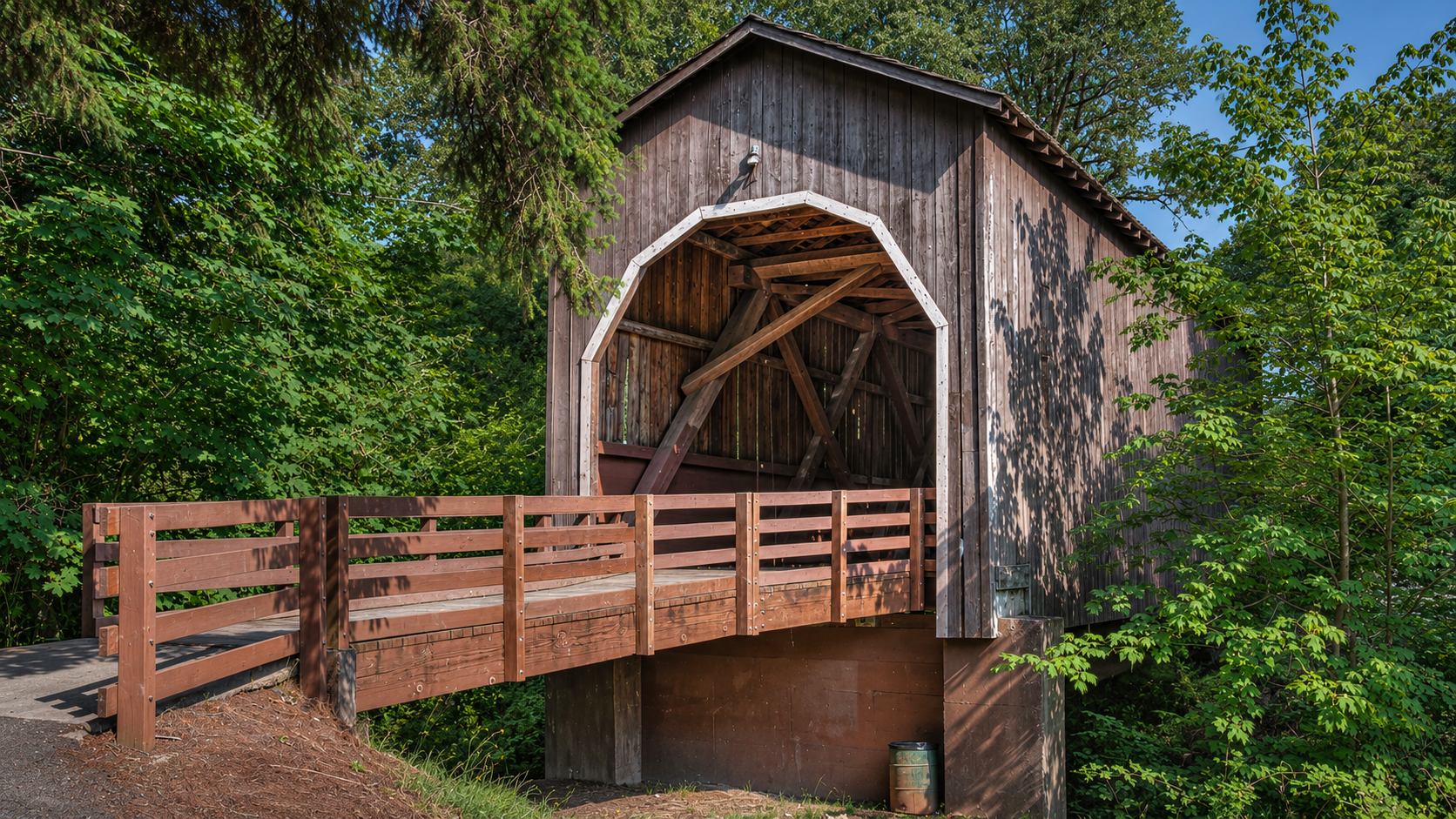
Oregon’s Pass Creek Covered Bridge has secured national historic recognition after more than a century of service, community preservation and structural challenges, opening another opportunity to protect the wooden landmark in Drain.
The National Park Service added the Douglas County bridge to the National Register of Historic Places on October 14, recognizing its statewide engineering significance. The designation could help support applications for preservation funding, but the crossing remains closed, with no confirmed reopening date or fully funded restoration plan.
For Drain, a small community in southwestern Oregon, the listing marks another chapter in an effort that saved the bridge from disappearing when vehicle traffic ended more than four decades ago. The structure now stands in Civic Center Park, still spanning Pass Creek, approximately 380 feet downstream from the road crossing it once served.
Oregon Parks and Recreation announced the listing October 30. The state’s Advisory Committee on Historic Preservation had recommended the nomination in June.
Built in 1925, the bridge survives from an era when Oregon communities relied on local timber and skilled bridge builders to carry roads across rivers and creeks. An estimated 450 covered timber-truss bridges once stood throughout the state. No more than 50 remain.
Pass Creek’s 61-foot span preserves the Howe truss construction that became a familiar feature of Oregon’s covered bridges. Wooden structural members work with metal tension rods to support the crossing, while cedar siding and a gabled roof protect the framework from rain. The enclosure measures approximately 19½ feet wide and rises about 30 feet at its peak.
The bridge’s history reaches beyond its official construction date. An earlier covered crossing served the stage route between Roseburg and Scottsburg in the 1870s, and some hand-hewn timbers in the present structure may have been salvaged from that predecessor. Those substantial wooden members remain among its notable historic features.
Some historical accounts suggest the bridge could date to 1906, although that possibility remains unresolved. Records of a neighboring railroad bridge replaced that year may account for the conflicting dates. The National Register nomination identifies 1925 as the construction year.
For generations, the covered bridge carried North First Street traffic over Pass Creek. Its working life required periodic repairs, including replacement of roof components after heavy snowfall caused damage in 1969. Rot and insect damage eventually forced its closure to vehicles in 1981.
Drain chose to preserve the bridge as a community crossing. Workers dismantled it in 1987, numbering and documenting its structural members before reassembling it downstream in 1988. New concrete piers and timber approaches supported the relocated span, and reinforcing beams strengthened portions of the aging framework.
The move kept the bridge over Pass Creek and maintained its north-south orientation. Behind the civic center, it began another period of service as a pedestrian and bicycle crossing, retaining a public role after a concrete bridge accommodated road traffic at its former location.
That setting helped the structure qualify for historic recognition despite its relocation. Its continued relationship with the creek, together with surviving materials and visible trusswork, preserved enough of its historic character to demonstrate the engineering practices behind Oregon’s covered bridge tradition.
Deterioration eventually interrupted that second working life.
An Oregon Department of Transportation-funded project in 2013 and 2014 stabilized sections of the bridge, reinforced weakened members, replaced damaged siding and installed galvanized metal roofing. Engineers subsequently found severe decay at the southeast corner, including failure of an original bottom chord, a major horizontal truss member. A reinforcing timber installed during the relocation had also deteriorated.
The findings prompted an immediate recommendation to close the bridge to pedestrians in 2014. It has remained closed since.
ODOT selected the bridge in 2015 for a pilot project using three-dimensional laser scanning to document its construction. The resulting digital record provides detailed information that could assist rehabilitation planning. A condition reassessment in 2024 documented continued deterioration.
National Register status gives preservation efforts a new credential when seeking assistance. Certain grant programs support planning and rehabilitation of historic properties, subject to eligibility requirements, competition and available money. Listing does not itself pay for repairs or establish that the structure is safe to reopen.
The designation also leaves ownership in place rather than transferring the bridge to the federal government. Oregon law requires local governments to provide a minimum level of protection for National Register properties, with local decisions determining how those protections are carried out.
The next steps for Pass Creek will require an updated repair strategy, a reliable project budget and funding commitments. No construction schedule or reopening date has been confirmed in the designation announcement.
Drain’s earlier preservation effort kept the bridge standing when its years of carrying cars ended. Its new place on the National Register recognizes that achievement and the Oregon craftsmanship still visible beneath its roof. Restoring public access now depends on another investment in the wooden crossing the community saved nearly four decades ago.