


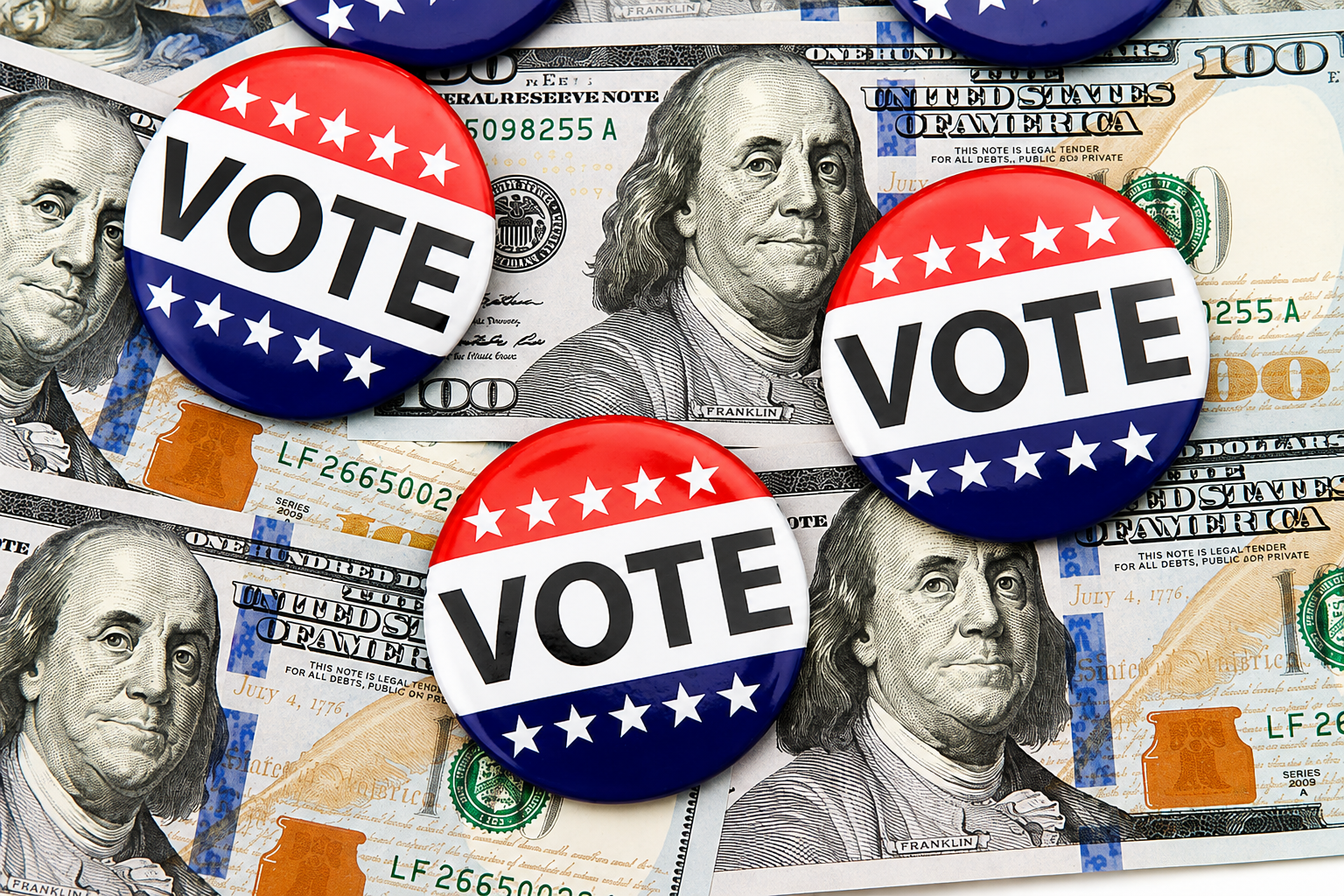
A campaign finance proposal being prepared for a possible 2028 Oregon ballot could change how corporations and other organizations spend money in elections across the state, including county, city and ballot measure campaigns throughout Southern Oregon.
Attorneys and campaign finance advocates associated with Honest Elections Oregon are preparing proposed initiatives that would restrict political spending by corporations and potentially other business entities. The proposals have not qualified for the ballot, and the final language has not yet completed Oregon’s initiative process. Organizers have indicated that filings could begin soon as part of an effort aimed at the 2028 election.
If a proposal ultimately qualifies, receives voter approval and survives anticipated constitutional review, its provisions could apply well beyond races for governor and the Oregon Legislature. Depending on the final language, elections for county commissioners, city councils and other local offices could fall within the new system, along with local ballot measure campaigns. The proposal addresses independent political expenditures, an area of campaign finance that is legally different from contributions made directly to candidates.
Under current federal constitutional law, corporations and labor unions may spend money independently advocating for or against political candidates. Those expenditures cannot legally be coordinated with the candidate when they are classified as independent spending, but they are not subject to the same restrictions that apply to direct campaign contributions.
That framework stems largely from the U.S. Supreme Court’s 2010 decision in Citizens United v. Federal Election Commission. The ruling held that the government cannot prohibit corporations and unions from making independent expenditures for political communications based on the corporate identity of the organization making the expenditure.
The Oregon initiative being developed would attempt a different legal approach. Instead of relying solely on conventional campaign contribution limits, the proposal would use state authority governing corporations and other legal entities to restrict their ability to use organizational funds for election-related spending. The legal theory has not been conclusively resolved by the federal courts. Related proposals have emerged in other states, including Montana and Hawaii, where questions surrounding corporate political spending and state authority are already producing legislative and legal disputes.
For Southern Oregon elections, the practical effect would depend heavily on which organizations are covered by the final Oregon language and what types of expenditures are prohibited. Independent expenditures can currently be used to purchase political advertising without transferring the money to a candidate’s committee. An organization can finance its own mailers, online advertisements, radio advertising and other political communications supporting or opposing candidates as long as the activity satisfies legal requirements governing independent spending.
If the Oregon proposal eventually prohibits covered organizations from making those expenditures, organizations affected by the law would no longer be able to finance those political communications in the same manner. That could apply to elections throughout Josephine, Jackson, Douglas, Klamath and other Southern Oregon counties if the final initiative establishes statewide restrictions covering local contests.
The question could become particularly relevant in county and municipal elections because independent political organizations sometimes participate in campaigns without becoming part of a candidate’s official committee. A restriction applying statewide would establish the same basic rules for covered organizational spending whether the election involved a statewide office, an Oregon legislative district or a local government position. The proposal could also affect ballot measure campaigns if the final language includes spending intended to influence measures rather than limiting its application to candidate elections.
Southern Oregon voters regularly consider local funding measures, bonds, tax proposals, charter amendments and other ballot questions. Organizations sometimes finance advertising supporting or opposing those measures independently of the political committees formally associated with a campaign. Whether those expenditures would be restricted cannot be determined until the Oregon proposal is formally filed and its definitions are available for review.
The organizations covered by the initiative will be another major technical issue because corporations encompass more than publicly traded companies and large employers. Businesses of different sizes can operate under corporate structures, while nonprofit organizations can also be incorporated. Labor organizations and other membership organizations operate under additional legal structures that may be addressed separately. Consequently, the precise definitions contained in the initiative will determine which Southern Oregon organizations could continue making independent expenditures and which would be prohibited from doing so.
The developing proposal is separate from campaign finance changes Oregon has already enacted. Beginning in January 2027, Oregon is scheduled to implement contribution limits established by legislation approved in 2024 and subsequently modified by lawmakers. Those laws regulate money contributed to candidates and political committees and establish additional campaign finance requirements.
Independent expenditures remain a separate component of the system. A contribution involves money provided to a candidate or political committee, while an independent expenditure involves money spent by an outside organization on its own political communication. The proposed initiative would attempt to regulate that second category more extensively.
For a Southern Oregon candidate, the distinction can be straightforward. A covered organization might be prohibited from independently purchasing advertising promoting that candidate even though the candidate never requested, received or controlled the expenditure. The same restriction could apply to independent advertising opposing the candidate. Any restriction written broadly enough to include local ballot measures could similarly affect organizations purchasing advertising surrounding county levies, municipal measures or other local questions presented to voters.
Individual political participation would be governed separately. The developing proposal is directed at the spending authority of corporations and other organizations rather than eliminating the ability of individual Oregon residents to make political contributions or independently express political views. The final initiative language would establish the boundaries between individual spending, organizational spending and political committee activity.
Several steps remain before Oregon voters could encounter such a proposal on a ballot. Initiative sponsors must formally file their language with the state, proceed through Oregon’s review process, obtain the required number of valid signatures and satisfy election deadlines. Challenges over ballot language or constitutional requirements can also arise before an initiative reaches voters.
Approval at the ballot box would not necessarily conclude the matter because federal constitutional protections for independent political expenditures are established under Citizens United and related cases. Restrictions based on the legal status of corporations or other organizations could therefore face federal litigation.
For Southern Oregon, the immediate situation remains unchanged. Corporations, unions, political committees and other organizations continue to operate under existing federal and Oregon campaign finance laws, while Oregon’s previously enacted contribution limits are scheduled to begin in 2027. The proposed 2028 initiative represents a separate possible change, and its direct consequences for elections in Grants Pass, Medford and communities throughout Southern Oregon will become clearer when the proposal is formally filed and the definitions of covered organizations, elections and prohibited expenditures can be examined against the way local campaigns currently operate.