


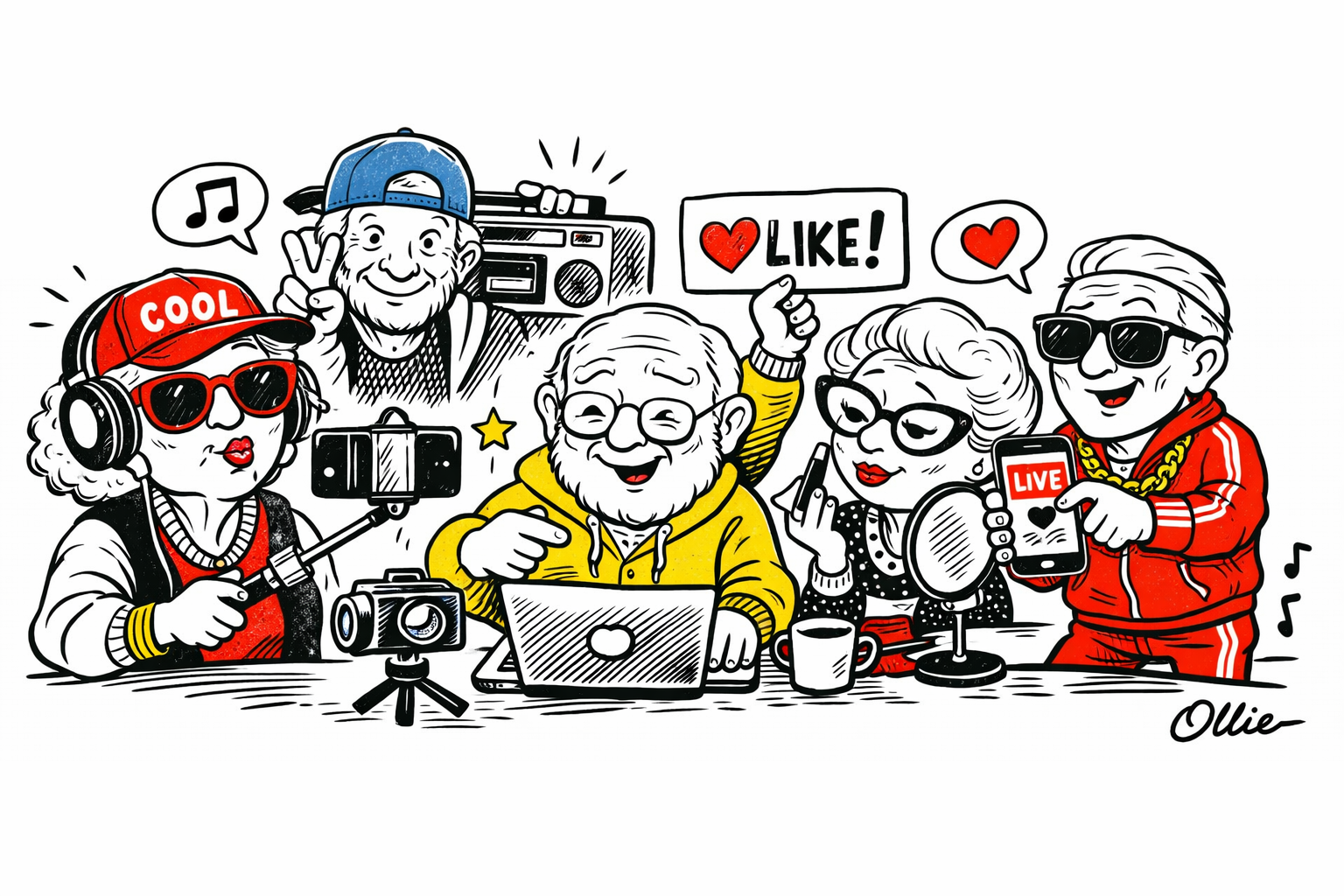
So, you want to be a social media influencer, but you are only a few years away from collecting Social Security. It is a question that carries more weight than it might first appear, because stepping into the digital spotlight at this stage of life is not simply a hobby or a side pursuit, it is a complete shift into a world driven by constant visibility, public judgment, and emotional exposure. What may seem like an opportunity for reinvention can quickly become a test of identity, resilience, and self-worth in an environment that rarely offers stability and never slows down for those unprepared.
The modern influencer economy is not a profession in the traditional sense. It is a performance-driven ecosystem where value is assigned in real time, often by strangers, and often without context. For younger generations raised inside this environment, there is at least some level of conditioning that allows them to absorb criticism, adapt quickly, and separate identity from reaction, even if imperfectly. For many older adults, that layer of conditioning simply does not exist, and the emotional cost of entering this arena can be far greater than anticipated for the thin skinned.
A lifetime of work typically builds a stable sense of self. Skills are developed, reputations are earned, and identity becomes rooted in contribution rather than applause. Social media reverses that equation. Applause comes first, and if it fades, so can the sense of worth for those who begin to depend on it. This creates a subtle but powerful shift from internal confidence to external validation, a transition that can be especially destabilizing for someone already navigating the psychological realities of aging, transition, or loss of professional identity.
In that environment, criticism is not an occasional obstacle, it is a constant companion. It arrives unfiltered, often blunt, sometimes unfair, and rarely delivered with the kind of nuance found in face-to-face interaction. The ability to process that criticism without internal collapse is not optional, it is foundational. Without it, every comment becomes a referendum on self-worth rather than an opportunity for perspective. When that line blurs, defensiveness replaces growth, and reaction replaces reflection.
The uncomfortable truth is that influence requires endurance. It requires the ability to be seen, questioned, disagreed with, and at times dismissed, without unraveling. Constructive criticism, in particular, plays a critical role. It is the mechanism through which content improves, perspective sharpens, and credibility develops over time. When an individual cannot tolerate even measured, well-intended feedback, the platform does not become safer, it becomes more hostile. The absence of resilience invites a cycle of overreaction, public missteps, and increasing scrutiny.
For older adults entering this space, that dynamic can feel less like professional growth and more like emotional exposure. There is often a gap between intention and reality, between the idea of influence and the lived experience of it. Without a strong internal anchor, the pursuit can begin to resemble a search for approval rather than an expression of purpose.
There is also the matter of authenticity. Influencer culture rewards presentation, but sustaining a constructed persona over time demands energy, consistency, and a willingness to adapt to shifting expectations. For someone who has spent decades building a life grounded in reality, the pressure to perform rather than simply exist can create a quiet but persistent strain. The result is often a widening gap between who a person is and who they feel compelled to appear as online.
None of this suggests that older adults should be excluded from digital spaces. On the contrary, lived experience can offer depth and clarity that is often missing in fast-moving online discourse. The issue is not participation, it is preparation. Entering a space defined by public feedback without the ability to absorb that feedback is not just impractical, it is potentially harmful.
If criticism, even when constructive, feels intolerable, then the role itself may be misaligned with personal well-being. Influence is not simply about being seen, it is about being seen and still standing firm in who you are. Without that foundation, the platform does not elevate, it erodes, and you begin to fade into the abyss.
Reinvention later in life can be powerful, but only when it is rooted in stability rather than shaped by the unpredictable tides of attention. In a world where everyone can have a voice, the real challenge is not being heard, it is being able to listen, adapt, and remain intact in the process.