John West is asking Josephine County voters for a return to power, stepping back into the public arena after being recalled by 62% of the voters for the very position he now seeks again. His campaign voice is confident, forceful, and built around a message many residents want to hear. Taxes are too high. Government is spending too much. Working families are getting squeezed.
“Let’s cut taxes and stop taxes that effect working families and seniors on a fixed income deeply,” West wrote in a recent public post. He followed that with a warning, urging voters to reject a measure he claims would raise gas taxes, double payroll taxes, and dramatically increase DMV fees across Oregon.
It is a message designed to connect with frustration. It is also a message that demands scrutiny.
Because once the rhetoric is set aside, a basic and unavoidable question remains. Can a county commissioner actually do what John West is promising?
The answer, grounded in the structure of Oregon government, is NO!
Gas taxes are set by the state legislature. Payroll taxes tied to statewide programs are set by the state. DMV fees are set by the state. These are not policies debated or decided in Josephine County. They are not subject to a vote by county commissioners. They are not within the authority of the office West is running for.
A county commissioner cannot lower the state gas tax. A county commissioner cannot block a statewide payroll tax. A county commissioner cannot prevent DMV fee increases. The position simply does not have that reach.
Yet West presents these issues as central to his campaign, framing them as problems he can directly confront. That disconnect between promise and power is not subtle. It is foundational.
The concern is not whether taxes are too high. Many residents believe they are. The concern is whether a candidate is accurately representing what they can do about it.
When a candidate tells voters he will stop or cut taxes that are controlled entirely outside his jurisdiction, it creates an expectation that cannot be met. That is not a matter of opinion. It is a matter of structure.
West’s own words sharpen that contrast. In one post, he states, “Oregon is already among the top 12 highest gas tax states. Vote no on Measure 120.” He then lists what he describes as the consequences, including a 15 percent increase in gas taxes and a doubling of payroll wage taxes.
Even if those claims were fully accurate in their details, which requires separate verification, the central issue remains unchanged. A county commissioner does not have the authority to enact or stop those changes. At most, they can voice opposition or support. They cannot decide the outcome.
That reality does not appear anywhere in the messaging.
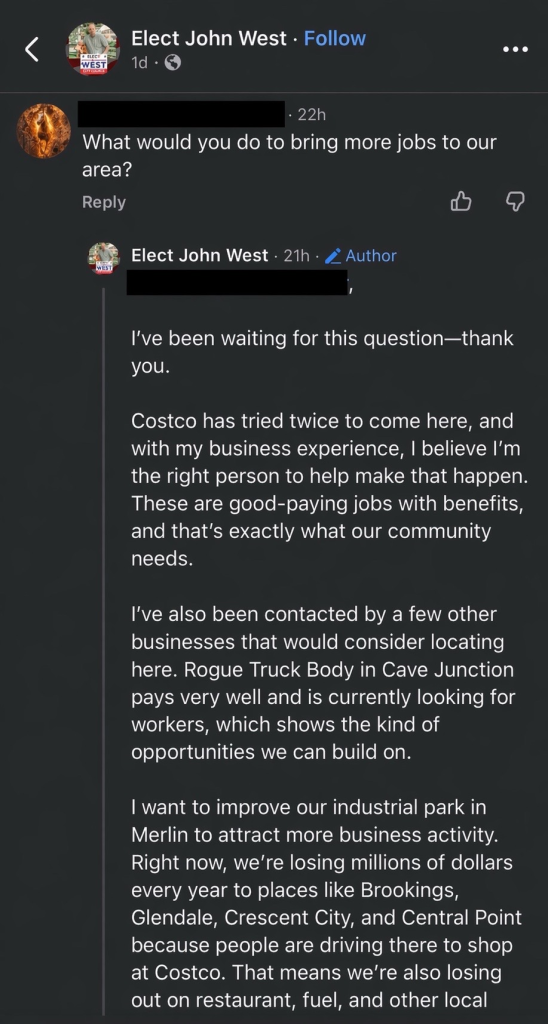
The pattern continues when the conversation turns to economic development. When asked what he would do to bring more jobs to the area, West responded, “Costco has tried twice to come here, and with my business experience, I believe I’m the right person to help make that happen.”
That claim does not hold up under scrutiny.
Independent verification conducted for this report included direct outreach to Costco. Two separate representatives confirmed there are no current plans, no pending proposals, and no ongoing discussions regarding a Costco location in Josephine County. According to those representatives, there has been no engagement with local officials or intermediaries about placing a store in the area.
That alone undercuts the premise of the claim, but the logistical reality goes even further.
Costco’s site selection process is not speculative or political. It is driven by hard metrics. Population density, regional draw, traffic patterns, distribution efficiency, and proximity to existing warehouses all play a decisive role. Josephine County sits within the established service radius of the Medford Costco, which already captures the regional demand. From a corporate standpoint, placing another warehouse within that same corridor would create overlap, not expansion.
The numbers do not support it. The geography does not support it. The company itself does not support it.
The idea that a single county commissioner could “make that happen” collapses under both corporate confirmation and basic retail logistics.
West continues, “I want to improve our industrial park in Merlin to attract more business activity. Right now, we’re losing millions of dollars every year to places like Brookings, Glendale, Crescent City, and Central Point because people are driving there to shop at Costco.”
Here, the argument begins to touch on something real. County infrastructure, land use, and development planning are within the scope of a commissioner’s role. Investment in an industrial park is a tangible policy discussion. But even in this space, the language stretches beyond the limits of certainty.
Attracting business is not a switch that can be flipped. It is a process shaped by market conditions, regional competition, workforce availability, and long-term planning. Suggesting that one office holder can reverse economic trends through intent alone oversimplifies a complex system.
There is a consistent pattern across these statements. Real frustrations are identified. Real issues are named. Then they are paired with promises that exceed the authority of the office being sought.
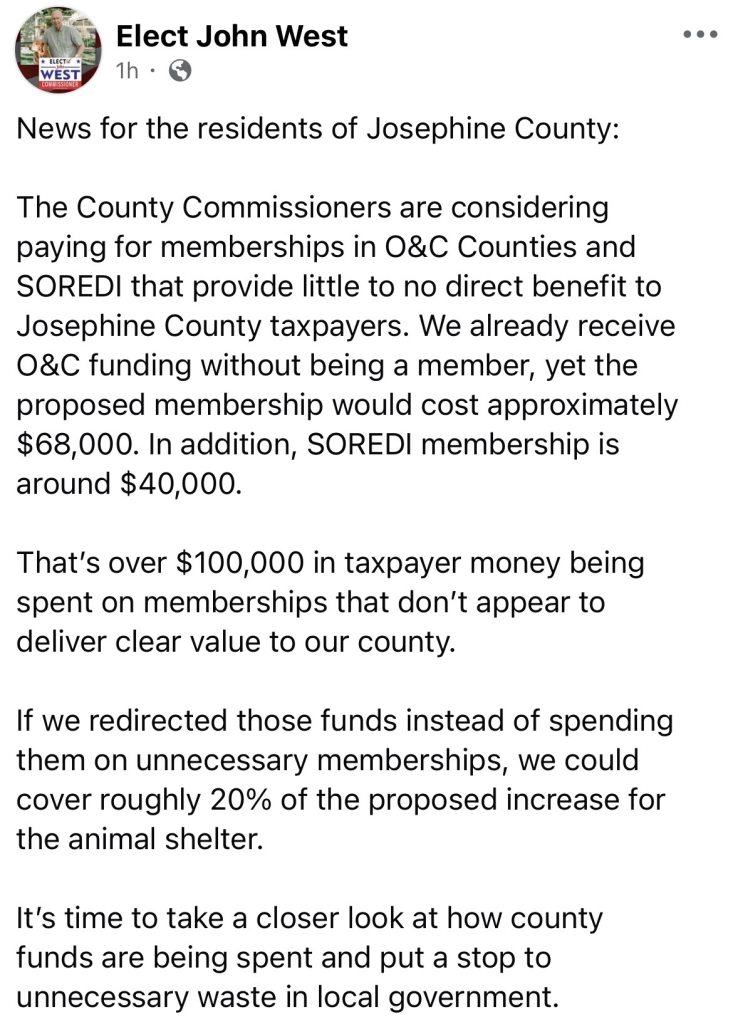
Not every claim made by West falls outside his reach. In a separate statement, he criticizes proposed county spending on memberships in organizations such as O&C Counties and SOREDI, estimating a combined cost of more than one hundred thousand dollars. He argues that those funds could be redirected to local priorities.
That is a legitimate policy position. County commissioners do control budget allocations. They do decide how discretionary funds are spent. They do have the authority to question whether certain expenditures deliver value to taxpayers.
Even there, however, the conclusion is not automatic. Organizations like SOREDI are intended to drive regional economic growth, often producing indirect benefits that are not immediately visible. Whether those memberships are worthwhile is a debate grounded in analysis, not assumption.
That contrast matters because it highlights the difference between advocacy rooted in the actual powers of the office and claims that extends far beyond it.
Josephine County voters are not being asked to evaluate a single issue. They are being asked to evaluate a pattern.
Does John West understand the limits of the position he is seeking?
If he does, why present statewide tax policy as something he can directly control?
If he does not, what does that say about his readiness to return to office?
There is no ambiguity about what a county commissioner can and cannot do. The role is defined. Its powers are established. Its limits are clear. It is not a statewide office. It is not a legislative seat in Salem. It is a local position with local authority.
Campaigns can stretch language. They can amplify concerns. They can simplify complicated systems into digestible talking points. But there is a line between simplification and misrepresentation. When that line is crossed, voters are left with a version of reality that does not match the office on the ballot.
John West’s campaign sits directly on that line.
Some of what he says reflects real issues within his reach. Much of what he promises does not.
That leaves voters with a choice that is less about agreeing with his message and more about trusting the foundation beneath it.
Because at the end of the day, this is not just about taxes or jobs or spending. It is about whether the person asking for power understands the power they are asking for.
And if they do not, the consequences do not fall on the candidate.
They fall on the county.
At some point, voters must confront a difficult but necessary question: are the statements being made by John West the result of a fundamental misunderstanding of the facts, or are they deliberate misrepresentations intended to regain public office? Either possibility should give the public pause. This is not a matter that should be settled by assumption, rhetoric, or even by this publication alone. It demands independent verification. Voters owe it to themselves and to the integrity of their community to examine the record, compare campaign claims against established law, and ask direct, specific questions of the candidate himself. The responsibility does not end at listening; it requires scrutiny. When a candidate’s public assertions appear to diverge sharply from legal realities, that gap must be addressed openly and clearly. An informed electorate is the only safeguard against misinformation, and in this case, the contrast between what is being claimed and what is supported by law warrants careful, deliberate attention.
The accompanying images reflect a series of public statements and representations made by Josephine County commissioner candidate John West, both in direct conversations with constituents and in broader public forums. Taken together, these remarks outline his claims regarding economic development, infrastructure expansion, and future opportunities within the county, including projections about major retail interest, local growth potential, and policy direction. The statements also illustrate how West has communicated his positions and expectations to voters, offering a window into both his campaign messaging and the specific assertions he has made about what can be achieved if elected. These materials are presented to provide readers with a clear, documented reference point of his own words, allowing the public to evaluate the consistency, feasibility, and accuracy of those claims based on the full context in which they were delivered.