


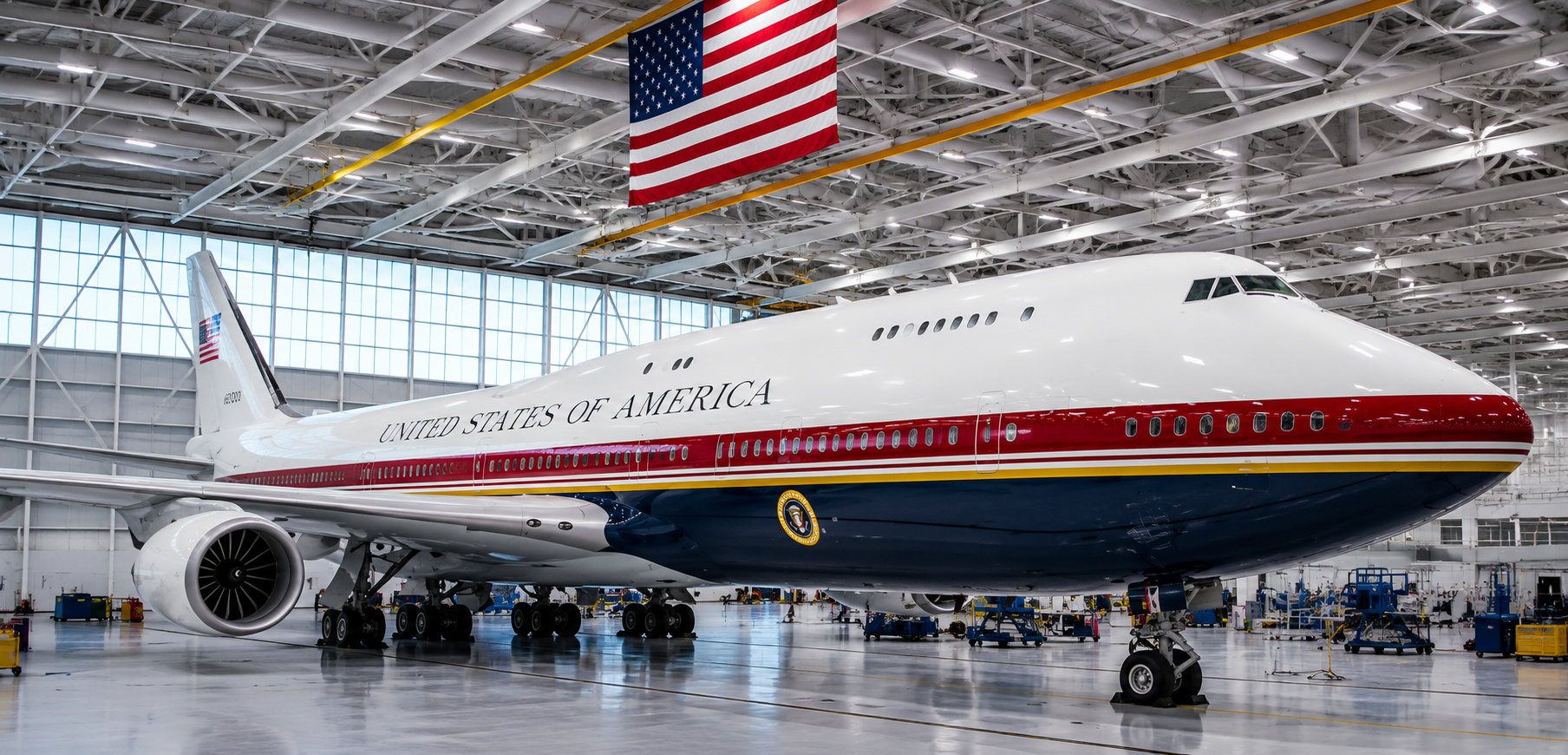
The Boeing 747 that the Trump administration promoted as a faster answer to the long-delayed replacement of Air Force One is heading back for another round of security modifications only weeks after entering presidential service. The latest development has shifted attention away from the aircraft’s transfer from Qatar and toward a question likely to follow the project for years: how much will taxpayers ultimately spend before the aircraft is fully converted into one of the world’s most secure airplanes?
President Donald Trump confirmed that the aircraft will undergo additional upgrades before returning to regular presidential service, describing plans to further enhance its capabilities. The announcement came after the president used one of the older Air Force One aircraft during a recent overseas trip, drawing renewed attention to the status of the converted Boeing 747 and the work still required before it reaches its intended configuration. Public officials have not disclosed the classified systems involved in the latest round of modifications, but the decision makes clear that the conversion project remains ongoing even after the aircraft began transporting the president.
For months, administration officials defended accepting the former Qatari government aircraft as a practical interim solution while Boeing continues work on two long-delayed next-generation Air Force One aircraft. Because the airplane itself was transferred without a traditional purchase price, supporters argued the government avoided buying another aircraft outright. That did not eliminate the cost of transforming the jet into a presidential command platform. Every major communications system, secure network, defensive capability and mission component required for presidential operations must either be replaced, rebuilt or independently certified before military officials can rely on the aircraft for the nation’s most sensitive missions.
Air Force officials have testified before Congress that the conversion is expected to cost less than $400 million, a figure covering the installation of secure communications, presidential mission equipment and other classified systems needed to place the aircraft into service. Critics on Capitol Hill and several aviation analysts contend the government’s estimate may not capture the full taxpayer investment once engineering changes, specialized testing, certification, maintenance infrastructure, training, spare parts and long-term support are included. While some outside estimates have suggested the overall investment could eventually approach or exceed $1 billion, those figures have not been adopted by the Air Force and remain independent projections rather than official government estimates.
The renewed retrofit is expected to require additional engineering, installation work and extensive testing before the aircraft resumes regular presidential operations. Although much of the work remains classified, presidential aircraft must be capable of maintaining secure communications under virtually any circumstance while protecting sensitive information and supporting the president during national emergencies. Those capabilities distinguish Air Force One from every other government aircraft and help explain why converting an airplane originally built and operated for another government is a far more complex undertaking than refurbishing a standard executive jet.
The latest work also renews questions about the compressed schedule used to place the aircraft into service. The converted Boeing 747 began carrying the president while Boeing’s replacement VC-25B aircraft remain years behind schedule. Those purpose-built aircraft were ordered under a multibillion-dollar contract in 2018, but repeated engineering challenges, supply chain disruptions and production delays have pushed expected delivery into 2028 while program costs have continued to rise. The former Qatari aircraft was intended to narrow that gap by providing a newer presidential aircraft years before Boeing’s replacements are ready.
Federal officials have not reported finding hidden surveillance equipment, malicious software or other evidence that the aircraft had been compromised during its previous service. Even so, standard security procedures require exhaustive inspection and verification of systems before any aircraft can be trusted with classified presidential communications. The additional modifications announced this week reflect the continuing effort to ensure the aircraft meets those standards before its conversion is considered complete.
Congress is expected to continue monitoring both the progress and the cost of the project as additional work moves forward. Whether the Air Force ultimately completes the conversion within its current estimate or whether the total taxpayer investment grows as new modifications are added will remain a central issue as the interim Air Force One program advances. For now, the aircraft that was introduced as a quicker bridge to the next generation of presidential transportation is returning for more work, leaving the ultimate cost of that decision unresolved while engineers continue preparing it for the unique demands of presidential service.