


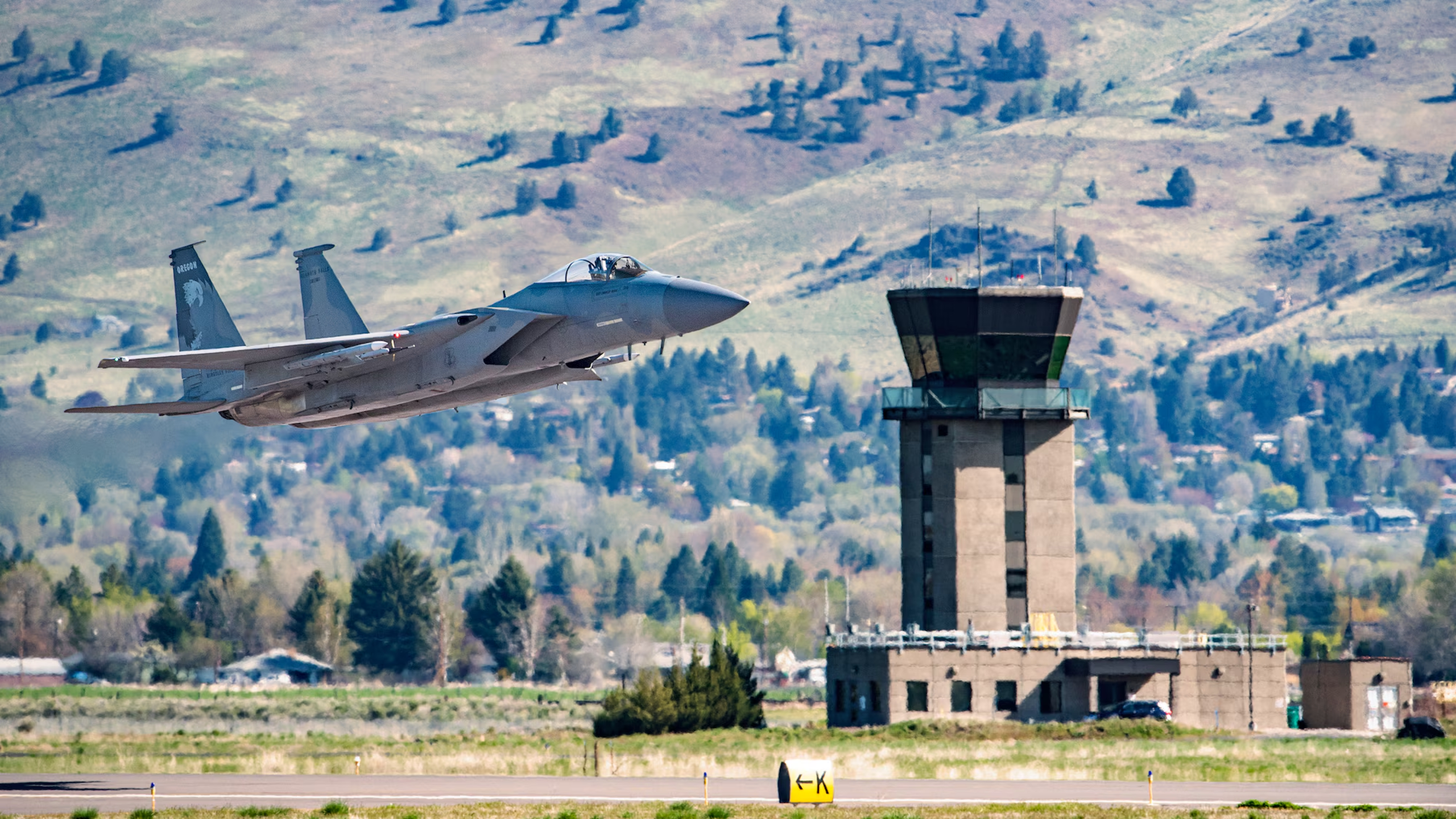
Southern Oregon’s military infrastructure, economic development and role in national defense are at the center of a bipartisan congressional effort to replace an aging jet fuel facility at Kingsley Field in Klamath Falls, where the Oregon Air National Guard is preparing to receive a new generation of military aircraft.
U.S. Senators Jeff Merkley and Ron Wyden, joined by Congressman Cliff Bentz, announced Monday, November 23, that they are urging the Defense Logistics Agency to prioritize construction of a replacement jet fuel facility at the installation, home to the Oregon Air National Guard’s 173rd Fighter Wing. The request comes less than two months after the U.S. Air Force formally authorized Kingsley Field to accommodate a fleet of 26 F-35A Lightning II fighter aircraft.
The congressional delegation cited deteriorating infrastructure, safety concerns and decades of deferred maintenance in its appeal to federal defense officials. Portions of the existing fuel infrastructure date to 1958, with more than 35 years of deferred maintenance contributing to conditions that have required temporary repairs to sustain military operations.
The delegation raised concerns about the facility’s ability to meet federal safety and regulatory requirements while supporting the installation’s expanding responsibilities. Members of Congress described the replacement project as ready for execution and are seeking federal prioritization as preparations advance for the arrival of the first F-35A aircraft, anticipated during the summer of 2027.
Federal records indicate that concerns surrounding the fuel infrastructure have persisted for more than a decade. Department of Defense budget documentation prepared in February 2015 identified environmental and occupational safety concerns at Kingsley Field and included a $2.5 million fuel facility replacement proposal within the Defense Logistics Agency’s fiscal year 2016 military construction budget.
By May 2024, congressional military construction spending disclosures identified a substantially larger funding request of $25,372,000 for fuel facility replacement at Kingsley Field. An additional $80,941,000 was requested for aircraft shelters and associated infrastructure, bringing the combined value of the two proposed military construction investments to more than $106.3 million.
Those figures represent previously submitted congressional funding requests rather than confirmed construction awards. A revised project cost, construction contract and completion schedule have not been announced in connection with Monday’s congressional appeal.
The latest request coincides with one of the most substantial operational transitions in Kingsley Field’s military history. On October 5, 2026, Secretary of the Air Force Dr. Troy Meink signed the formal Record of Decision authorizing the establishment of an F-35A fighter pilot training squadron at the Southern Oregon installation. The decision was subsequently published in the Federal Register on October 23.
The authorization provides for 24 primary aircraft and two backup aircraft, along with construction, renovation and operational modifications necessary to accommodate the advanced fighter fleet. Kingsley Field will become the Air Force’s third formal F-35 training unit, joining established training operations in Arizona and Florida.
Under the leadership of Colonel Adam Gaudinski, commander of the 173rd Fighter Wing, the installation is preparing to transition from its longstanding F-15 Eagle training mission to fifth-generation fighter pilot instruction. The conversion is expected to take place over several years as aircraft, equipment, personnel and supporting infrastructure are introduced.
The expansion carries economic implications for Klamath County and surrounding Southern Oregon communities. Kingsley Field, identified by the congressional delegation as Klamath County’s largest employer, supports military and civilian employment while generating demand for housing, retail businesses, professional services and regional suppliers.
Construction associated with the F-35 transition and proposed fuel facility replacement could create contracting opportunities for engineering firms, construction companies, electricians, equipment suppliers, transportation providers and other skilled trades throughout the region. Federal environmental planning has also identified approximately 30 additional personnel associated with the new aircraft mission, although comprehensive projections for construction employment and broader regional economic activity have not been released.
The installation’s continued modernization represents a potential source of federal investment in a region where rural communities have historically relied on agriculture, timber, manufacturing, healthcare and public-sector employment. Military construction expenditures could introduce additional economic activity into Southern Oregon, particularly if regional businesses secure contracts associated with the expansion.
Beyond its federal training responsibilities, the Oregon Air National Guard maintains a statewide role in emergency response, disaster assistance and civil support operations. The 173rd Fighter Wing has been part of the Oregon Air National Guard since 1983, establishing Klamath Falls as a longstanding component of Oregon’s military presence and the nation’s fighter pilot training network.
Monday’s congressional announcement brings together Oregon’s two Democratic senators and a Republican congressman representing much of Southern and Eastern Oregon in a coordinated effort to secure federal attention for the installation’s infrastructure needs.
The Defense Logistics Agency has not publicly announced whether it will grant the delegation’s request or establish an accelerated construction schedule. Funding authorization, contracting arrangements and the anticipated completion date for the replacement facility remain outstanding.
With the first F-35A aircraft expected to arrive next summer, federal defense officials face an approaching transition at Kingsley Field while Oregon’s congressional delegation continues pressing for the replacement of fuel infrastructure originally constructed nearly seven decades ago.