


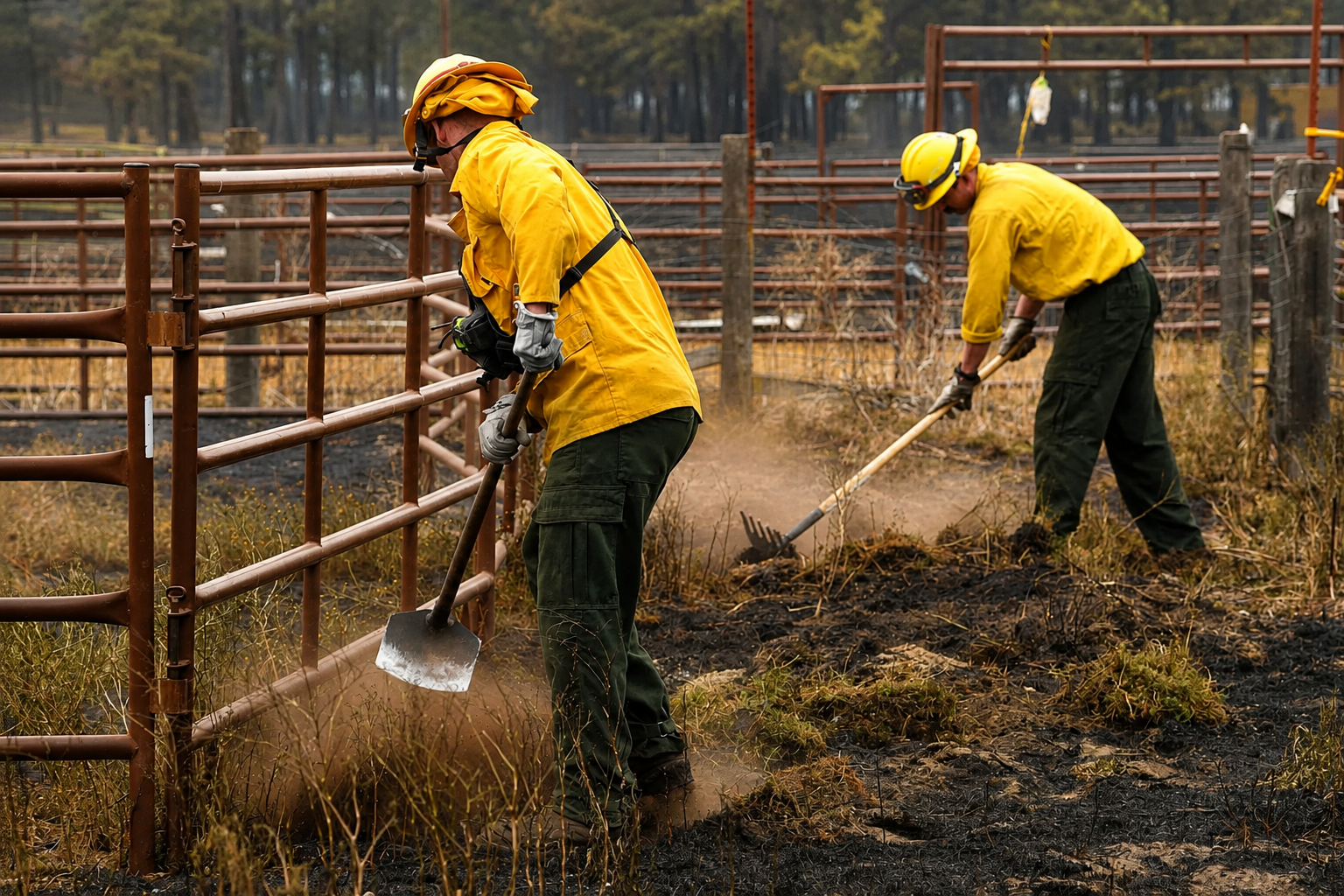
The Wrights Spring Fire continues to command a major emergency response across Klamath County, where a wildfire exceeding 53,000 acres has forced evacuations, threatened rural communities, closed roads and forest lands, and created an unusually large sheltering operation for residents and hundreds of animals removed from properties in the fire’s path.
As of Thursday, August 13, the Wrights Spring Fire was approximately 53,000 acres and 6 percent contained, with nearly 950 personnel assigned to the incident. First detected August 5, the fire is burning primarily within and around the Fremont-Winema National Forest west of Sprague River and southeast of Chiloquin. Its rapid expansion during the first several days spread the emergency across a wide portion of Klamath County, placing homes, ranches, agricultural properties and transportation routes within areas of concern.
Firefighters have been strengthening control lines from the Horton Reservoir area toward Bliss Road while securing portions of the southeastern perimeter. Crews are also suppressing spot fires near Swan Lake Rim and constructing contingency lines southeast of the main fire as protection against possible movement toward Bly Mountain. Structural firefighters remain concentrated around Yonna Woods and Bly Mountain, where preparations are underway to protect homes and other buildings should fire conditions change.
Aircraft continue supporting firefighters working across rugged terrain and extremely dry vegetation. Engines, water tenders, bulldozers and other equipment are operating throughout the fire area as crews reinforce existing lines and establish additional barriers where the fire could advance. Portions of the Fremont-Winema National Forest’s Chiloquin Ranger District remain under an emergency closure covering affected federal lands, roads and trails because of hazards associated with the wildfire and suppression operations.
While firefighters work along the perimeter, evacuation has created a separate and complicated operation throughout Klamath County’s agricultural communities. Moving a household from a rural property can also mean relocating horses, cattle, goats, pigs, poultry and other animals, sometimes on short notice and with several trailers required to complete the evacuation.
That responsibility has brought a remarkable number of animals to the Klamath County Fairgrounds in Klamath Falls.
Designated as a large-animal evacuation location, the fairgrounds has become a central point for livestock displaced by the Wrights Spring Fire. Earlier in the response, approximately 713 animals were being housed there, filling available horse stalls and requiring pigs, goats and smaller livestock to be accommodated in additional barns and holding areas. The number has fluctuated as animals arrive, depart or are transferred to other locations.
Klamath County 4-H members, agricultural organizations and volunteers have been assisting with the extensive daily requirements of caring for evacuated animals. Feeding and watering must continue throughout the day, stalls and pens require cleaning, bedding must be replaced and newly arriving animals have to be placed where they can be safely accommodated.
The operation has created demand for grass hay, animal bedding and shavings, poultry feed, cat and dog food, pig feed, bowls, cages and other supplies needed to sustain a temporary livestock population of this size.
Capacity has become an important consideration as the evacuation continues. Livestock owners have been asked to coordinate before transporting animals to the fairgrounds because available space can change rapidly. Southern Oregon Emergency Aid has been coordinating placements and helping connect displaced animals with private pastures, corrals and other suitable locations throughout the region when additional accommodations are necessary.
Residents displaced from their homes are being assisted through a separate sheltering system. Level 1, Level 2 and Level 3 evacuation notices remain part of the emergency response in affected areas, with authorities directing residents to current Klamath County evacuation information because boundaries can change with fire behavior and suppression progress.
Emergency shelters have been established at Chiloquin Elementary School in Chiloquin and Living Springs Fellowship in Bonanza. Both locations can accommodate residents with small animals, while horses and other large livestock are being directed through the coordinated agricultural sheltering system.
Fire operations have also altered travel across portions of Klamath County. Sections of Sprague River Road and Bliss Road have been closed as firefighters and heavy equipment move through the area. Motorists without an emergency reason to enter affected areas are being asked to stay clear so engines, tenders, bulldozers and other response vehicles can operate without additional traffic.
A temporary flight restriction remains over the incident, prohibiting unauthorized drones from entering airspace being used by firefighting aircraft.
State and federal resources have expanded with the size of the emergency. Oregon’s Emergency Conflagration Act was invoked during the fire’s rapid growth, allowing structural firefighters and equipment to be mobilized from across the state. FEMA approved a Fire Management Assistance Grant on August 9, making federal assistance available for eligible firefighting and emergency-response expenses incurred by state, tribal and local governments.
The fire has also resulted in a fatality. Jason Ensign, 47, of Klamath Falls, a contract bulldozer operator working on the incident, died August 6 after rapidly changing fire conditions during the early expansion of the wildfire reportedly prevented his escape.
Beyond the immediate fire response, agricultural damage could remain after evacuation orders are lifted. Fences, water troughs, pipelines, springs and grazing infrastructure may require inspection or repair, while fire-damaged grazing allotments could remain unavailable as vegetation recovers.
With containment remaining at 6 percent Thursday, firefighters continue working across a perimeter surrounding more than 53,000 burned acres. At the same time, the emergency response throughout Klamath County continues on another front as shelters house displaced residents, the fairgrounds accommodates evacuated livestock, and 4-H members, agricultural organizations and volunteers care for animals awaiting a safe return to properties across the fire-affected region.