


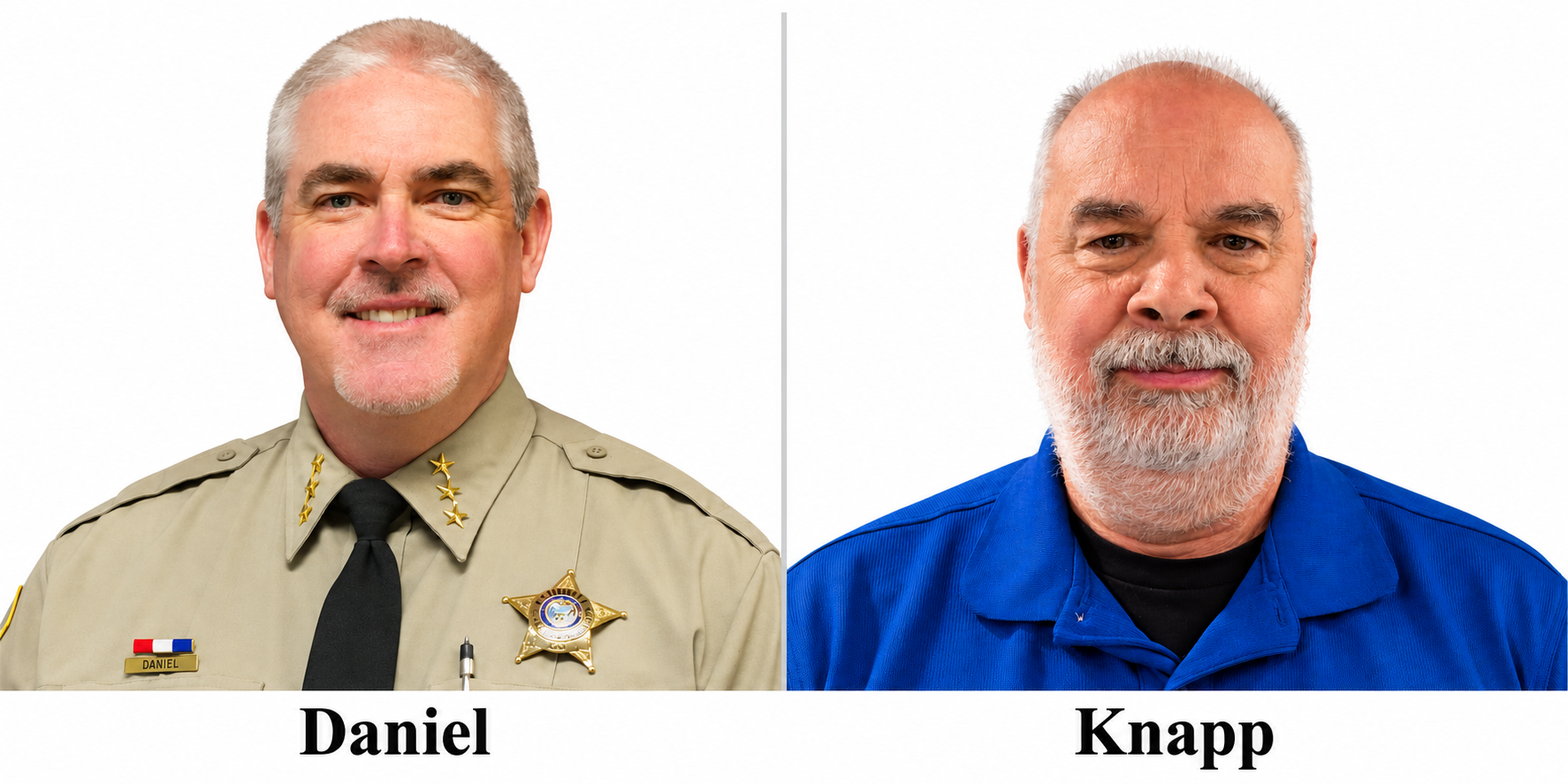
Josephine County’s next sheriff will inherit the responsibility of maintaining law enforcement coverage across a sprawling rural county, managing a financially demanding jail system and addressing persistent concerns about staffing, criminal investigations and public safety. With the November 3 general election approaching, incumbent Sheriff Dave Daniel and challenger Jonathan Knapp are presenting competing plans for the future of an agency whose decisions affect thousands of residents from Grants Pass to the Illinois Valley and beyond.
The contest brings nearly three decades of local law enforcement experience under Daniel against Knapp’s proposals for changes in department management, rural patrol deployment and jail financing. Both candidates place public safety at the forefront of their campaigns, but their positions diverge considerably over the proposed jail levy, detention capacity and the best use of available resources.
At issue is more than who wears the sheriff’s badge. The election will determine how the county approaches the daily demands of emergency response, criminal investigations, jail operations and law enforcement services in communities where deputies may travel considerable distances to answer calls for assistance.
Dave Daniel: Maintaining Jail Capacity and Expanding Existing Law Enforcement Operations
Sheriff Dave Daniel is seeking another term with an emphasis on preserving the department’s established programs, maintaining detention capacity and expanding law enforcement coverage as staffing and financial resources permit.
Daniel has led the Josephine County Sheriff’s Office for nearly 12 years and has approximately three decades of experience in local law enforcement. His administration has overseen the development of around-the-clock patrol operations, a major crimes detectives division, the Josephine Marijuana Enforcement Team and a K-9 program.
Central to Daniel’s public safety position is support for renewing the existing jail and juvenile detention levy at 93 cents per $1,000 of assessed property value. Approximately 89 cents of that rate would support adult jail operations, while four cents would go toward juvenile detention services.
Daniel maintains that preserving the jail’s ability to accommodate up to 185 adults in custody is essential to effective law enforcement. Without adequate detention funding, he warns that Josephine County could experience conditions resembling the severe financial reductions of 2012, when the jail population fell to approximately 40 to 50 inmates and restrictions limited which offenders could remain in custody.
Rural patrol coverage is another priority. Daniel supports hiring additional deputies, improving deployment according to calls for service and restoring a resident deputy program that was suspended because of staffing shortages.
The resident deputy initiative would place personnel closer to outlying communities, reducing travel distances and increasing opportunities for deputies to address recurring local concerns. Daniel has identified a $13,000 federal grant application as one potential resource for supporting overtime associated with the program.
His law enforcement priorities also include maintaining specialized investigations involving drug trafficking, violent crime, domestic violence, child abuse and other serious offenses.
Daniel supports continued cooperation with the District Attorney’s Office, Oregon State Police, Grants Pass Police Department and regional victim assistance organizations. He also favors maintaining existing accountability policies, financial oversight procedures and outside investigations when potential conflicts of interest arise.
His approach emphasizes continuity in department leadership, retention of established law enforcement programs and securing the financial resources necessary to maintain existing operations.
Jonathan Knapp: Restructuring Jail Financing and Increasing Rural Law Enforcement Coverage
Jonathan Knapp is seeking to replace Daniel with a plan centered on changes to jail financing, patrol staffing, investigative resources and department administration.
Knapp brings approximately 20 years of law enforcement experience, along with a bachelor’s degree in public safety administration and a master’s degree in business management.
His opposition to the proposed jail levy represents one of the clearest differences between the candidates.
Knapp questions whether the county’s current financial approach is justified by the jail’s actual inmate population, particularly when operating expenses are calculated around a detention capacity of 185 adults. He has raised concerns about the relationship between available beds, average occupancy and the financial obligations imposed on property owners.
Rather than continuing the existing funding structure, Knapp proposes charging outside law enforcement agencies for the actual costs of housing individuals they arrest. His proposal would seek financial contributions from agencies using the county jail, including those operating within Grants Pass.
Knapp also advocates changes to rural patrol deployment, including maintaining at least four deputies on duty and establishing substations in communities such as Wolf Creek, Williams and Cave Junction.
His proposals include creating a trained volunteer posse to assist with traffic control, scene security and other nonviolent assignments, allowing sworn deputies to concentrate on emergency response, criminal investigations and more serious law enforcement duties.
Additional investigative personnel, expanded school resource officer coverage and a dedicated traffic enforcement unit are also among his priorities. Knapp proposes developing a traffic enforcement operation intended to support its own costs through available revenue mechanisms.
Department recruitment and retention represent another part of his approach. Knapp supports competitive compensation, improved training, professional supervision and administrative practices designed to maintain an experienced workforce.
He also advocates greater public access to information concerning department expenditures, staffing and operational performance.
His proposals emphasize expanding the availability of law enforcement personnel in rural communities while reconsidering how detention services are financed and how departmental resources are distributed.
Jail Funding and Rural Patrols Draw the Sharpest Differences
The proposed five-year jail and juvenile detention levy, Measure 17-129, has become a defining issue in the sheriff’s race. The measure would continue the existing property tax rate of 93 cents per $1,000 of assessed value, with an estimated $57.1 million generated over five years.
Daniel supports the measure as a means of maintaining detention operations and ensuring that law enforcement agencies can bring arrested individuals to the county jail. Knapp opposes it, questioning the funding arrangement and proposing that agencies using the jail contribute directly toward detention costs.
Their differences extend to rural patrol coverage. Daniel points to ongoing recruitment, data-based deployment and the restoration of resident deputies. Knapp advocates specific minimum staffing levels, rural substations and additional volunteer support.
Both identify serious criminal investigations, employee recruitment and cooperation with other law enforcement agencies as essential responsibilities. Daniel emphasizes the programs and partnerships developed during his administration, while Knapp proposes expanding investigative personnel, school resource officers and traffic enforcement.
The candidates have also addressed the importance of impartial policing, public accountability and responsible management of department expenditures, with Daniel emphasizing existing policies and Knapp calling for changes in departmental oversight and public reporting.
The November 3 election places two different approaches to Josephine County law enforcement before voters at a time when detention financing, rural patrol staffing and the cost of maintaining public safety services remain unresolved concerns.
Daniel is seeking to continue the operations and programs established during his tenure, supported by renewed jail funding, additional personnel and existing partnerships. Knapp is seeking changes to detention financing, broader rural patrol coverage and an expansion of specialized law enforcement services.
Both candidates have presented their priorities for the Sheriff’s Office, giving Josephine County residents specific positions to consider as they prepare to select the county’s next sheriff.
The outcome will determine who leads the department through the next term, while the separate levy vote will help establish the financial resources available for one of the county’s most significant public safety responsibilities.