


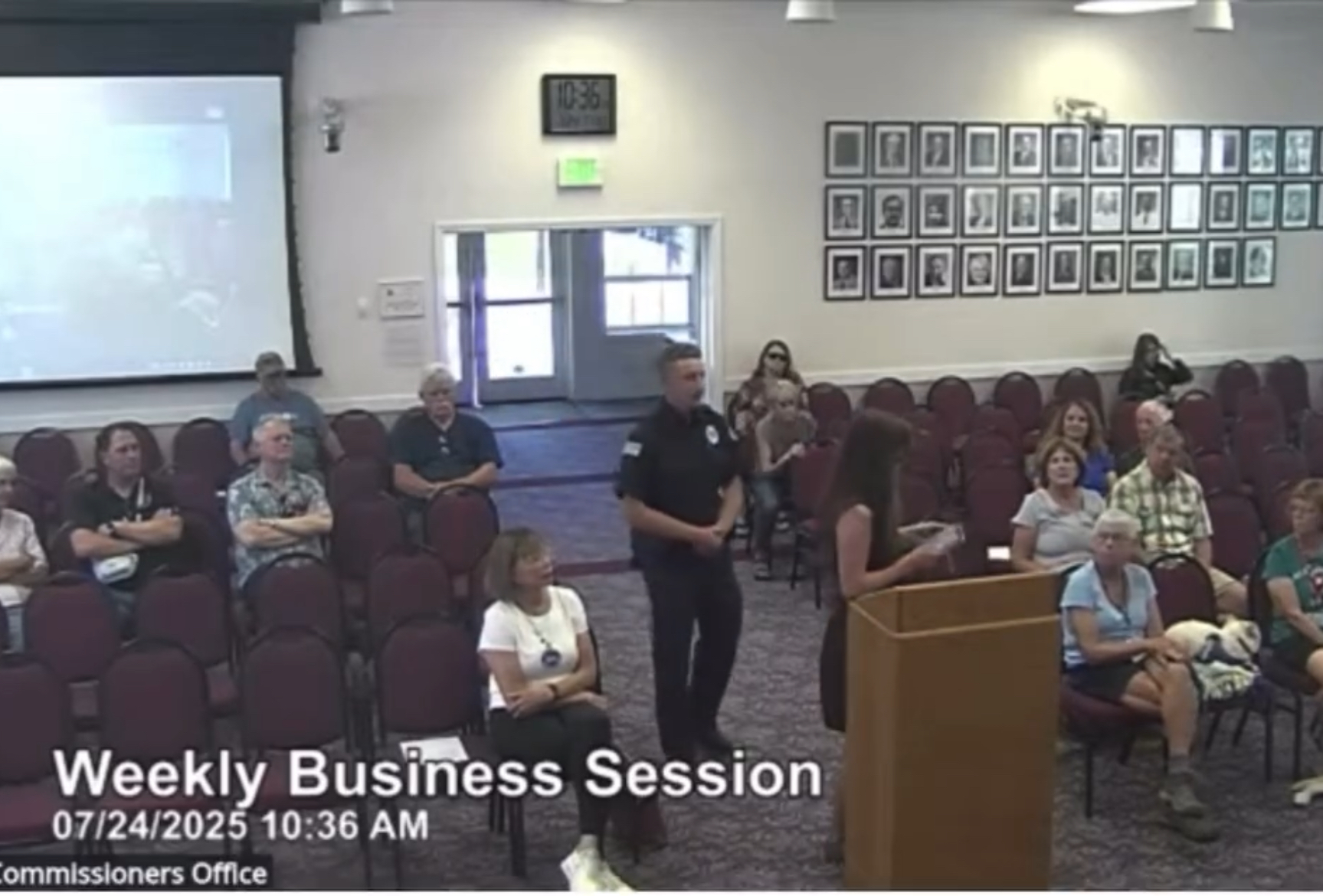
During Wednesday’s Josephine County Board of Commissioners Weekly Business Session, a troubling scene unfolded that further illustrates a widening disconnect between local government and the citizens it claims to serve.
Resident Vanessa Ogier, a respected community advocate who ran for Grants Pass City Council last year, approached the podium during public comment to address what many have called a critical failure in emergency response during the recent Board Shanty Fire. Her statement, measured and articulate, criticized the county’s emergency management operations—particularly the lack of public notification and coordination that left many residents in the dark as flames crept dangerously close to homes and vulnerable populations.
Ogier’s concerns were not isolated. Her remarks reflected those of a community shaken by the reality that, without updates from the Oregon Department of Forestry (ODF) and third-party emergency crews, many residents—especially the elderly without internet or social media access—might not have known a fire was even underway. Meanwhile, the Josephine County Board of Commissioners spent the days following the incident praising Emergency Management Director Michael Sellers and the overall response effort, seemingly detached from the on-the-ground experiences of the public they serve.
Yet Ogier’s efforts to hold the board accountable were abruptly halted. As her speech extended just six seconds past the three-minute public comment limit, appointed Commissioner Andreas Blech, not known for his tolerance of dissent, snapped into action. Rather than allow her to wrap up a sentence or finish her point—as is often permitted for favored speakers—Blech barked over her voice and promptly demanded she leave. When she did not immediately comply, he escalated matters by calling in security to have her forcibly removed from the room.
This aggressive response to a calm, poised, and factual statement raises serious questions about the democratic process in Josephine County. Ogier was not shouting. She was not disruptive. Her only offense was daring to confront the board with a truth it did not want to hear.
At the core of her remarks was a damning indictment of the county’s restructured emergency management system. Ogier highlighted how emergency preparedness and response efforts had been stripped down and consolidated under an IT-heavy framework that is fundamentally incompatible with public safety coordination. She pointed to the lack of training, certification, or experience among those now managing life-and-death situations—positions once held by seasoned public safety professionals, now handed to politically connected appointees.
Ogier also referenced past failures, including the March 2025 floods, during which no centralized alerts, road closure updates, or evacuation protocols were communicated. The county’s emergency website lagged behind by nearly 24 hours, and the social media response was reduced to reposting content from other agencies, offering no original or actionable information. In her words, this is not just bad performance—it is operational negligence.
In the final portion of her remarks, Ogier proposed a path forward: encouraging neighborhood-level emergency planning and communication, something she noted would become critical in the face of future disasters. But that message was cut short—not by time, but by ego.
Commissioner Andreas Blech, who was never elected by the people of Josephine County but instead appointed by Barnett and Smith, has developed a reputation for condescension and control. His action on Wednesday was not about time limits. It was about power.
Other speakers in past meetings have frequently gone over time without consequence—particularly those praising the board or aligning with its political direction. But when voices like Ogier’s challenge the narrative, the rules are suddenly enforced with authoritarian precision.
This is not just a story about a woman being silenced. It is about a government that no longer tolerates public oversight. It is about a board so insulated in its own self-congratulation that it views criticism as a threat rather than an opportunity to improve. And it is about a county in crisis—not just from wildfires, but from the wildfire of arrogance spreading through its leadership.
As the smoke clears from the Board Shanty Fire, another fire still burns—one fueled by broken trust, silenced voices, and a leadership structure more interested in controlling the message than protecting the public. The residents of Josephine County deserve better than a board that pats itself on the back while calling security on the people they are sworn to serve.