


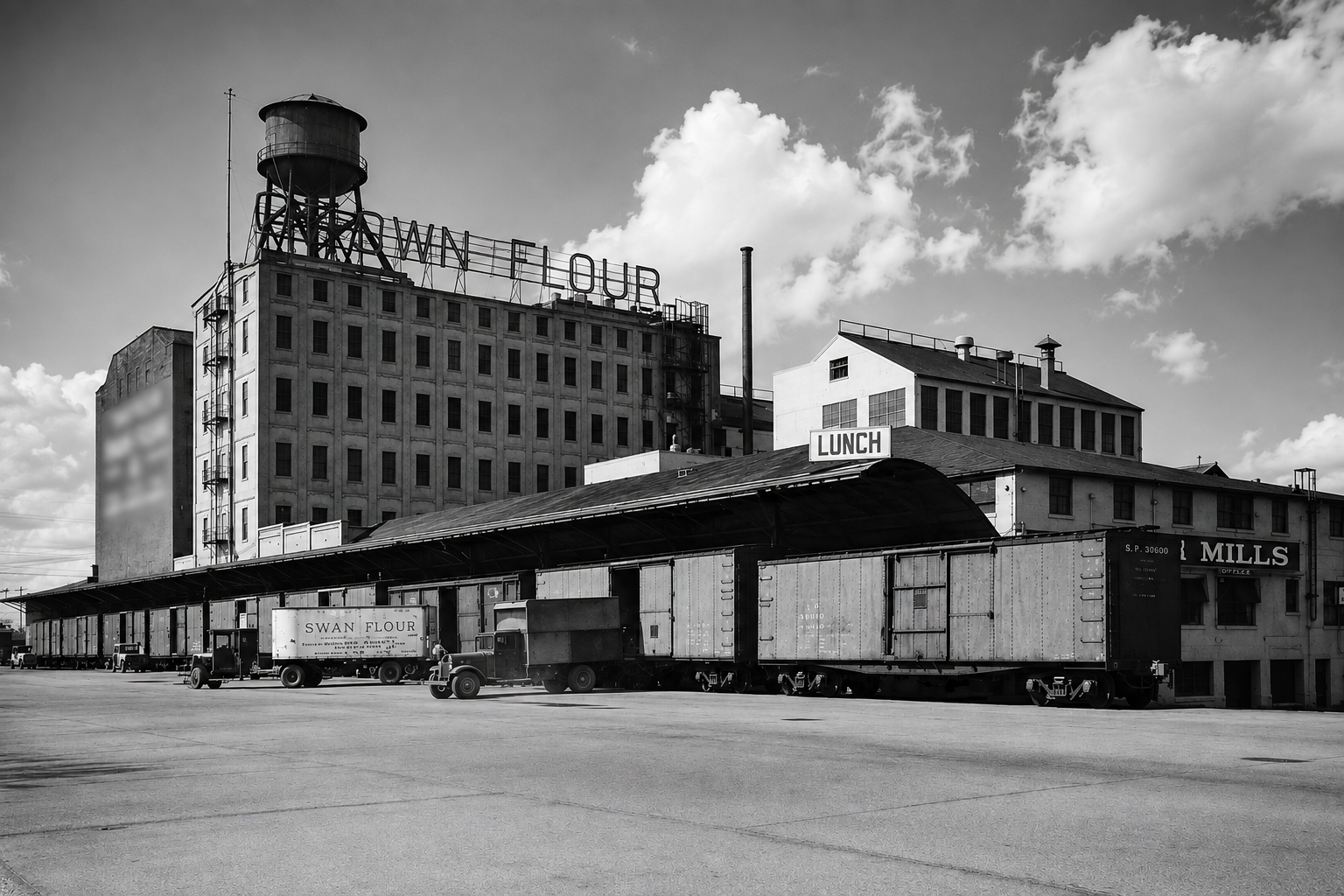
For more than a century, Centennial Mills occupied a piece of Portland’s waterfront where the city’s industrial past remained visible in brick, timber and steel. It survived changing economies, redevelopment proposals, partial demolition and decades of debate over what should become of the aging complex. Now, after fire left the remaining warehouse dangerously unstable, Portland is preparing for a demolition that will remove a familiar landmark while resolving a growing public safety problem along the Willamette River.
The final chapter is expected to become unmistakably visible Monday afternoon, August 17, when demolition contractors plan to use controlled explosives to bring down the property’s prominent water tower. The operation will begin a methodical removal of what remains of the approximately 116-year-old industrial complex along Northwest Naito Parkway, bringing an end to a structure that generations of Portland residents have associated with the city’s working waterfront.
Centennial Mills dates to an era when Portland’s proximity to the Willamette and Columbia rivers helped transform the city into an important commercial center for agricultural products moving through the Pacific Northwest. Grain, flour, railroads, ships, docks and warehouses were not background features of Portland’s economy; they were fundamental pieces of it. Industrial complexes along the river connected Oregon farms and businesses with national and international markets, and Centennial Mills became one of the physical reminders of that period.
Much of the original complex had already disappeared. A major selective demolition project conducted in 2015 and 2016 removed deteriorating structures and unsafe wharves while preserving portions of the historic property and salvaging materials. Over the years, the future of the waterfront site generated repeated discussions about preservation, redevelopment and how Portland should handle a prominent but increasingly difficult industrial property.
Those discussions changed dramatically after the August 2 fire.
Nearly 100 firefighters responded when the blaze grew to four alarms, and the fire caused extensive structural damage throughout the eight-story warehouse. Floors collapsed, remaining exterior portions became unstable and concerns quickly shifted from the property’s long-term redevelopment possibilities to the immediate danger posed by what was left standing.
The problem was compounded by the building’s location beside active Union Pacific railroad tracks. Portland officials warned that an uncontrolled collapse could threaten passing trains, railroad employees and nearby property. Rail operations subsequently became part of a complicated safety dispute as freight traffic continued through an area where the damaged warehouse remained capable of collapsing.
Mayor Keith Wilson declared a local emergency, allowing the city to establish a coordinated incident command structure and accelerate its response. City officials and Union Pacific worked through questions surrounding freight movements, train speeds and precautions near the building. Portland also raised concerns after learning that rail cars containing toxic inhalation hazard chemicals had moved through the collapse zone while the structure remained unstable.
Environmental concerns added another dimension. Debris testing detected asbestos and lead, requiring demolition planning to account not only for falling walls and heavy materials but also for the possibility that contaminated dust and fibers could become airborne. Residents and businesses near the property are being advised to remain indoors during the initial explosive operation and until visible dust has cleared. Nearby Fields Park is closed, and a 300-foot exclusion area is expected to be established around the demolition zone.
Monday’s controlled operation will be carefully staged. Contractors plan four simultaneous explosive charges to bring down the water tower, with warnings issued before detonation and sirens sounding as the operation approaches. Afterward, heavy equipment will continue dismantling unstable walls while crews attempt to contain debris within the property’s footprint. Reducing the remaining structure to roughly half its current height could take as long as two weeks, while completing the larger cleanup operation may require several weeks.
For residents elsewhere in Oregon, the direct effects should be considerably smaller. The demolition itself is a Portland-area public safety and environmental operation rather than a statewide emergency. However, Centennial Mills sits beside an important freight corridor, giving the situation economic relevance beyond the immediate neighborhood. Union Pacific moves hundreds of thousands of rail cars through Oregon each year, carrying products and materials used by businesses throughout the state. Maintaining safe movement through Portland’s rail network matters to industries and communities far beyond the city limits.
There is also a broader Oregon story contained in the loss of Centennial Mills. Portland developed as an economic gateway for products originating throughout the state, particularly agricultural and natural-resource commodities. The old waterfront warehouses and mills were physical links in a commercial chain that connected rural Oregon with Portland’s docks and ultimately with markets around the world. Removing Centennial Mills does not erase that history, but it does remove one of its increasingly rare physical witnesses.
For longtime residents, Centennial Mills was not necessarily beautiful in a conventional sense. Its weathered industrial appearance was part of the waterfront landscape, a reminder that Portland’s riverfront existed as a workplace and transportation hub long before residential towers, parks, restaurants and modern redevelopment reshaped surrounding neighborhoods.
Its disappearance therefore represents both loss and necessity. Historic buildings can preserve a city’s identity, but preservation becomes considerably more difficult when a structure has suffered catastrophic fire damage, contains hazardous materials and presents a credible threat of uncontrolled collapse beside an active railroad. After two weeks of emergency planning, transportation concerns, environmental testing and public debate, the city now has a defined route toward removing that danger.
What eventually replaces Centennial Mills will become another chapter in the long evolution of Portland’s waterfront. What disappears during the demolition is something considerably older: one of the remaining silhouettes of an industrial Portland built around mills, warehouses, railroads and river commerce.
By the time the cleanup is complete, the waterfront will be safer and a serious structural hazard will have been removed. It will also look different. After approximately 116 years beside the Willamette, Centennial Mills is reaching the end of its physical life, leaving Portland with the responsibility of remembering why the landmark stood there in the first place and what it represented in the development of the city and Oregon’s economy.