


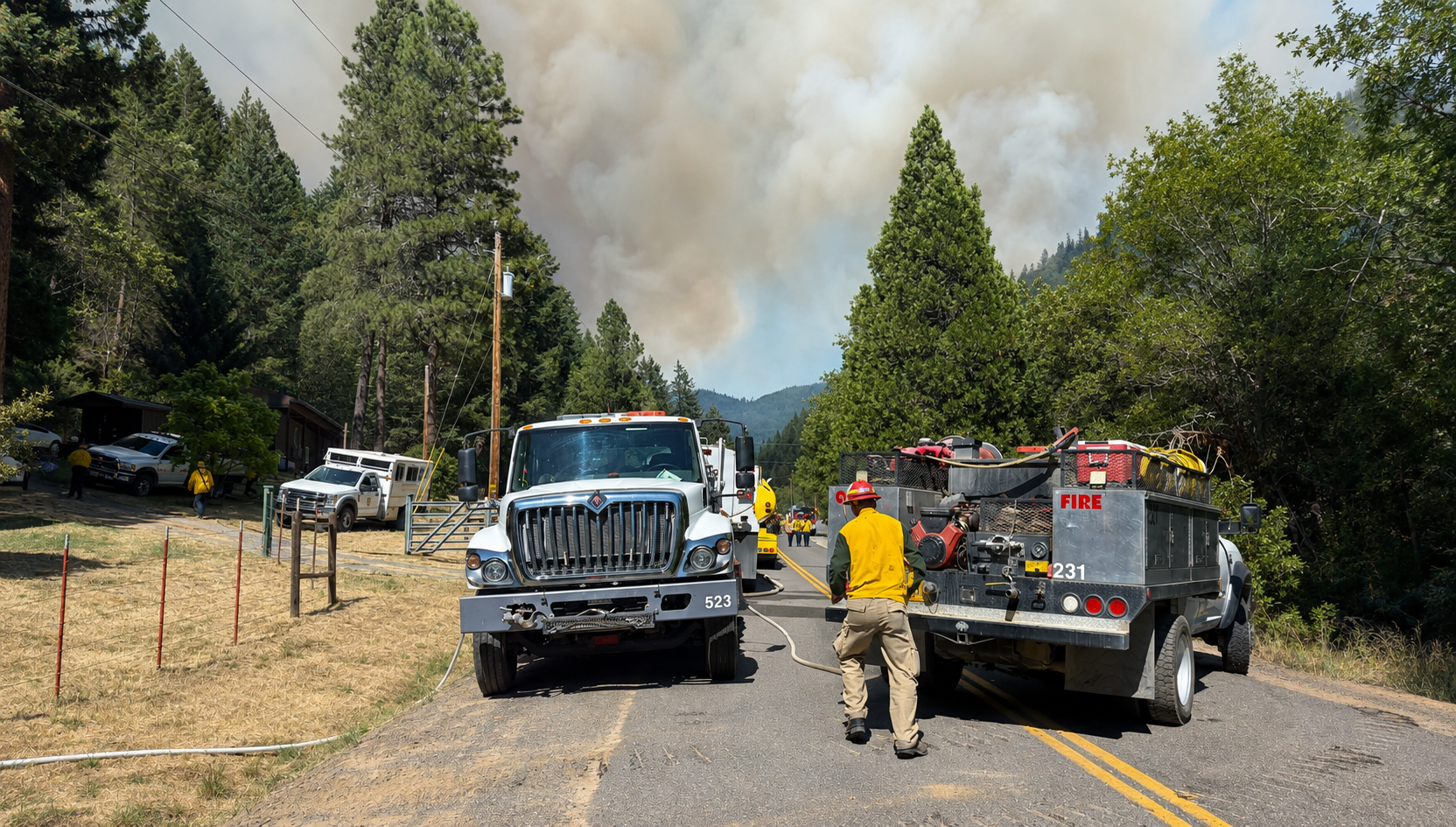
What began as a roadside fire in northern Jackson County has rapidly grown into Oregon’s largest active wildfire, drawing hundreds of firefighters, aircraft, heavy equipment, and structural protection resources from across the state as crews work to protect homes and slow the fire’s advance through rugged forestland north of Rogue River.
The East Evans Creek Fire has quickly become the region’s most significant wildfire emergency of the summer, expanding from a small ignition Friday afternoon into a fast-moving incident that has forced evacuations, closed major roadways, and prompted one of Oregon’s largest coordinated firefighting responses this fire season. As flames continue burning through steep terrain north of Medford, emergency officials are urging residents throughout Southern Oregon to remain vigilant as weather conditions and difficult topography continue to challenge suppression efforts.
The wildfire was first reported Friday afternoon in the 18000 block of East Evans Creek Road, approximately 26 miles north of Medford. Preliminary information indicates the fire began after a motor vehicle crash involving a power pole and a downed electrical line ignited dry roadside vegetation. Firefighters responding to the collision immediately transitioned from assisting at the crash scene to attacking a rapidly spreading wildfire. The official cause remains under investigation.
Within only a few hours, the fire expanded dramatically as hot temperatures, critically low humidity, gusting afternoon winds, and exceptionally dry vegetation combined to create dangerous burning conditions. By Saturday, the fire had grown to approximately 2,000 acres, with subsequent infrared mapping placing the burned area at roughly 2,655 acres. Fire managers caution that acreage estimates remain subject to change as additional aerial mapping is completed and firefighters gain improved access to remote portions of the fire perimeter.
The fire is burning across a combination of private property and Bureau of Land Management lands characterized by steep slopes, dense brush, mature timber, and hazardous standing dead trees. Portions of the fire are also burning through previous burn scars, creating an unpredictable landscape for suppression crews. Wind-driven embers have repeatedly ignited spot fires well ahead of the main fire, allowing flames to spread rapidly across difficult terrain before containment lines can be fully established.
As the threat to nearby homes and communities intensified, Governor Tina Kotek invoked Oregon’s Emergency Conflagration Act, authorizing the Oregon State Fire Marshal to mobilize structural firefighting resources from departments throughout the state. The declaration has brought additional engines, firefighters, and specialized equipment to Southern Oregon, allowing local agencies to concentrate on wildfire suppression while structural protection teams defend homes and businesses threatened by advancing flames. The activation marks the first use of the Emergency Conflagration Act during Oregon’s 2026 wildfire season.
The firefighting effort has continued to expand as the incident has grown in size and complexity. More than 400 personnel are now assigned to the fire, supported by helicopters, fixed-wing aircraft, bulldozers, water tenders, engines, hand crews, and other specialized equipment. Oregon Department of Forestry Incident Management Team 1 has assumed command in unified command with the Oregon State Fire Marshal’s Blue Incident Management Team, allowing local Southwest Oregon District firefighters to remain available for additional fire starts elsewhere in Jackson and Josephine counties during what is expected to be an active wildfire season.
Evacuation orders remain in effect for neighborhoods surrounding the fire. Areas facing the greatest immediate threat continue under Level 3 “Go Now” evacuation orders, while nearby communities remain under Level 2 “Be Set” and Level 1 “Be Ready” notices as fire behavior continues to evolve. Emergency managers continue monitoring conditions around the clock and emphasize that evacuation boundaries may change quickly should fire activity increase or weather conditions deteriorate. Residents are encouraged to remain prepared, monitor official emergency notifications, and leave immediately if their evacuation level is upgraded.
Road closures also remain in place throughout the Evans Creek corridor to provide firefighters with safe access for suppression operations. East Evans Creek Road remains closed near Meadows Road, while West Fork Evans Creek Road and several surrounding routes continue to experience restrictions. Officials are asking motorists to avoid the area altogether unless travel is absolutely necessary, noting that unnecessary traffic can delay emergency operations and create additional safety hazards.
Emergency shelters have been established for residents displaced by the wildfire, while separate facilities are caring for evacuated horses, livestock, and household pets. Local emergency management agencies continue coordinating shelter operations to ensure both residents and animals have access to temporary accommodations for as long as evacuation orders remain in effect.
Although firefighters have made steady progress protecting structures and strengthening containment lines, officials stress that the fire remains an active and evolving incident. Crews continue reinforcing fire lines, extending hose systems into remote terrain, removing hazardous trees, and improving access for equipment as they work to limit additional growth. Continued warm temperatures, low humidity, and periodic gusting winds are expected to remain significant challenges until weather conditions improve.
For Southern Oregon, the East Evans Creek Fire is a stark reminder that wildfire season has entered its most dangerous period. With forests and grasslands remaining exceptionally dry throughout the Rogue Valley and surrounding mountains, fire officials continue urging residents to remain prepared, respect all evacuation notices and road closures, eliminate activities capable of starting new fires, and stay informed as firefighters work around the clock to protect lives, homes, and the communities that remain in the fire’s path.