


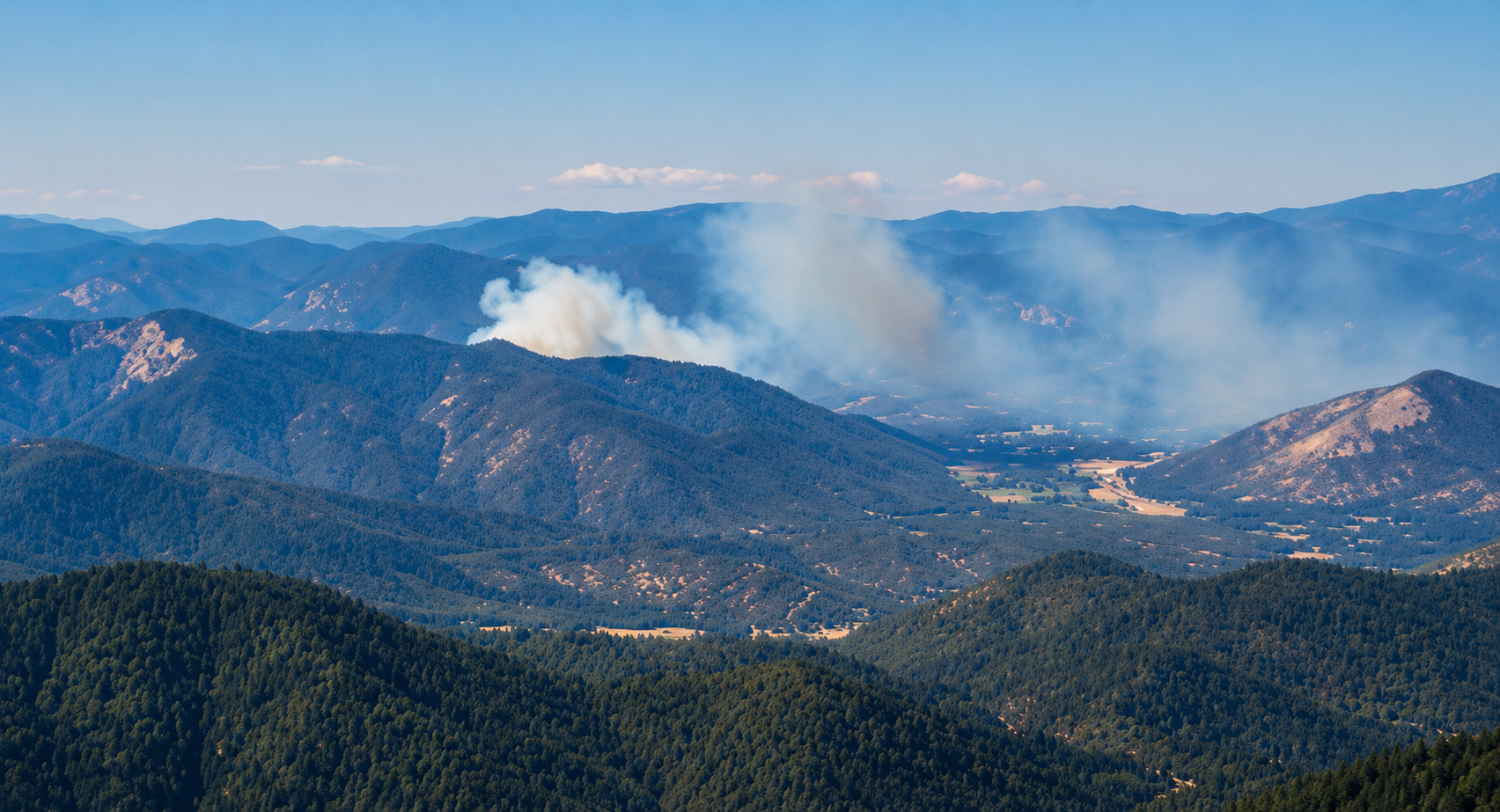
The emergency posture surrounding the Fielder Mountain Fire has eased considerably, with all remaining evacuation notices now lifted as firefighters continue securing the 573-acre burn west of Rogue River and strengthening containment across rugged portions of the fireline.
Containment has reached 53 percent, a substantial change from the opening hours of the incident, when the fire accelerated through dry vegetation and steep terrain and triggered evacuation orders across portions of Jackson and Josephine counties. The advancing fire drew a sizable ground and aviation response as crews worked to protect homes, establish defensible fireline and keep the incident from gaining additional ground.
The Fielder Mountain Fire began shortly after 3 p.m. Thursday, Aug. 13, near Interstate 5 north of Rogue River. What was initially estimated at only several acres quickly became a far more demanding incident as flames moved through dry fuels and difficult country. Wind, terrain and limited access complicated the initial attack, forcing firefighters to establish containment wherever the landscape allowed while aircraft worked overhead to slow the fire’s advance.
At the height of the emergency, residents across the affected area were placed under Level 1 “Be Ready,” Level 2 “Be Set” and Level 3 “Go Now” evacuation notices. An evacuation shelter was established at North Middle School in Grants Pass, while the Jackson County Expo in Central Point was made available for livestock displaced by the fire.
Those evacuation notices have now been canceled, allowing the surrounding communities to move out of the heightened state of readiness that accompanied the fire’s early growth. Suppression work, however, remains active across the burn area, where crews are continuing the slower and increasingly detailed work required to transform established fireline into dependable containment.
The current 573-acre figure also provides a more precise picture of what actually burned. Earlier acreage estimates were revised following infrared mapping that gave fire managers a clearer measurement of the perimeter. The adjustment did not represent a corresponding surge in fire activity or a significant new expansion of the footprint, but rather a more accurate calculation of acreage already affected by the fire.
Bringing the Fielder Mountain Fire to its current position has required an extensive combination of personnel, heavy equipment and aircraft. During the initial attack and subsequent suppression effort, hand crews, engines, bulldozers, water tenders and specialized tree-felling personnel were deployed across the incident. Helicopters, air-attack platforms, air tankers and other aviation resources supported crews from above as firefighters worked to establish and reinforce containment on the ground.
Much of that work unfolded in unforgiving terrain. Sections of the fire burned across steep slopes where engines and water tenders could not simply drive to the fireline, requiring crews to build containment by hand and with bulldozers wherever equipment could safely operate. Helicopters helped bridge those access limitations by supplying water to portable tanks positioned closer to firefighters working in areas beyond the practical reach of conventional water delivery.
The landscape created hazards beyond the flames themselves. Burning logs, loose rocks, weakened trees and other debris could move downhill and potentially carry heat or fire across containment lines. Crews responded by shaping portions of the fireline to capture rolling material before it could reach unburned vegetation, while specialized personnel identified and removed fire-damaged trees capable of falling across working areas or established lines.
With the perimeter increasingly secured, the character of the operation has shifted from stopping an advancing wildfire to hunting down the heat it left behind. Firefighters have been working progressively deeper inside the perimeter, particularly near homes and other sensitive locations, where mop-up has extended hundreds of feet into portions of the burned area.
That work can be painstaking. Heat can remain concealed beneath logs, root systems, ash, vegetation and other material long after open flames disappear. Infrared technology has helped crews locate pockets of residual heat that may be difficult or impossible to identify visually, giving firefighters another tool for finding areas capable of smoldering unnoticed and potentially reigniting surrounding fuels.
Hazardous trees and fire-weakened snags remain another concern within the footprint. Specialized tree-felling personnel have been used where necessary to remove unstable trees threatening firefighters, equipment or containment lines. Eliminating those hazards allows crews to move more safely through burned terrain while continuing the detailed work needed to secure the perimeter.
Despite the fire’s rapid early expansion and proximity to populated areas, no structures were reported lost during its major period of growth. Interstate 5 remained open while firefighting operations unfolded nearby, although emergency traffic, equipment and fire activity affected surrounding roads and placed the Rogue River area under an intense firefighting presence.
Road closures associated with the incident have since been lifted as conditions improved. Fire engines, heavy equipment and personnel may nevertheless remain visible throughout the area as crews continue moving between firelines, staging locations and sections of the burn requiring additional attention.
The cancellation of evacuation notices should not be confused with the end of the fire. At 53 percent containment, nearly half of the perimeter has yet to reach containment status, and considerable work can remain even when a wildfire no longer poses the immediate threat that existed during its initial expansion. Containment lines must be reinforced, hot spots extinguished and previously secured sections repeatedly inspected to make certain heat does not find an opportunity to cross back into unburned vegetation.
Hot, dry or windy conditions can make that work particularly important. A fire may appear quiet on the surface while heat remains buried below, capable of persisting for days and resurfacing when fuels dry or winds increase. Mop-up and patrol therefore remain central to the operation as firefighters work toward securing the entire 573-acre footprint.
The official cause of the Fielder Mountain Fire remains under investigation. No determination has been announced, and investigators will continue examining the circumstances surrounding the ignition before an official cause can be established.
For communities surrounding Rogue River, the most immediate measure of progress can now be found beyond the containment percentage. Evacuation maps that only days ago carried escalating warnings have been cleared, roads have reopened and the fire that once demanded preparations for residents to leave their homes has been pushed into a more controlled phase of suppression.
Firefighters are not finished with Fielder Mountain. The work has simply changed. The urgent race to stop a fast-moving wildfire has given way to the deliberate task of securing its edges, finding the heat still hidden inside them and making certain the fire stays within the ground it has already burned.