


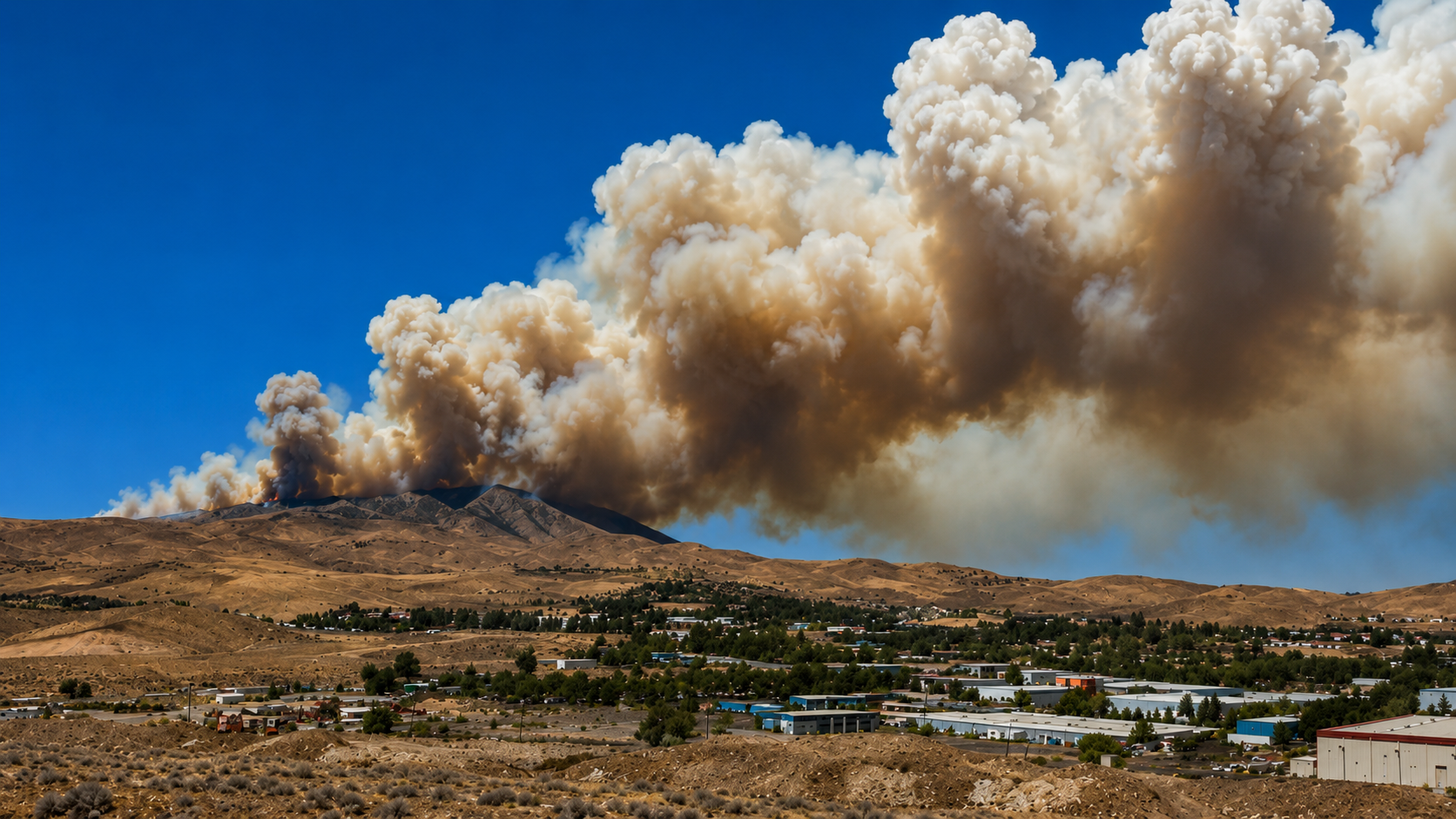
A wind-driven wildfire sweeping across the rugged landscape northwest of Reno has forced tens of thousands of residents from their homes, injured civilians and first responders, destroyed structures and mobilized a large state, local and federal emergency response as firefighters confront one of Nevada’s most serious wildfire emergencies of the summer.
The Hawk Fire began Saturday, Aug. 22, near Hawk Meadow Trail in the Somersett area northwest of Reno. Within little more than a day, the fire had crossed thousands of acres of dry grass and brush, reaching more than 15,000 acres in later Sunday estimates as shifting winds repeatedly changed the direction and intensity of the flames.
The rapidly expanding evacuation footprint has placed a significant portion of the Reno area under emergency restrictions. Approximately 42,000 residents were ordered to evacuate, while roughly 45,000 additional people were placed within evacuation warning areas. The mandatory evacuation zone extended toward the University of Nevada, Reno, illustrating how quickly a wildfire that began along the mountainous outskirts of the city became an urban emergency.
The university remained outside the mandatory evacuation area Sunday, but conditions throughout northwest Reno continued to change. Authorities urged people in warning zones to prepare to leave before conditions deteriorated rather than waiting until evacuation became mandatory.
Six people have been injured, including three civilians and three first responders. Structures have also been destroyed, although authorities had not established a final damage count Sunday as firefighters continued working through active portions of the fire.
No fatalities had been confirmed.
The Hawk Fire remained at zero percent containment in the latest official information available Sunday. Earlier aerial mapping placed the fire at 10,522 acres, while subsequent estimates following additional fire activity placed the footprint above 15,000 acres. Differences between acreage figures reflected the speed of the fire and the time required to obtain updated aerial mapping across difficult terrain.
Strong winds, low humidity and exceptionally dry vegetation have complicated the firefighting operation. Wind changes have pushed the fire in different directions, making it more difficult for crews to establish dependable containment lines while simultaneously defending residential neighborhoods.
Unified command for the fire includes the U.S. Forest Service, Truckee Meadows Fire Protection District and Reno Fire Department. Hundreds of firefighters and emergency personnel have been assigned to the incident, supported by state, local, federal and international resources. Aircraft have been used where conditions permit, while crews on the ground have worked to construct fire lines and protect neighborhoods along the advancing perimeter.
Nevada Gov. Joe Lombardo declared a state of emergency for Washoe County as the scale of the incident became clear. The declaration allows state resources to be coordinated with the local response and expands Nevada’s ability to provide personnel, equipment and emergency assistance.
The Nevada National Guard has also been mobilized. Two Guard helicopter crews were assigned to aerial firefighting operations, while approximately 60 Guard members were deployed to support law enforcement and security operations in evacuated communities.
The emergency has extended far beyond the fire line.
Approximately 10,000 customers remained without electricity Sunday after emergency de-energization measures and fire-related outages affected portions of northern Nevada. Major roads were disrupted, including sections of U.S. 395, creating additional complications for residents leaving evacuation areas and emergency crews attempting to reach threatened neighborhoods.
Medical facilities also responded to the changing fire conditions, with patients moved from facilities in threatened areas. Reno-Tahoe International Airport remained outside the evacuation area and continued commercial operations, while the Reno-Stead Airport experienced fire-related impacts.
Washoe County established the Reno-Sparks Convention Center as an evacuation shelter, while separate arrangements were made for displaced animals. Officials continued directing residents to the county’s emergency evacuation maps because boundaries could change rapidly with wind and fire behavior.
The cause of the Hawk Fire has been classified as human-caused, but investigators have not publicly identified the specific ignition source or announced that the fire was deliberately started. The investigation remains underway.
Nevada wildlife officials and land-management agencies are also confronting the broader consequences of another major wildfire across northern Nevada. The Nevada Department of Wildlife manages wildlife and habitat throughout the state, while federal agencies oversee substantial areas of public land surrounding the Reno region. No confirmed assessment of wildlife losses from the Hawk Fire had been released Sunday.
Fire restrictions were already in effect across portions of Nevada before the Hawk Fire began. Federal restrictions covering public lands in the region are designed to reduce additional human-caused fires during periods when dry vegetation, heat and wind can allow a small ignition to become a large wildfire within hours.
The Hawk Fire follows other significant fires that have already tested emergency resources in northern Nevada this month. Earlier fires, including the Bug and Fred Mountain fires, prompted evacuations in Washoe County and the Reno-Sparks Indian Colony and led to a separate state emergency declaration earlier in August.
The latest fire has brought the threat directly against the northwest side of one of Nevada’s largest population centers.
Fire crews continued working Sunday to protect neighborhoods, establish containment lines and slow the fire before another period of changing winds. Evacuation orders remained the central public-safety concern, with authorities warning residents not to rely on previous fire boundaries when deciding whether to leave.
For thousands of families across northwest Reno and Washoe County, the immediate situation remains unsettled. Homes remain inside evacuation zones, road and utility disruptions continue, and firefighters are operating along a perimeter that has changed substantially since the fire began Saturday.
Until containment improves and evacuation orders are formally reduced, emergency officials are treating the Hawk Fire as an active threat to Reno and surrounding communities.