


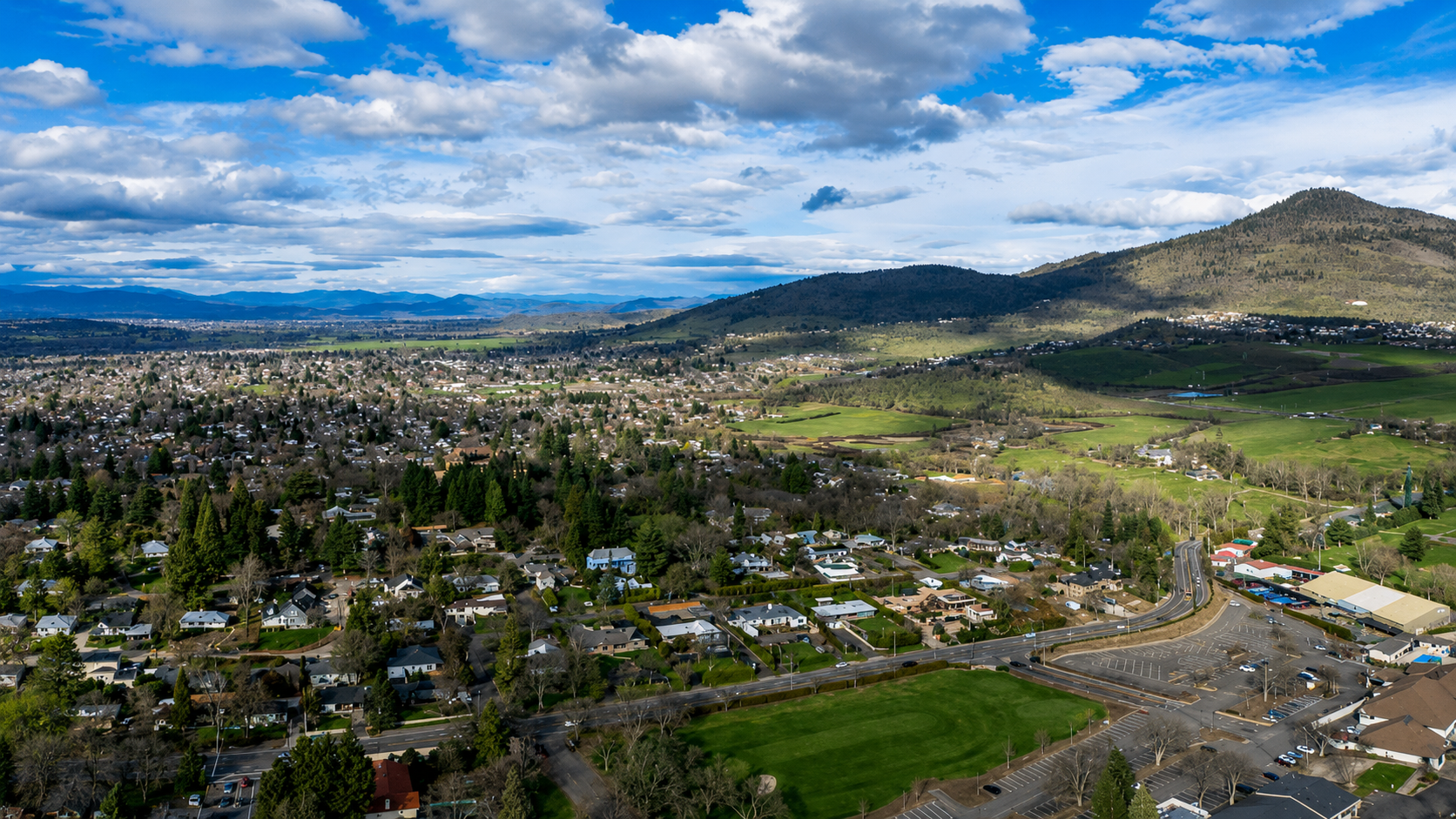
Acres of undeveloped ground scattered across Medford may look largely unchanged today, but decisions moving through the city’s planning system this month could determine what portions of that land become years from now. From the South Stage Road corridor to northeast Medford, proposals involving commercial zoning, agricultural overlays, land partitions and a new Jackson County animal shelter are putting dozens of acres into the regional development conversation.
The Medford Planning Commission met Thursday, August 13, with a significant proposal involving approximately 24.5 acres at the northeast corner of South Stage Road and Orchard Home Drive among the land-use matters under consideration. The application from KDA Homes seeks a two-lot partition of the property while also requesting a zoning change affecting a portion of the site.
The property contains approximately 24.51 net acres, or 25.86 gross acres, and carries a combination of single-family residential zoning and an Exclusive Agriculture overlay. Under the proposal, approximately 6.52 net acres, or 7.48 gross acres, of proposed Parcel 1 would be rezoned to Community Commercial. The Exclusive Agriculture overlay would also be removed from that portion of the property.
No immediate construction project accompanies the application. The proposed parcels would initially be classified as reserve acreage, and the application does not include immediate on-site or off-site improvements. The significance of the proceeding instead rests with the future use of the property and the possibility that acreage now carrying residential and agricultural zoning could eventually accommodate commercial development.
For residents across Jackson and Josephine counties, the proposal offers a closer look at how regional growth frequently begins. Large developments rarely arrive with construction crews as the first visible sign of change. They often begin years earlier through partitions, zoning decisions, transportation planning, utility considerations and other land-use proceedings that establish what can eventually be built.
South Stage Road occupies an increasingly important position in Medford’s development pattern. Its connections with residential neighborhoods, Interstate 5, Highway 99 and other transportation corridors make decisions involving sizable properties in the area relevant beyond adjoining landowners. Future development can influence traffic volumes, infrastructure requirements, commercial activity and the overall mixture of residential and business uses along the southern portion of the city.
The August 13 proceeding is only one piece of a larger collection of land-use activity moving through Medford this month.
On August 27, the Planning Commission is scheduled to consider separate applications connected with a proposed new Jackson County dog shelter in northeast Medford. Those proceedings involve substantially more acreage and include both a zoning request and a proposed reduction in the setback required for a dog-care facility.
Jackson County’s proposal involves two undeveloped tax lots containing approximately 47.17 gross acres. The county is seeking to rezone 46.17 acres from Heavy Industrial to Heavy Commercial, bringing the zoning into alignment with the property’s Commercial designation under Medford’s General Land Use Plan.
The proposed animal-care facility would encompass approximately 27,233 square feet on a 27.82-net-acre parcel near Kingsley and Grumman drives. Because the property lies within airport-related overlay areas, its development also operates within land-use requirements associated with nearby aviation activity.
A separate application associated with the shelter asks Medford to reduce the required setback for a dog-care facility from 200 feet to 60 feet. That request, along with the rezoning proposal, is scheduled for consideration during the Planning Commission’s August 27 meeting.
Taken together, the South Stage Road and northeast Medford proceedings place a considerable amount of property before the city’s planning system within a matter of weeks. The projects are unrelated, and each must be evaluated independently under the applicable land-use standards, but collectively they illustrate the decisions occurring behind Medford’s physical expansion.
The Planning Commission occupies a central position in that process. Its responsibilities include decisions involving zone changes, land divisions, conditional-use permits, exceptions and planned-unit developments, along with recommendations to the City Council and other public bodies on matters involving zoning and growth.
Those responsibilities give planning proceedings importance well beyond the paperwork attached to an individual application. A partition determines how property can be divided. A zoning change establishes categories of permitted development. A conditional-use decision can determine whether a particular operation is appropriate for a site, while setbacks establish physical separation between uses and surrounding properties.
Medford’s role as Southern Oregon’s largest city also gives its development decisions regional consequences. Residents routinely travel into the city from Grants Pass, Central Point, Eagle Point, White City, Phoenix, Talent, Ashland and surrounding communities for employment, medical care, shopping, transportation and public services. Changes in Medford’s commercial and public-service landscape therefore become part of a broader regional economy rather than remaining confined to city boundaries.
Neither the South Stage Road proposal nor the Jackson County shelter proceedings guarantee what surrounding areas will ultimately look like years from now. Land-use approval and actual construction are separate stages, and future projects may require additional reviews, permits and infrastructure work before development occurs.
What the August proceedings provide is an earlier view of where change is being considered. Across nearly 26 gross acres near South Stage Road and another 47 gross acres associated with the northeast Medford rezoning request, decisions moving through the public process are establishing the framework for development that Southern Oregon residents may eventually see taking shape on the ground.